
Following the scent


Play
Traditional perfumers are going strong in Singapore
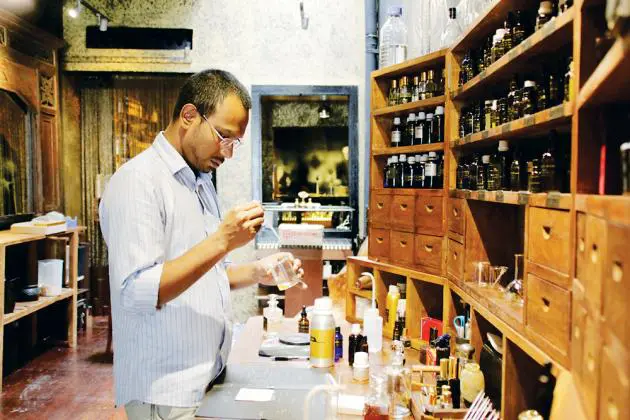
At his sturdy wooden desk lined with glass bottles, Johari Kazura creates scents for all occasions. Like a modern–day alchemist, he carefully blends exotic ingredients from all over the world, occasionally lifting a glass beaker to his nose to test the results.
If the scent is not to his liking, it will be discarded. If it is satisfactory, he will tweak it until he gets it just right – and then bottle it and sell it in his perfume shop in the heart of Singapore’s Kampong Glam district, sometimes referred to as the Arab Quarter.
“I grew up with these things,” he says. “This is the fun part of the business.”
Kazura, 38, is the owner of Sifr Aromatics and among a handful of traditional perfumers – most from the same family – plying their trade in Singapore today.
A cluster of stores stand in the same area, a trendy neighbourhood in the shadow of the Sultan Mosque, where hip cafes and bars share the streets with older shops selling traditional textiles, carpets and perfumes.
For Kazura, the business is in the blood. His grandfather, an Indian Muslim, arrived in Singapore in 1933 and started a small business selling perfumes near the mosque, later opening more shops in neighbouring Malaysia and India.
He died in 1979, when Kazura was four, but his photo hangs proudly in the store.
Kazura’s father learned the trade, and today runs his own shop a stone’s throw away. After studying economics at the University of Michigan in the United States, Kazura returned to help his father run the business.
Around four years ago, he opened Sifr – the name means zero in Arabic – with his South Korean girlfriend and business partner. He wanted to experiment with different scents and customisations, he says.
“It’s easier to do something if you are doing it from scratch sometimes. It's easier to experiment.”
The store doubles as his workshop, where he creates scents using hundred of ingredients sourced from all over the world – including from some of the suppliers his grandfather used.
The best sandalwood comes from India, he says, and his frankincense and myrrh come from Africa and the Middle East.
They jostle for space on his desk with vetiver from India, patchouli from Indonesia, lavender from France, and roses from Turkey and Bulgaria, among other ingredients.
Blending them is an art as much as a science, although Kazura says perfumers can train their noses to distinguish between scents.
“Jalapeno is spicy in a different way than wasabi is,” he says. “People don’t differentiate the smells, they don’t pay so much attention to the smells.”
Perfumes were first blended in ancient Egypt and Mesopotamia, according to historians, and still play an important role in the Arab and Muslim world. As well as being used for personal grooming, oil-based perfumes can be used in an incense burner to create pleasant aromas in the home, and are often used on special occasions such as weddings.
“The Prophet says ‘When you present yourself to God, be clean, smell good’,” says Kazura. “It’s in the culture a lot, so you’ll always see perfumes being sold in mosques around the world, or around the mosque.”
When Kazura branched out on his own he wanted to experiment with other things, and now makes alcohol–based perfumes – adding alcohol dilutes the blends, making them sprayable – as well as scented candles, waxes and other products.
His customised perfumes start at about 100 Singapore dollars (Bt2,560) and go up to 500 dollars. He also hosts perfume-making workshops, which are popular with corporate team-building groups.
“Perfumes are a luxury at any price point. You don’t really need it, but it makes you feel better,” he says. “There’s a trend towards hand-crafted, customised goods, so there’s a great interest in that now.”
At the shop she manages around the corner, his cousin Safinah, 26, agrees. Her father started the business in 1978, later naming his shop after her. Today, Safinah sells perfumes and colourful hijabs, the headscarves worn by many Muslim women.
Traditional woody scents like amber and ord are less popular with young customers nowadays, she says, “so we are bringing in more interesting notes, more citrusy, refreshing” – for example, a vanilla and jasmine blend.
Oil-based perfumes contain no alcohol, so can be worn by pious Muslims, but Safinah feels they are also “more interesting” than regular, mass–produced perfumes, as people can play around with them and experiment with different aromas.
“It’s just like cooking – you want more spicy, you can add more.”
The small, family-run perfume stores around the mosque attract loyal customers, including Singapore residents and tourists.
“I loved the delicate little bottles that the shop owners used for selling the different fragrances,” says British expat Himaya Cooper, 32, who went shopping with her mother, who was visiting.
“The perfumes were not too expensive and had a rich, intense scent. My mum bought several to take home for relatives in Scotland. I noticed a group of Japanese tourists who also seemed to be snapping up souvenir perfumes to take home.”
