
The sacred teardrop


Play
Sri Lanka has come a long way since the civil war ended four years ago - but some things never change in the home of Theravada Buddhism
Sri Lanka has for centuries lured travellers and traders with its serene palm-shaded beaches and promise of precious stones, majestic elephants and valuable spices.
Meanwhile, 2,000 years of Buddhist art and architecture has formed a cultural bedrock for its Sinhalese population, making this “jewel” hanging from the “pendant” of India a stronghold of Theravada Buddhism.
Over the centuries, its prime position on the Indian Ocean trade route has seen generations of Arab, Malay, Portuguese, Dutch and British explorers arrive and transform Sri Lankan cuisine and culture. All the while the Tamil population in the north and east has infused a vibrant Hindu influence.
Slacking in Galle
Deserted white sands lapped by the soda-clear Indian Ocean waters draw travellers to indulge in flop time at the friendly, trendy town of Galle, a one-hour, 45-minute drive south from the capital Colombo.
Long dubbed Sri Lanka’s Goa for its elegant colonial mansions and historic churches, nowadays slacker-friendly bars and restaurants dot the coast, which also hides some of the world’s best beaches.
Galle’s granite-faced Dutch colonial walls, constructed in the mid-17th century, are credited with saving its town centre, a World Heritage site, when a tsunami devastated the east coast 2004.
Disemboweled buildings still stand sentry along a winding one-lane road.
The full story of the tsunami is told in Galle’s Maritime Archeological Museum, which opened in 2011.
But the tragedy slips quickly from the mind as you wander Galle’s quaint lanes and European whitewashed buildings overloooking turquoise waters that glow magenta at dusk.
Decadent Colombo
The capital is the first stop for the growing number of visitors, with Sri Lanka firmly back on the global trail after the 25-year-long civil war ended in 2009.
Four and a half years later, there is almost no trace of the bitter conflict. It seems the whole country – the people, its wildlife, new buildings and businesses – is jammed together and competing for space. Roadside stalls sell everything from the ubiqiotous rice-and-curry packets to iPhone attachments, Naturally, the traffic is a nightmare.
With political stability and a booming economy comes a Sri Lankan nouveau riche hungry for the good life has emerged. Colombo offers plenty to satisfy their appetite.
One place to check out is Gallery Cafe, located near the coast road. This trendy eatery was designed by one of Sri Lanka’s most renowned architects, Geoffrey Bawa, with elegant outdoor seating, mahogany decking and ponds . It’s also a great place for crab and prawns.
Another cool hangout riding high on new peace and prosperity is Brewery By O. The mall in which it sits is a former colonial-era Dutch hospital reincarnated as a buzzing arcade overflowing with noisy cafes and restaurants.
Thronged by the new class of cosmopolitan young professionals, Brewery By O is a great place to sample the national lager, Lion (a pint will set you back 200 rupees – about Bt55).
If the bars, restaurants and beaches become routine, then a short trip to the country’s second-largest city and cultural “gem” is in order.
Cultural Kandy
Kandy is home to the last remnants of the Sri Lankan monarchy, which held out against successive waves of Dutch and British colonial expansion until the early 19th century. It is also home to the Buddhist Temple of the Tooth, which claims possession of an actual tooth of the Buddha.
Adorned with plenty of elephant tusks, the temple is the holiest shrine in Theravada Buddhism, akin perhaps to St Peter’s Basilica in the Vatican. The shrine receives a steady stream of visitors, many pilgrims among them.
Like many other world-renowned religious sites, there is a dress code here. Visitors wearing shorts or tank tops risk being turned away, and you must remove your shoes before entering. During the puja, a time of offerings and prayers, the heavily guarded inner sanctum housing the holy tooth is open to both worshippers and tourists. But one never actually gets to glimpse the tooth. What you do see is a casket-shaped gold stupa, called a dagoba. Inside, in Russian-doll fashion, are another six successively smaller dagobas with the sacred relic at their centre.
Visitors stop at the doorway – the dagoba casket lies at arm’s length from the gilded altar in front of them. Guards keep the queue moving so no one gets more than 15 seconds inside the shrine room.
Sigiriya
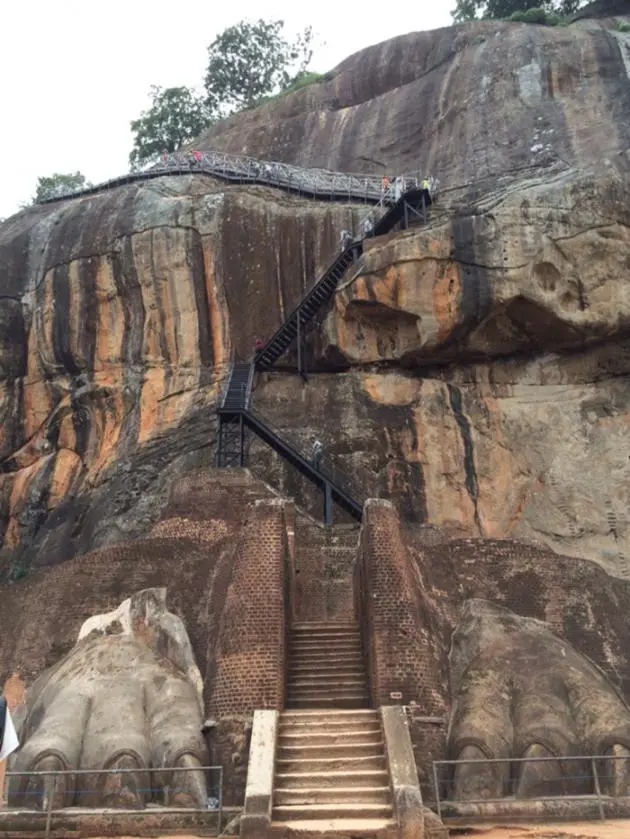
The next stop on Sri Lanka’s pilgrim trail is Sigiriya, two and a half hours north by car. This massive column of rock rises nearly 200 metres up from the tree-shaded plain. Climb its 1,200 steps between giant stone lion paws and you find yourself amid the 1,600-year-old ruins of King Kasyapa’s palace.
This place became a monastery after the king’s death, the remnants of which are now Unesco-listed world heritage.
