
Of phantoms & Democrazy
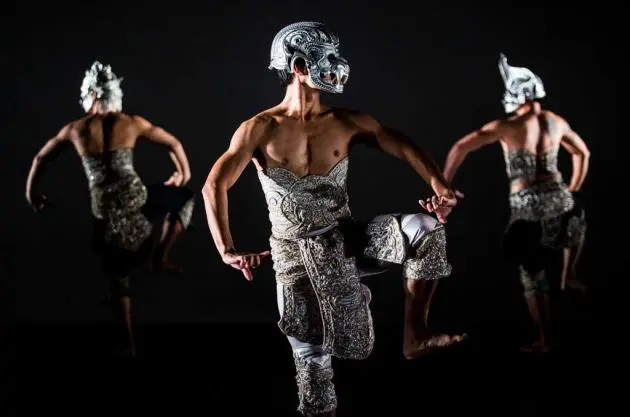


Independent theatre and dance companies light up the Bangkok stage
After what can only be described as a saturation of musicals over the last couple of years, the focus in the theatre world in 2013 was more on drama than show tunes with most of the best productions coming, as usual, from Bangkok’s smaller and less-funded troupes.
That’s not to say there weren’t any musicals. The world’s most popular production in this genre, “The Phantom of the Opera”, haunted the stage of Muangthai Rachadalai Theatre for more than a month in May and June and even the high ticket prices couldn’t keep away the crowds. However, those who had watched the musical overseas seemed disappointed that Bangkok’s imported version was exactly the same, a reason perhaps for local producers to explore other and more exciting options.
Those same commercial theatre producers, who presumably want to tap into the foreign tourist market and have pricey imported productions stay here longer, may want to look at “Nanta”. The Korean non-verbal comedy continues to perform six shows a week at a venue converted from a cinema in RCA Plaza, targeting Chinese tourists in particular.
Dreambox also stuck its musical neck out with a short run of “Madame White Snake” in November, It was to have been followed by Scenario’s “Lueat Khattiya” at Rachadalai but this has now been put off until next month due to the current political tensions.
The most active of Bangkok’s smaller venues this year has been Democrazy Theatre Studio in Soi Saphan Khu off Rama IV Road, just 10 minutes on foot from MRT’s Lumpini station.
From Nophand Boonyai’s “Adoption” in January through Anatta Theatre Troupe’s classy musical play “2475 the Musical: Retro Love Story in the Revolutionary Time” in October to Saosoong Theatre’s “Phop Rak Mak Krasan” this month, this former photography studio has hosted small-scale productions in a wide variety of theatrical styles and dramatic content every month, reinstating its status as a major hub of contemporary Thai theatre. The venue is a true black-box theatre in which seating stands and performance areas can be arranged in different configurations and the white walls and floor can be painted in different colours for different productions, providing the audience not only with intimacy but also the right atmosphere for each work.
While the almost 6,000 likes on Democrazy’s Facebook are ten times less than that of Rachadalai, it has an almost equally strong base for its size and marketing budget. Audience numbers are constantly increasing thanks to the variety of programmes that both entertain and educate, and which cost so little that many theatre fans opted to skip “Phantom” and spend the admission money on 10 plays here.
Crescent Moon Theatre also continued its contribution to the development of new plays with staged readings at their Crescent Moon Space in Soi Thonglor. B-Floor Theatre started the year with an interdisciplinary work “Survival Games” which also allowed new performers to showcase their skills, and remained productive with a range of smaller yet equally significant works by their members.
New Theatre Society, led by true masters of adaptation Damkerng Thitapiyasak and Parnrut Kritchanchai, also remained very prolific, with the company reaping its rewards with top awards from the Bangkok Theatre Festival.
Another noteworthy development was the artist-in-residency programme, which has seen many university drama departments invite professional artists or companies to campus to work with their students. Among the successes were “The Verdict” on which Damkerng worked with University of the Thai Chamber of Commerce students and “Typhoon” on which B-Floor’s Teerawat Mulvilai worked with Thammasat University students. This is an initiative that merits substantial support from university administrations as it can, for aspiring young artists, significantly help bridge the gap between the ivory towers and the real world while offering to the audience new standards of university theatre.
On the contemporary dance stage, Pichet Klunchun Dance Company remained active in 2013, domestically and internationally, with both solo and group works, most commendably the Thailand premiere of “Black and White”. 18 Monkeys Dance Theatre was even more active, putting up four new works this year.
Two international dance and theatre festivals started the year on AEC notes – Chulalongkorn University’s “Our Roots Right Now” and Bangkok University’s World Symposium on Southeast Asian Performing Arts. But with the exception of “Fire, Fire, Fire”, supported by the Goethe Institut’s Tanzconnexions programme, the works draw little attention from a public bored with the AEC tag. Noteworthy was Pichet Klunchun Dance Company’s “Tam Kai”, which was talent spotted during “Our Roots Right Now” and snapped up for an eight-city tour in the Netherlands in October.
The fact that we have not heard any news about the further development of these festivals probably means that they are one-offs and we should switch our attention and support to the regular festivals, which have less, or nothing, to do with the AEC.
In February, the British Council’s “Live at Scala” presented an evening of small-scale experimental works by British and Thai artists. B-Floor premiered their “(In)Sensitivity” here and later developed it for performances at their venue.
From May to June, the French-Thai Cultural Festival La Fete was smaller in scale and is now, fittingly, shifting more towards collaboration between the artists of two countries. At Aksra Theatre, the audience witnessed a prime example of intercultural collaboration in “Yo Gee Ti”.
And Bangkok’s 15th International Festival of Dance and Music, in its usual September-October slot, saw lower audience numbers than previous years – perhaps a sign that it too needs a revamp in programming choices – though many still have fond memories of the excellent double bill from Brazil’s Grupo Corpo.
The studio on the fourth floor of the Bangkok Art and Culture Centre (BACC) became another venue for performing arts in 2013 hosting in quick succession Asiatopia, the Bangkok Theatre Network’s Bangkok Theatre Festival, Friends of the Arts Foundation’s International Dance Festival and the International Butoh Festival Thailand.
This year also marked the first time awards in different categories were given to contemporary Thai dance and theatre artists, with support from BACC, the Office of Contemporary Arts and Culture as well as the private sector. The award ceremony was attended by all major free TV and cable TV channels – a good sign that this event is not a one-off.
As 2013 draws near to the close, we should thank all the artists for their efforts and creativity. We wish them happy holidays and a more prolific 2014 under the spotlight.
