
Just for the record


Art treasures are being preserved "forever" in digital form
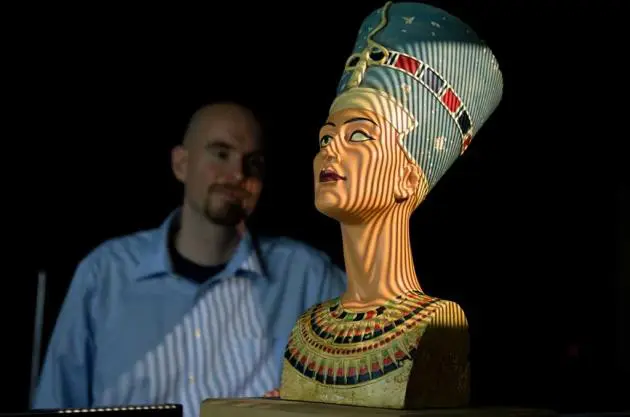
To preserve a copy of it for the ages, a cherished bust of ancient Egypt’s Queen Nefertiti must take a ride on a conveyor belt as scientists who are experts on 3D copies watch.
The idea is that, once a work of art has been scanned in 3D, its outer shape will be preserved digitally forever, even if war or disaster destroys the original. If the worst happened, at least a replica could be made.
The scanner already exists in Germany, developed by the Fraunhofer Institute’s graphic data-processing unit in Darmstadt, a city near Frankfurt. If it goes into regular production, it could begin making copies of art treasures quickly without the hassle of taking plaster casts.
The lab has already tried the routine with Nefertiti, a depiction of a very beautiful pharaonic queen. They did not a get a loan of the original, which is one of Berlin’s most prized art treasures and is too fragile to even be removed from the capital’s Egyptian Museum.
They did their experiments with a commercially available 1:1 copy of the bust.
The commercial copies took months to make. Darmstadt’s scanner, developed by a team of scientists led by IT specialist Pedro Santos, takes just a few minutes to generate a three-dimensional digital image of a bust or similar art object.
“There are certain countries on the planet that already realise they cannot preserve their cultural heritage,” says Santos in a sly dig at Germany, which spends vast amounts to preserve its past, but still suffers setbacks.
Despite the German passion for heritage, much of it was destroyed in World War II. Within the past five years a major archive repository has collapsed, destroying priceless documents. The cause was unnoticed subsidence under the foundations in the city of Cologne.
A decade ago an historic library in the city of Weimar was gutted by fire, ruining 50,000 books from the 17th and 18th centuries.
Digital copies are now recognised as the best insurance against the unforeseen.
They can be used to make replicas, which can be loaned easily, and they can make the hidden part of a museum’s collection virtually accessible to the public. “On average a museum artefact is only put on display once every 10 to 15 years,” Santos says.
The first prototype is costing about half a million euros (Bt22.6 million) to build, but the researchers expect the price to be much less once the scanner goes into series production.
Other ways to produce 3D scans exist, but the Darmstadt researchers say the existing machines can take up to 24 hours to scan just one item. Their scanner is faster. “With our method, objects of 60 by 60 centimetres can be scanned in just a few minutes,” says deputy project leader Martin Ritz.
On the conveyor belt, the Nefertiti replica is pushed beneath two semi-circular gantries. The inner arch has nine sources of light, while the outer one has an equal number of cameras. With a loud mechanical buzzing sound, the arches move over the bust, stopping briefly at various points in order to take pictures from all sides.
“When I take pictures with these nine cameras from nine different angles I get 81 pictures in all. These are then used to calculate a geometric reconstruction,” Ritz explains.
At the moment, following the scanning process on a computer monitor, the colour digital imagery of Nefertiti is incomplete. The gaps show as black areas. Those are the spots not yet “seen” by the scanner, which is the reason that the object must continue its ride on the conveyor belt, automatically coming to a halt before a robotic arm bearing a second scanner.
“At this position all the remaining gaps in the 3D model will be fleshed out,” Ritz says. At the end, the digital image appears on the computer screen and can be transferred to a database. After adding meta-information, it can be put on the Internet for global access.
This begs the question: why go to a museum if you can see a digital replica on the Internet?
Hans Lochmann, spokesman for the museum science conference of Germany, says digitisation won’t deter museum visitors. “The original has a completely different aura,” he says. “You get to see the real thing.”
He adds that the prime benefit from digital copies will be for scholarship and science. Modern experts expect access to information on the Web, and libraries, museums and archives have to keep up with that demand.
It could be some time before the Fraunhofer Institute scanner is put on duty in a museum.
Right now it is going through comparative tests. The researchers are sending students to museums in Berlin and in Frankfurt to perform digital 3D scans using the previous generation of technology.
Later the same objects will be scanned with the Fraunhofer prototype. If the new device is reliable, faster – and cheaper – it stands a good chance of becoming the next-generation scanner.
