
Louvre wonders come to China
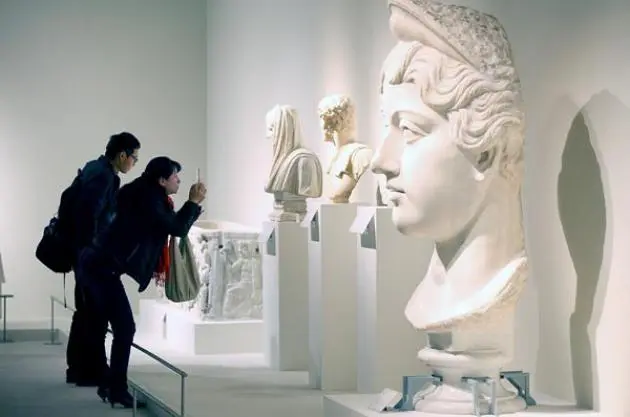


Ancient Roman treasures once owned by French royalty are on view in Beijing
After two centuries standing at the Louvre, Diana de Gabies leaves France for the first time and greets viewers at a Chinese museum, as a warm-up to celebrate the establishment of diplomatic relations between the two countries five decades ago.
The Roman-era marble statue, also called “Artemis, the Diana of Gabies”, portrays a gracefully standing Artemis, the Goddess of the Hunt, who is ready to buckle her cloak that is presented by her believers.
Dated back to about the first century, the statue is testimony to Roman copying of the Greek style. It was unearthed at Gabii, Italy, in 1792 by the British history painter Gavin Hamilton and was later purchased by Napoleon, who then gave it to his brother-in-law, Prince Camillo Borghese.
At the National Museum of China, Artemis is placed in front of Hamilton’s oil painting, drawn from the Greek myth – Venus introduces Helen to Paris, a dangerous prelude to the Trojan War. The painting became part of the Louvre collection in 2011.
The statue and painting are sharing the limelight with 280 pieces and sets of antiquities from the Louvre’s treasure trove to form the exhibition “Mediterranean Civilisation”.
It marks the first cooperation between the Louvre and the National Museum and, according to Jean-Luc Martinez, president-director of the Musee du Louvre, it provides a chance to inspect the Louvre’s collections from a different perspective.
“One of our duties at the Louvre is not only to showcase French art but also the world’s diverse cultures,” Martinez says.
“For example, the French royal collections boast Italian paintings and Greek and Roman sculptures. The most famous works at the Louvre come from the Mediterranean, a cradle of human civilisation, and that’s why we have come up with the theme of this exhibition.”
The Louvre’s three best-known pieces – Venus de Milo, the Mona Lisa and the Winged Victory of Samothrace – all celebrate Mediterranean civilisation over a time span of four millennia.
At the exhibition, sculpture, pottery, gold and silverware and paintings from eight curatorial departments at the Louvre are assembled for the first time to exemplify the communications and clashes among different cultures nurtured by the Mediterranean Sea.
Other works making a debut in China include an extravagant pocket watch that once belonged to King Charles X of France. The product of the queen of England’s watchmaker is ornamented with 265 diamonds. It came into the French king’s collection as a gift from the Dey of Algiers around 1816, demonstrating France’s powerful presence in the Mediterranean along with the Ottoman Empire’s decline in the 19th century.
The exhibition adds the Louvre to the National Museum’s top-of-the-line partners since its reopening in 2011, which include the Met, the Uffizi Gallery and the British Museum. Museum deputy director Huang Zhenchun says that exhibiting with these world-class museums has compensated for his museum’s inadequate collection of Western art.
The Louvre had 9.75 million visitors in 2012, of which foreigners accounted for 70 per cent, Martinez says. Chinese visitors, numbering 440,000, formed the second-largest foreign group after Americans.
“The museum has seen a 40-per-cent increase in Chinese viewers annually, and China is likely to be the top source of visitors in the years to come,” he says.
The Paris museum has been bold in embracing modernity to extend its influence. It launched a 3DS audio guide for the Nintendo portable game console in 2012.
Its regional branch, the Louvre-Lens in northern France, received 800,000 visitors in its first 10 months after opening in December 2012. And the Louvre Abu Dhabi is scheduled to open next year, viewed as “an overseas sample to bring French culture to the world scene”, Martinez says.
Since attaining his post nearly a year ago, Martinez has organised several educational projects to reach out to those who seldom visit museums. The introduction boards for all exhibition halls are being rewritten to make antiquities more accessible and new exhibition halls on art history and the Louvre’s past as a royal relic site are being established.
“The Louvre will take quite a different look in 2014,” the director says.
WEST MEETS EAST
“Mediterranean Civilisation” runs until Sunday at the the National Museum of China, east of Tiananmen Square at 16 East Chang’an Jie, Dongcheng district, Beijing. It’s open from 9 to 5 daily except Monday.
