
He suffers for his art - and loves it


Ji Dachun likes to watch others paint. It both inspires and shames him
Artist Jin Dachun finds painting both painful and miserable, yet that hasn’t stopped him over the last 38 years. In his current exhibition “Without a Home” at Beijing’s Ullens Centre for Contemporary Art, the 45-year-old is displaying more than 40 works from the past decade, spanning several key moments of his career.
The exhibition running until May 11 also marks the artist’s first institutional exhibition in the capital, reviewing his most comprehensive works to date.
Best known for his surrealistic, satirical critiques of modern Chinese society, Ji is often juggling between traditional eastern forms and the post-modern art construction of the West.
“When I face a long-established art style, such as traditional Chinese ink painting, I feel confused, because it’s hard to maintain the core while adding my own interpretation. So I just do some experiments by painting what I like without many rules,” Ji says.
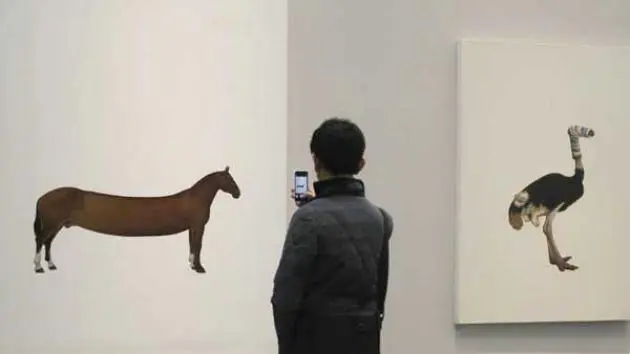
The testing period gave birth to some humorous images, such as a long horse and an ostrich putting a sock on its head, which gave the public an impression of Ji as a “playful artist”.
Seeing his works at the exhibition, one could easily be confused, since some of them are abstract and in black-and-white – “Plastic Brain Fluid” evokes both Chinese landscape painting and Western abstraction. Others are colourful and tell a story, such as “Romeo and Zhu Yingtai”, which has tragic figures of classical literature from two different countries.
“I am still moving on and exploring in darkness,” Ji says. “Unconsciously, I evolved.”
Ji hails from Jiangsu province and graduated from the Department of Oil Painting of the Central Academy of Fine Arts in 1993. His early work depicts historical figures, cartoon animals, children’s toys and everyday objects against stark white backgrounds. Later, his practice engaged more biological and cybernetic forms, which adapted forms of anatomical and botanical drawings.
“I like trying new ideas, though most of the time the result is bad,” he says. “I also like watching other people paint, which not only inspires me but also makes me feel ashamed. I don’t think a good artist can create good work all the time. He has to suffer failure, which will lead to a new height and a different perspective.”
Ji’s works have been exhibited widely abroad, with solo exhibitions at Rome’s Museum of Contemporary Art in 2013, the Museum of Fine Arts Berne in 2007, and the Posco Art Museum in Seoul in 2005.
During the past two decades, what Ji has been doing, he says, is seeking the difference between him and other artists as well as the difference of his own works. “That’s why I say painting is painful and unreal. But gradually, after 40, I can feel the happiness from it.”
