
Where the guru rematerialised


Play
The "miracles" that earned Sathya Sai Baba millions of followers are still being felt in Puttaparthi
After a long drive through the rocky wilderness, I felt like I’d arrived at an oasis in the desert when my destination finally came into view.
Puttaparthi evokes similar feelings in the thousands of pilgrims who arrive here every year. This small town in the southern Indian state of Andhra Pradesh was home to Sathya Sai Baba, an internationally renowned spiritual leader whose lifelong religious practice was grounded in Hinduism.
Born to a poor family, at the age of 14 he announced he was the reincarnation of the saint Shirdi Sai Baba, who died on October 15, 1918. His fame quickly grew beyond Puttaparthi, fuelled by rumours he had performed miracles.
Soon, reports of his ability to heal diseases and make objects levitate reached the outside world. By the time of his death in 2011, he had millions of followers at home and overseas, and religious centres in more than 120 countries, including Thailand and Japan
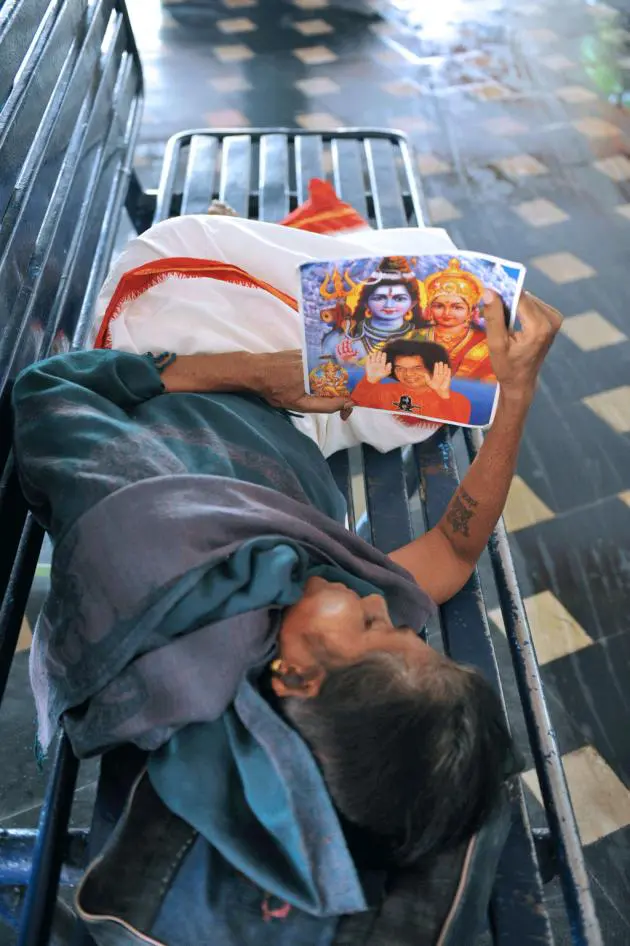
Three years after his death, Sai Baba’s presence is still everywhere in Puttaparthi. Three-wheeled motorised rickshaws run along the streets with portraits of the mop-headed guru and his message plastered on the back. “God is in you,” it reads.
Tens of thousands of Sai Baba devotees arrive from elsewhere in India and abroad every year for spiritual retreats at the ashrams in the town. Many are eager to speak with outsiders about their guru, starting with what they call the miracles he has performed.
One evening on a recent trip, I was attracted by the gentle sound of singing coming from the ashram where Sai Baba stayed. His followers were singing a devotional hymn to their spiritual teacher.
I asked ashram volunteer Prashant Srivastav, 75, what had led him to follow Sai Baba’s path.
“He waved his right hand in front of me, and while I was staring at it, a pen appeared,” explained Srivastav. “He handed it to me, saying, ‘Why don’t you write a book?’ I accepted it as his will.”
Srivastav looks back on the experience in 2010 as the greatest moment of his life. Inspired, he followed his guru’s wish and used the pen to write a book on the life and teachings of Sai Baba, which has recently been published. He also helped take care of the guru in his final years, something he recalls with pride.
Sai Baba is best known overseas for reported mystical powers that included the ability to materialise vibhuti (holy ash) and small objects such as rings, necklaces and watches. Miracles attributed to the guru included cases of healing, and even resurrection. They sealed his reputation as a divine being among devotees.
Among believers’ claims is that he once instantaneously travelled to the United States, bought a watch, and returned with a dated receipt that proved he had been in two places at once. Boosted by such stories, along with testimonies of cancer sufferers “cured” by his touch, Sai Baba’s popularity reached a peak in the ’90s, when media, film stars and prominent politicians flocked for audiences with the sage.
However, sceptics dismissed his “miracles” as conjuring tricks, and Sai Baba also faced accusations of sexual abuse and fraud over the years. He denied the charges, calling them smear campaigns, but nevertheless lost some followers to the controversy.
On the other hand, teacher James Timons, 37, who visits the ashram every year from New York, said: “There’s more to him than miracles. His greatest gift is unconditional love. He had a pure belief in saving everyone beyond that of Hinduism.”
Putting into practice his maxim “love all, serve all”, Sai Baba built hospitals and schools across the nation, and provided free medicine, education and drinking water for the impoverished lower classes.
When he died in 2011, Indian Prime Minister Manmohan Singh was quick to praise his efforts to improve education and sanitation.
Meanwhile in Puttaparthi, locals long for the resurrection of a saint who declared he would be reborn and return to this world.
For now, Sai Baba has left a legacy of millions of believers across the globe. And his spiritual message is being kept alive by religious centres in more than 120 countries, including Thailand and Japan.
