
On the blood-slicked road to heaven


Play
A visitor to the remote Indonesian island of Sumba is swept along by the gory sights of a traditional funeral
The crowd along the street is shoulder to shoulder. I can feel their pressure around me.
Older children climb coconut trees for a better view. An opening forms. An elaborately decorated buffalo is pulled in.
We are witnessing a funeral in a village in the remote island of Sumba, eastern Indonesia.
The buffalo is led by a rope to the front of the house of the deceased. The crowd form a circle around it. Then the world comes to a standstill, radiating from where the beast stands.
A man with a machete walks slowly to the animal’s side.
“Only the most experienced are allowed to strike,” Desmond, the village head, whispers in my ear. “ What if the blow cut the rope? The buffalo could kill us then. What if he hit the horns? So humiliating!”
Earlier in the day, relatives and friends of the deceased had brought pigs and buffaloes as gifts, their arrivals greeted by mock battle gestures by the men and a swaying dance by the women.
The buffaloes were decorated with bright red turbans. The largest of them, a pink buffalo, was especially sacred.
Over 200 people had gathered. “Funerals are big news in Sumba,” Daniel, a young man, tells me.
In Sumbanese society, ancestors are revered and death means elevation from the mundane world to the realm of Marapu, a few steps closer to God in their ancient animist religion.
Death is also when social standing is gauged, meaning fortunes are spent on building grand tombs and organising elaborate sacrifices and funeral feasts.
The man with the machete delivers a swift blow to the buffalo’s jugular. A bloody mist spurts out, then a blood waterfall. Men jump on one leg, brandishing swords, crying “ka, ka, ka, ka”.
Women yell. The crowd surges forward as the stricken buffalo pulls at its ropes. The coconut trees, each with a kid on top, sway too. The buffalo strains.
“This has one has so much life!” someone screams.
The crowd becomes fluid, moving left, forward, backwards, right, following the movements of the wounded beast.
“Take pictures now,” Desmond screams at me. “Now, now, get its dying eyes!”
My heart is pounding. The road has turned red and wet. The buffalo staggers then falls. It is quickly dragged away to make way for another.
In all, seven buffaloes and four pigs are slaughtered that day before the dead body is placed in a tomb.
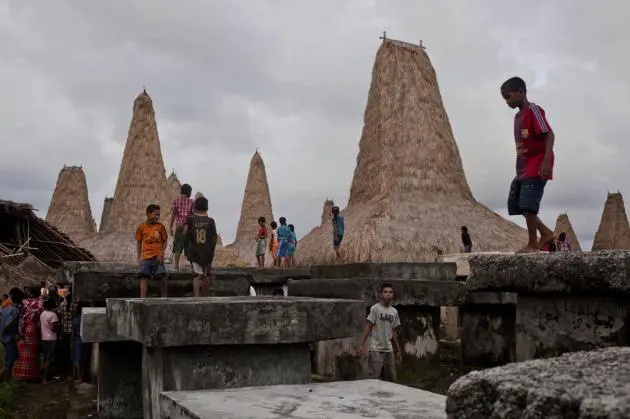
All along western Sumba, one can see similar megalithic tombs, some over 500 years old.
Sacrifices and feasts follow each step of tomb building. Once cut, the stones may be left at the quarry for decades as the family saves up or borrows enough to move these to the village.
The moving of the stones is one of the most costly aspects and offers a magnificent spectacle: a thousand men using vines to pull giant slabs over wooden rollers for a week, accompanied by motivational shouts and singing and feasts at the end of each day. They culminate in the banquet of sacrificed flesh.
“These animals are precious,” says Daniel. “We only eat meat during such feasts. Their blood spilled in front of the house ensures the dead’s passage to heaven. The slaughtered animals will join her there.”
