
Shilin in the mist


Play
Fascinating forests of stone, high peaks and glacial waterfalls make Yunnan a must-visit for every nature lover
Southern China is home to some of the most magnificent stone forests in the world and after visiting Zhangjiajie in Hunan province to see the Wulingyuan Scenic Area and its Avatar Hallelujah Mountain – so called after its starring role in James Cameron’s hit 3D movie – I was certain that I would never again experience such majesty in karst and sandstone.
It’s turned out though that the best was still to come when, on a recent trip to Kunming, the capital of Yunnan, I was taken to the breathtaking stone forests of Shilin.
Named a Unesco World Heritage Site in 1997 and immortalised by Zhang Yimou in his drama “Riding Alone for Thousands of Miles”, the 350-square-kilometre area is guaranteed to take your breath away.
It takes three hours by coach from the city to reach the entrance to the stone forest and the first thing we see on our arrival is a large three-dimensional tourist map that explains the history and formation of the park and the karsts.
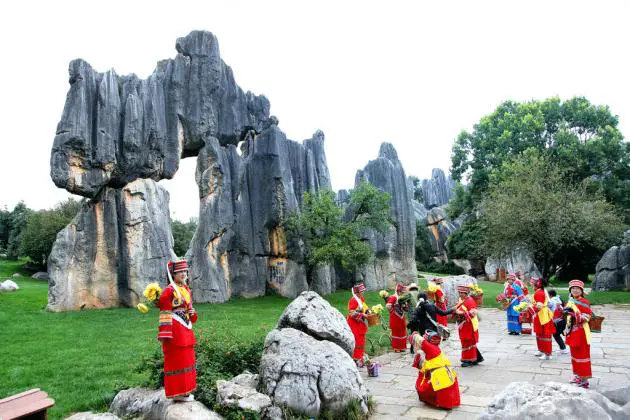
The first stop is particularly popular with photo-snapping tourists, who quickly avail themselves of the traditional red tribal costumes for rent and pose for friends and selfies.
We walk through narrow passages within the labyrinthine stone forest and are bewitched by these magnificent stone masterpieces that spring up from the ground in the manner of stalagmites, many of them looking like petrified trees.
At the centre, we gaze in wonder at the massive rock formations then climb a narrow and crowded stairway to the peak view pavilion from where we enjoy a panoramic view of the greater stone forest. Music drifts through the air from a group of dancers and singers, apparently performing a traditional Sani Yi song of friendship and hospitality. Adjacent to the performers, we spot a few Sani Yi vendors offering local handicrafts, fruits, and drinks.
The next day, we are once again on the move, this time heading 160 kilometres out of Kunming to the Jiaozi Snow Mountain Scenic Area. The signs, I observe, are clearly marked and as our bus nears its destination, I’m amazed to see Jiaozi Mountain spelt out in large English letters and Chinese characters on the hillside, just like the famed Hollywood sign in Los Angeles. The top of the tall entrance pillars, currently under construction, disappear into the sea of fog.
The scenic area is spread over 250 kilometres with its highest peak a massive 4,223 metres above sea level.
Our bus drops at Xia Ping Zi, a large plaza at an the elevation of 3,533 metres and surrounded by mountains. Shivering despite our winter clothes, we set off up the mountain to the ropeway station then follow a signpost that takes us along the wooden pathway to a vendor offering hot roasted potatoes. The snack is delicious and soon I can feel the warmth spreading to my bones.
We stick to the pathway as we climb higher winding through pine trees and eventually reaching Huaxi Stream at an altitude of 3,867 metres. A gurgling stream fed by melting ice and snow flowing down from the Moon Rock Waterfalls, its banks are lined with flowers.
Jiaozi itself is a mountain glacial landform, featuring lofty peaks and precipices, well-preserved virgin forests, glacial lakes, alpine meadows and glaciers. It was listed as a natural reserve of Kunming in 1989 and a provincial-level scenic attraction in 1993.
By the time we have climbed to just under 4,000 metres to what is known locally as the Flying Waterfall but more accurately an ice fall – some of us are feeling dizzy. Our guide has the answer: a can of the fresh air that has made entrepreneur Chen Guangbiao into a millionaire.
Suspicious at first, I am amazed to find that it actually works and am attempted to buy a second can for our onward journey to Lotus Waterfall.
The writer travelled in China as a guest of Thai AirAsia.
Get your rock on
_ Thai AirAsia flies daily between Bangkok and Kunming. The flight departs Don Mueang at 9am and lands in Kunming at 12.30. The return flight leaves Kunming at 1.20pm and arrives at 2.50pm.
