
High-tech in a classic cover


Play
Nikon releases a retro camera with dedicated mechanical controls that loses none of the effects enjoyed with other DSLRs
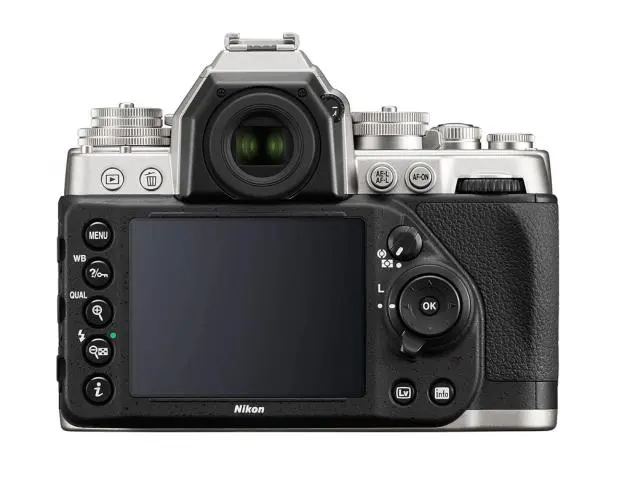
A classically styled but thoroughly modern full-frame digital single-lens reflex camera (DSLR), the Nikon Df will delight serious shutterbugs with its good performance and excellent image quality.
A full-frame camera – it uses an image sensor that's the same size as a 35-mm (36 x 24 mm), – Nikon refers to it as the FX-format. The Df is the smallest and lightest FX-format body so far.
Long-time Nikon fans will be happy that the Df is equipped with a Nikon F mount, meaning that it be used with older, non-AI NIKKOR lens. The Df can also be mounted with Nikon's DX-format lens by selecting the type of lens from the menu.
The Df uses the same FX-format CMOS sensor as the D4 flagship model with effective pixel count of 16.2-million pixels and EXPEED 3 image-processing. It also supports a broad range of standard sensitivities, from ISO 100-12800, with additional reduction to the equivalent of ISO 50 and expansion to the equivalent of ISO 204800 when necessary. As a result, the Df can achieve superior image quality under a wide variety of lighting conditions.
Its optical viewfinder is very large with magnification of 0.70x and 100-per-cent coverage.
The Df is equipped with the Multi-CAM 4800 autofocus sensor module. It features 39 focus points to enable acquisition and tracking of the intended subject.
The Df comes with AF-S NIKKOR 50mm f/1.8G (Special Edition) kit lens, which maximises its portability. This is a redesign of the AF-S NIKKOR 50mm f/1.8G normal lens and a perfect match for the Df. This compact, lightweight, and fast fixed focal length lens uses an aspherical lens element that enables both sharp rendering and beautiful blur characteristics.
The Df has no full automatic exposure mode but is still easy to use because the controls are intuitive.
There are large dials for adjusting ISO sensitivity, shutter speed, and exposure compensation and a smaller dial for choosing exposure modes. It also provides switches and buttons for changing exposure bracketing, selecting metering method, shutter release mode, previewing depth of field, and changing white balance, as well as providing a customisable function button. These buttons, dials and switches allow you to change shooting parameters easily without having to dig into the camera's menus. And the large dials allow you to have quick visual confirmation of current settings while you focus on shooting. Making it even simpler, all the dials come with a lock mechanism to prevent you from accidentally changing the values.
Making the most of the Df isn't hard if you have basic shooting knowledge. Basically, you can use the dial to select the ISO setting that suits the lighting conditions then choose either the shutter speed or aperture value before letting the camera select the rest of the settings in the semi-auto exposure modes of Programmed auto (P), Shutter-priority auto (S) and Aperture-priority auto (A).
More advanced shutterbugs can use the manual (M) mode and control both shutter speed and aperture values. In the M mode, you can use the shutter-speed dial to change the shutter speed value and use sub-command dial at the front of the camera to set aperture value.
The Df also has an interesting exposure mode, called 1/3 Step (Exposure Modes S and M). You need to rotate the shutter-speed dial to the 1/3 STEP mark then adjust the shutter speed in increments of 1/3 EV by rotating the main command dial, located at the back of the camera below the control panel. In this mode, you can choose values between 1/4000 and 30s.
Apart from setting the values of aperture, ISO and shutter speeds, you can also select Picture Control by going into the camera's menu. Options include Standard, Neutral, Vivid, Monochrome, Portrait and Landscape.
Another option activated via the menu is Active D-Lighting. This mode lets the camera preserve details in both high light and shadow, which is useful for capturing photos in high contrast scenes.
The camera also has the High Dynamic Range (HDR) option, again activated via the menu. This option lets the camera preserve details in high lighting and shadow by combining two shots taken at different exposures.
I tested the Df with the f/1.8G kit lens. When I used the portrait picture effect together with P mode, I managed to capture beautiful portraits with a beautifully blurred background. The P mode was easy to use. I needed to adjust only the ISO and then turn the main the command dial to the right for large apertures to blur background details or rotate the dial to the left for small apertures to increase the depth of field or slow shutter speeds to blur motion.
I also tried the Vivid picture effect with the P exposure mode and found that the camera really captured very colourful photos.
The Df has good performance as well. It has a power-up time of about 0.14 second and a release time lag of about 0.052 second. It could capture 5.5 fps in the high-speed continuous shooting.
Nikon says Df's battery can last for about 1,400 shots per full charge.
Nikon Df's body retails for Bt87,900. With the kit lens it goes for Bt95,900.
Key specs:
_ Type: Single-lens reflex digital camera
_ Lens Mount: Nikon F bayonet mount
_ Image sensor: FX 36.0 x 23.9 mm CMOS sensor
_ Effective pixels: 16.2 million
_ Shutter speed: 1/4000 to 30 secs with bulb, time modes
_ ISO sensitivity: 100-12,800 (ISO 50, 204,800 options)
_ Exposure Modes: A, M, P, S
_ AF-area Mode: 9, 21 or 39 point Dynamic-area AF
_ Exposure Metering System: TTL exposure metering using 2,016-pixel RGB sensor
_ Metering method: centre-weighted, matrix, spot
_ Monitor: 3.2-inch wide TFT LCD with 921,000 dots
_ Viewfinder: Eye-level Pentaprism Single-Lens Reflex Viewfinder with 100% coverage for FX lens, 97% for DX lens
_ Storage media: SD, SDHC, SDXC
_ Battery: EN-EL14a Rechargeable Li-ion Battery (1,400 shots per charge)
_ Dimension: 143.5 x 110 x 66.5mm
_ Weight: 710g
