
Creative collaborations
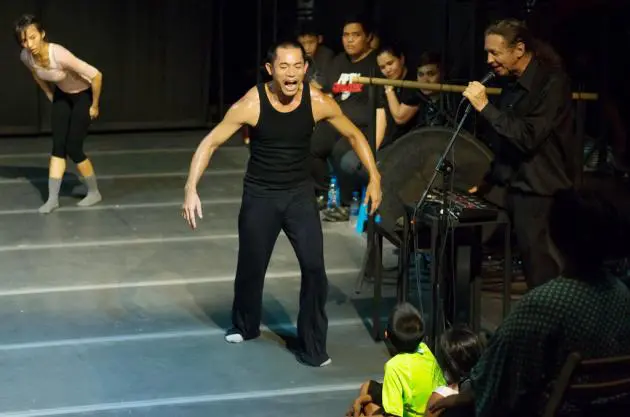


Dance movements and spoken words fill the works of Silpathorn artists
In what must have been a pleasant surprise for organisers, the Office of Contemporary Art and Culture (OCAC), the Wednesday and Thursday sessions of “Silpathorn: A Decade of Success in Thai Contemporary Art” drew a more diverse crowd to the Chang Theatre in Thon Buri, with the audiences well balanced between those already familiar with the artists’ works and others who simply wanted to try new experiences.
On Wednesday afternoon, Nikorn Saetang, artistic director of 8X8 Theatre and the 2010 recipient of Silpathorn Award, led a workshop on “dynamic movement of poetry and literature” at the small indoor theatre. It was the only workshop in the festival directly related to the performance he was presenting and thus offered those attending a complete experience.
At the outdoor space, the evening programme began with guest Indonesian artist Mugiyono’s “Rumours”. This solo contemporary dance was not only a smooth blend of various dance traditions but also dished up a good balance of essence and humour. Despite being performed entirely on a small rectangular stage without any musical accompaniment, it managed to capture and maintain the attention of the entire audience.
After the interval, Bruce Gaston, the 2009 honorary Silpathorn awardee and the only non-Thai Silpathorn artist, settled himself downstage in the middle of the classical Thai percussion instruments and offered a performance that went well with the recorded solo Ranat Ek tune of “Krao Nai” performed by the late national artist Boonyong Ketkong. Five members of Pichet Klunchun Dance Company, among them the 2006 Silpathorn awardee for whom the troupe is named, moved one by one from upstage left to downstage right. Taking inspiration from the dancer in front of him in the line, each dancer’s movements started as classical Thai then shifted in style with the interaction between them increasing as the performance proceeded.
Audience members who had watched “Tam Kai” either at “Our Roots Right Now” festival last January or its pre-Netherlands tour performances at this theatre last October, would have recognised the moves. Gaston’s presence greatly enhanced this keenly structured yet highly improvisational group work, making it seem as though all six dancers were performing simultaneously. As it evolved, the audience could see both the individuality of each dancer and the wholeness of their ensemble as well as their connection with the music.
The following day, with 2006 Silpathorn awardee Win Lyovarin’s “Mangkon Zen” in his hands, Nikorn introduced the opus then proceeded to retell several Zen tales in six different rooms and spaces in the Chang Theatre compound including in the stairway leading up to Pichet’s bedroom.
The veteran playwright, director and actor proved once again that he’s a master storyteller and solo performer. He carefully chose the tales from Win’s book, grouped them thematically, decided which parts should be narrated or acted out and on occasion invited some audience members to actively participate. In true Zen fashion, he didn’t offer any interpretation of these stories but left enough time and space for his audience to find the meanings by themselves.
Much credit was also due to art director Surachai Petsangrot and his team, who resourcefully picked, and redecorated with few props, the right corner for each set of Zen tales and effectively turned Chang Theatre into a complete performing arts centre for one evening.
At the post-show talk, Nikorn spoke of Win’s generosity in allowing him complete artistic freedom in adapting this book for stage. Nevertheless, one wonders what would have happened had Win, the recently consecrated National Artist, been more involved in the adaptation process and perhaps worked as the playwright for this collaboration. Such cooperation would also have fitted better with the main concept of this interdisciplinary collaboration at the heart of this 10th anniversary of Silpathorn.
