
Thailand rejects Cambodia’s bid to add shared resources to UNCLOS talks
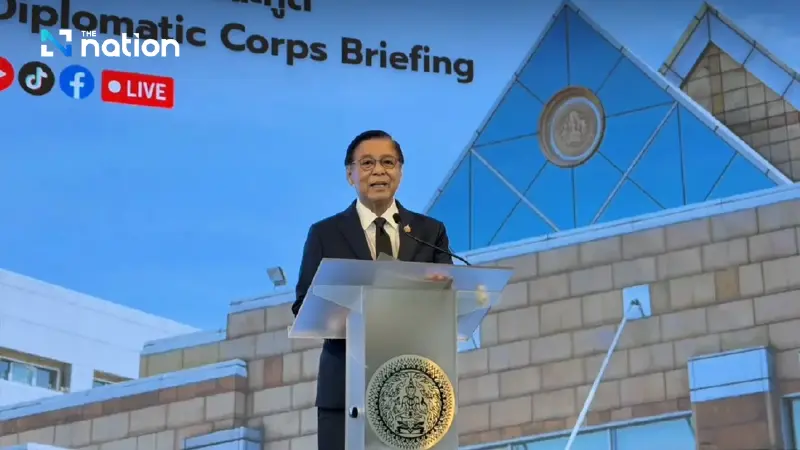


Thailand opposes Cambodia’s move to bring joint resource development into compulsory UNCLOS conciliation before maritime boundaries are settled
Thailand has rejected Cambodia’s attempt to broaden compulsory conciliation under the United Nations Convention on the Law of the Sea, or UNCLOS, to include joint resource development before maritime boundary issues are resolved.
Deputy Prime Minister and Foreign Minister Sihasak Phuangketkeow said Thailand disagreed with Cambodia’s decision to move immediately into compulsory conciliation, arguing that the two countries should first have pursued bilateral talks under the new context created after Thailand terminated MOU44.

Sihasak made the remarks after briefing foreign diplomats in Thailand on Cambodia’s notification that it would invoke compulsory conciliation under UNCLOS. The briefing was attended by 67 ambassadors, chargé d’affaires and embassy and consular representatives, along with representatives from four international organisations.
He said he was surprised that Cambodian Prime Minister Hun Manet had announced the move publicly before Thailand was formally notified. He also disputed Cambodia’s claim that Thailand’s termination of MOU44 had left no bilateral channel for negotiation.

According to Sihasak, the Thai and Cambodian prime ministers had discussed the issue during a bilateral meeting on the sidelines of the ASEAN summit in the Philippines. Thailand had made clear that MOU44 was terminated because it had produced no progress and because both countries, as UNCLOS parties, could still hold bilateral talks under the convention framework.
Thailand believes the two sides should first explore bilateral negotiation or voluntary conciliation. If those channels failed to make progress, further UNCLOS procedures could then be considered. Sihasak said Cambodia’s decision to proceed directly to compulsory conciliation did not reflect Thailand’s position.
Thailand rejects wider resource agenda
Sihasak said Cambodia had proposed that compulsory conciliation cover joint development of maritime resources even if talks on maritime boundaries did not succeed.
Thailand disagrees with that approach, he said, because compulsory conciliation should be limited to maritime boundary issues. Discussion on joint resource development is not automatically part of that process and would require prior agreement between Thailand and Cambodia.
He said the Cambodian proposal also ran counter to the spirit of the recent discussion between the two prime ministers, which focused on gradually restoring relations and using dialogue to address obstacles in bilateral ties, including maritime and land boundary issues.
Sihasak warned that Cambodia’s move could become an obstacle to efforts to improve relations, rebuild trust and resolve border-related problems.

Thai conciliators await Cabinet approval
Under the process, each side must nominate two conciliators within 21 days. Sihasak said Cambodia had already selected its names, while Thailand had also chosen two people with backgrounds in international law and litigation experience.
Thailand has not yet disclosed the names because they must first be approved by the Cabinet. After both sides nominate their conciliators, the four members will jointly select a fifth person to serve as a neutral chair. That process could take about one month or slightly longer.
Asked how long the overall process could take, Sihasak cited the Timor-Leste–Australia case, which took more than two years. He said he could not estimate the timeline for Thailand and Cambodia but stressed that Thailand objected both to Cambodia’s immediate use of compulsory conciliation and to its attempt to expand the scope beyond maritime boundaries.
Sihasak said Thailand had not been “dragged” into the mechanism by Cambodia, but Cambodia had chosen to use the procedure immediately. As a party to UNCLOS, Thailand has obligations under the convention, although the outcome of compulsory conciliation is not legally binding.
He said Thailand could refuse to participate, but the process would still move forward and conciliators could be appointed on Thailand’s behalf. In the end, the two countries may still have to return to bilateral negotiations.
Sihasak added that Cambodia’s approach could be aimed at projecting an image of taking the offensive against Thailand. However, he said the process itself could take up to two years, while direct negotiations might produce a result more quickly.
Foreign Ministry sets out Thailand’s seven-point UNCLOS stance
Thailand’s Foreign Ministry has laid out a seven-point position on Cambodia’s move to invoke compulsory conciliation under UNCLOS, stressing that Bangkok remains ready to proceed under international law while protecting the country’s interests.
- Thailand has repeatedly informed Cambodia that MOU44 no longer reflects the current context and that a new round of talks should be based on international law and UNCLOS principles, now that both countries are parties to the convention.
- Thailand maintains that direct talks between neighbouring countries remain the best and most constructive way to reach a mutually acceptable outcome.
- The ministry said Cambodia’s decision to move quickly into compulsory conciliation under UNCLOS runs counter to its own calls for restoring bilateral relations and resuming talks through existing frameworks, including discussions on maritime and land boundary issues.
- Thailand is prepared to proceed under UNCLOS, with the country’s best interests as the top priority. Prime Minister and Foreign Minister Sihasak Phuangketkeow has assigned Thailand’s legal advisers to prepare the list of conciliators and relevant legal positions.
- The ministry noted that compulsory conciliation is one of UNCLOS’s dispute-settlement mechanisms. Its outcome will be a set of recommendations from the conciliation commission and will not be legally binding. Both sides would still need to return to direct talks on the remaining disputed issues.
- Thailand urged the public to have confidence that it is fully prepared for the relevant process and will safeguard the country’s interests to the fullest extent.
- Thailand also rejected Cambodia’s allegations related to the land boundary, Chong Bok, Chong An Ma and other areas, reaffirming that it has complied with the joint statement from the third special General Border Committee meeting between Thailand and Cambodia on December 27, 2025. The statement was aimed at reducing tensions, maintaining peace and security, and ensuring public safety.

