
Thailand pushes BOI firms towards local IPOs
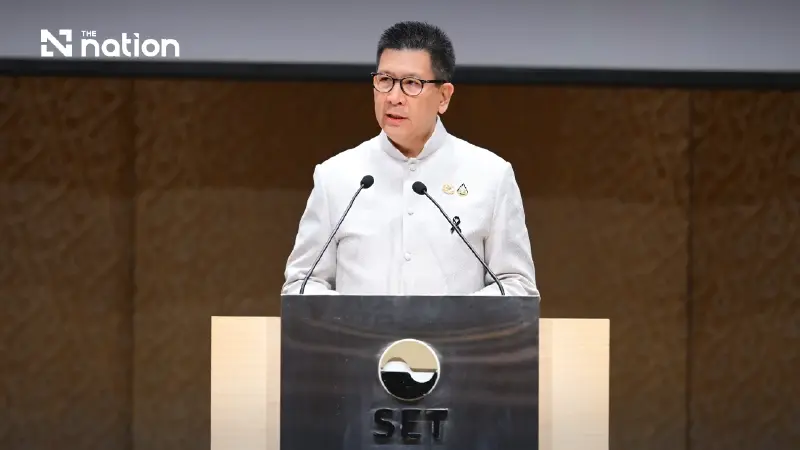


Deputy PM and Finance Minister Ekniti Nitithanprapas wants BOI-backed tech firms to list on the SET, as Thailand rides a 1980s-style investment wave
- The Thai government has launched a "BOI to IPO" initiative to encourage technology companies with Board of Investment (BOI) privileges to list on the Stock Exchange of Thailand (SET) instead of on foreign exchanges.
- The policy's goal is to retain wealth within Thailand's domestic capital market, which is lost when companies with major local production bases choose to list abroad.
- To support the initiative, the Finance Minister has instructed the SET to design a fast-track listing mechanism to make it easier and more attractive for these firms to go public locally.
- The government is actively approaching specific firms, such as a global optical transceiver manufacturer, to persuade them to consider a Thai listing instead of in markets like Hong Kong.
Deputy PM and Finance Minister Ekniti Nitithanprapas wants BOI-backed tech firms to list on the SET, as Thailand rides a 1980s-style investment wave.
Thailand's government wants technology companies benefiting from Board of Investment (BOI) privileges to list their shares on the Stock Exchange of Thailand (SET) rather than seek listings abroad, Deputy Prime Minister and Finance Minister Ekniti Nitithanprapas said on Tuesday, unveiling a "BOI to IPO" initiative intended to bring new-economy companies onto the domestic bourse.
Speaking at the SET Sustainability Forum #2/2026, themed "Turning Global Volatility into Strategic Supply Chain Advantage", Ekniti said the plan targets firms in artificial intelligence, digital infrastructure and other frontier industries that have set up manufacturing bases in Thailand but might otherwise list overseas.
"If these companies build their production base in Thailand but choose to list abroad, Thailand loses the opportunity to build wealth for our own capital market," he said.
He cited an unnamed global optical transceiver manufacturer — equipment used to transmit data by light in AI systems and data centres — whose largest production base in the world is now located in Saraburi province, with expansion under way to Ayutthaya.
The minister said his team had approached the firm's management to consider a Thai listing instead of Hong Kong, noting the company already earns and spends in Thailand.
"I asked him, 'Why go and list in Hong Kong? Why not dual-list in Thailand instead?" he said, adding that the firm had shown interest partly because it was struggling to keep up with demand and needed capital to expand its Thai plants.

Ekniti said he had asked the SET's leadership to design a fast-track listing mechanism, similar to the government's Thailand Fast Pass investment scheme, to draw such companies onto the exchange.
"The stock exchange must act as the midfield — it has to supply the strikers well," he said, describing the SET's role in a football-style division of labour between the private sector ("strikers"), the state and capital markets ("midfield") and fiscal discipline ("defence").
Investment wave likened to the 1980s
Framing the wider economic backdrop, Ekniti said Thailand was experiencing an investment surge comparable to the 1980s, when Japanese manufacturers relocated production to Thailand after being pressured to strengthen the yen.
He said that wave had built the Eastern Seaboard's petrochemical and automotive clusters, including the Laem Chabang and Map Ta Phut ports.
Today, he argued, a similar dynamic was under way — driven not by cost efficiency but by geopolitical fragmentation. Investors from China, the United States, Europe and elsewhere were choosing Thailand because it could trade with every bloc.
He said he had personally asked investors, including a global pet-food company and Chinese manufacturers, why they were relocating to Thailand; the answer, he said, was consistently that "Thailand can trade with everyone".
He also referenced conversations with international credit rating agencies during a recent trip to the United States, saying that before his visit their main concern was not public debt but Thailand's weak growth potential.

He said the country's outlook was later revised from negative to stable, which he linked to improved fiscal discipline, early debt repayment and roughly 60 billion baht in capital market inflows and a further 40 billion baht into bonds over the preceding weeks, as neighbouring countries faced downgrades.
Thailand Fast Pass and investment approvals
Ekniti, who chairs the BOI board, said investment applications reached a record one trillion baht last year, with a further one trillion baht in the first quarter of this year alone.
He attributed the acceleration to the "BOI Fast Pass" scheme launched in the fourth quarter of last year, which he said cleared bottlenecks of multiple overlapping permits so that approved investment pledges could convert into actual capital spending. The scheme has since been elevated by the Prime Minister into the broader "Thailand Fast Pass" policy.
He said private investment grew by more than 10% in the first quarter — the first double-digit growth in years — which he called a healthier form of recovery than one driven by stimulus spending.
"Investment is what builds the future," he said, contrasting it with consumption-led growth that "gets eaten and spent, and then it's gone."
Supply chains: from carmakers to SMEs
On supply chains, Ekniti pointed to the electric vehicle (EV) sector, saying Chinese manufacturers were using Thailand as their first right-hand-drive production base outside China and had begun exporting from Thai plants.
He said roughly 40 Thai companies were already integrated into one manufacturer's supply chain, with EV sensor components now being produced domestically, and said he had pushed BOI to attach technology-transfer conditions to future incentives rather than judging success purely on investment value.
He said the government was also working to connect large, digitally advanced companies with smaller suppliers. Measures include e-Tax Invoice adoption, faster VAT refunds for firms using digital systems, and encouraging banks to extend credit to SMEs once their transactions are verifiable through digital tax records.
"If it's a digital tax invoice, banks are willing to lend, because there's something to back it," he said, adding that digitalisation would help curb the double-invoicing practices that have historically hindered SME financing.
Clean energy, data centres and AI infrastructure
Ekniti said the National Energy Policy Council (kor por chor) had, the previous week, approved a first-of-its-kind measure to remove the 2,000-megawatt cap on Direct Power Purchase Agreements (Direct PPA), previously reserved for data centres, opening clean energy procurement to all industries.
A second measure grants third-party access to the electricity grid, allowing private renewable energy producers to sell directly to users rather than solely through state utilities.
He said the BOI had set up a subcommittee requiring new data centre projects to submit water management and environmental plans and to pay electricity tariffs that remain competitive with regional peers while staying above the rate paid by ordinary households to avoid data centres competing with the public for subsidised power.
On digital infrastructure more broadly, Ekniti said the government had approved a further 20 billion baht in investment from an optical transceiver manufacturer, on top of an existing 50 billion baht, bringing total investment to roughly 70 billion baht, with plans to create around 20,000 jobs and research partnerships with Suranaree University of Technology and Thammasat University.
He also referred to an unnamed US chip company that had chosen Thailand for cooling technology aimed at reducing data centre energy consumption.
Under the "Skill Bridge" programme, he said BOI-backed firms would be required to train Thai graduates in partnership with universities to match skills with industry needs, including semiconductor-related fields being coordinated with Deputy Prime Minister Yodchanan Wongsawat.
Seven strategic industries and a 12-year target
Ekniti said the government, working with the Joint Public-Private Consultation Committee (kor ror or), had identified seven strategic industries: high-value agriculture and food processing; electric vehicles; smart electronics and AI; wellness and healthcare; high-quality tourism; the creative economy; and community-based economies.
He said Thailand had set a national goal, developed with the World Bank, to become a high-income country within 12 years and to raise its global competitiveness ranking from 26th to the top 20 within four years, alongside lifting potential GDP growth from around 2.7% to above 3%.
"We rarely set long-term targets in Thailand before; this time, even if the goal is ambitious, we set it clearly," he said, citing Malaysia's high-income ambitions as a precedent once mocked but now close to realisation.
He closed by urging the SET to strengthen governance and transparency, describing fiscal discipline and openness as the "last line of defence" that reassures foreign portfolio investors comparing Thailand with its regional peers.
"I believe global momentum is genuinely moving towards Thailand," he said. "The data speaks for itself — investment applications, market inflows — better than anything I could say."
