
How Supply Chains Became Thailand’s Secret Weapon
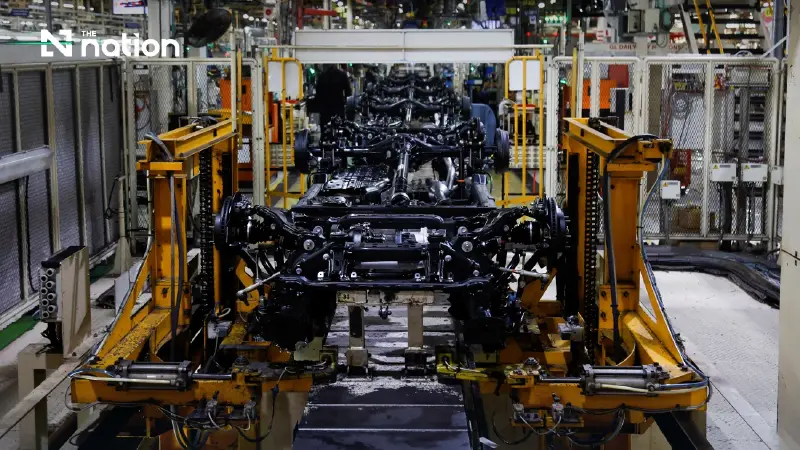


Thai business leaders and capital market regulators reveal how building resilient, multi-modal supply networks is transforming global volatility into a competitive edge
- Thailand is transforming its supply chains from a cost-cutting function into a strategic advantage by building resilient, "Just-in-Case" networks to navigate global volatility and trade conflicts.
- A "Big Brother" mandate requires large corporations to support and shield their smaller SME suppliers through shared technology and bulk purchasing power, strengthening the entire economic ecosystem.
- Companies are developing pre-planned, multi-modal transport routes—switching between land, sea, and air—to guarantee goods reach global markets despite disruptions like border closures.
- This supply chain reform, coupled with Thailand's geopolitical neutrality, positions the country as a stable "safe haven" for international investment seeking to diversify away from global risk.
Thai business leaders and capital market regulators reveal how building resilient, multi-modal supply networks is transforming global volatility into a competitive edge.
Long considered a routine back-office operation focused on cutting costs, supply chain strategy has emerged as Thailand’s most powerful economic weapon in navigating a chaotic global landscape.
At the Stock Exchange of Thailand (SET) Sustainability Forum on Tuesday, market regulators, financiers, and industrial heavyweights outlined how the kingdom is weaponising supply chain resilience, digital integration, and carbon transparency to outperform regional rivals amid escalating trade conflicts and geopolitical decoupling.
Opening the forum, Asadej Kongsiri, president of the SET, declared that the traditional metrics of supply chain management are officially obsolete.

"In the past, we thought of supply chains strictly in terms of the lowest price or the fastest delivery," Asadej said. "Today, a strong, flexible supply chain is a core competitive advantage. Companies that master this can compete with rivals anywhere in the world."
The urgency of this transformation comes as the global economy transitions away from decades of friction-free, low-interest globalisation.
Phaibool Nalinthrangkurn, chairman of the Federation of Thai Capital Market Organisations (FETCO), warned that business leaders must adapt to an era of "Global Disorder", dominated by trade wars, Middle Eastern conflicts, and "China Shock 2.0".
"In China Shock 1.0, the world benefited because China imported components to process and export," Phaibool explained. "In Shock 2.0, China uses far more domestic content. This has triggered a global wave of tariffs and protectionist barriers blocking Chinese goods."
To counter these shocks, Thai companies are ditching lean "Just-in-Time" models in favour of "Just-in-Case" survival strategies—stockpiling critical materials and establishing alternative trade corridors before crisis strikes.

The 'Big Brother' Strategic Defense
A key component of Thailand’s new strategy is protecting its 3.28 million small and medium-sized enterprises (SMEs), which form the backbone of the domestic market but face existential threats from cheap foreign imports and strict global emissions mandates like the EU's Carbon Border Adjustment Mechanism (CBAM).
To safeguard these vulnerable links, capital market authorities are deploying a "Big Brother" mandate, requiring large listed conglomerates to shield and elevate their smaller suppliers through shared technology and bulk purchasing power.
SCGJWD Logistics, for instance, manages 12,000 transport trucks across ASEAN, though it directly owns only 15%. Senior vice president Nattapume Pavaratn explained that the company shares its digital platforms and fuel-purchasing discounts with its SME partners to keep them solvent.
Nattapume added that SCGJWD now maintains a pre-planned "menu" of multimodal transport routes—switching seamlessly between land, sea, and air—to guarantee that "Product of Thailand" goods reach global markets even during sudden border closures.
Wannawat Opaswattana, director at the Office of Small and Medium Enterprises Promotion (OSMEP), stressed that without such intervention, SMEs risk being severed from global trade.
"SMEs face a quadruple threat: AI disruption, green trade mandates, cheap imports, and an aging society," he said. "Many have dropped out because they couldn't adapt in time."
Adapting to Industrial Disruption
The strategic shift is nowhere more critical than in Thailand’s automotive hub, which is undergoing a massive migration toward Electric Vehicles (EVs).
Suthad Setboonsarng, chairman of Somboon Advance Technology, pointed out that traditional Internal Combustion Engine (ICE) vehicles require roughly 30,000 components, whereas EVs require only 15,000—halving the local supply ecosystem.
Having navigated recent Suez Canal shipping blockages by establishing new supply corridors through India, Mr Suthad urged Thai manufacturers to view neighbouring ASEAN nations as strategic allies rather than competitors to build collective bargaining power against global trade blocs.

Data Transparency Unlocks Capital
From a financial perspective, bank lending is serving as the catalyst for this supply chain evolution. Gan Tirawat, an executive at Krungsri (Bank of Ayudhya), noted that financial institutions are eager to extend green and transition loans to smaller manufacturers, provided their operations are backed by verified digital records and corporate "big brothers".
"To access funding, you need data transparency," Gan said. "When major listed companies back their SME suppliers, it gives banks the confidence to extend supply chain financing with significantly lower risk."
Concluding the session, speaker consensus highlighted that Thailand’s neutral geopolitical stance—coupled with its proactive supply chain reforms—positions the country as a safe haven for international capital seeking to diversify away from global volatility.
"Thailand has a distinct advantage because we remain neutral," FETCO’s Phaibool said. "We are entering a new investment cycle aimed at lifting national capital investment to 30% of GDP, fundamentally expanding the country's long-term economic potential."
