
A fish that files


Kompin Khemkumnerd and Pavidcha Arayaphong set out to develop Thailand's very own animation hero
After a long and successful career with the Kantana Animation Studios, Kompin Khemkumnerd, who directed the Thai hits "Khan Kluay" and "Echo Planet" has decided to follow his dreams.
Along with fellow animator Pavidcha "Win" Arayaphong, formerly of DreamWorks Animation, he has formed Vuja De and the two are focusing their attention on creating a Thai character that will be as instantly recognisable as Japan’s Doraemon and South Korea’s Pororo.
"It’s a dream and we know it will take a while for Vuja De to make it to the big time," says Kompin, who is currently putting his efforts into the company’s debut project – an animation for the National Institute of Development Institution and Bangkok Metropolitan Administration’s campaign "To Pai Mai Kong" ("Grown Ups Don’t Cheat").
"We don’t have the funds to go straight into making an animated feature. What we can do is take slow steps that will allow us to be creative but also survive," says the director, who is also a lecturer at the Kantana Institute.
The two say they opted to reverse the expression "deja vu" to reflect their ability to look at things in daily life from a new fresh perspective.
Kompin’s departure from the Kantana studio was prompted by the company’s decision to put a temporary halt on making their own animated films and series and focus instead on live-action movies and creating shows for the new crop of digital TV channels.
Kompin says he and Win are enjoying the challenge of working on jobs like "Grown Ups". "It’s a valuable process in moving towards our goal," he says. "Creating a strong character like Doraemon takes a lot of time and in the meantime we can bring new ideas to our jobs and learn from our mistakes."
Kompin, who studied character animation at the California Institute of the Arts and worked at Walt Disney Animation and Bluesky Studios on "Tarzan", "Atlantis" and "Ice Age", is interested in character design and story development while Win’s focusis visual development.
"We are in different fields but complement each other," says Win, explaining that his talent lies in creating scenes or sequences from the story to see the story direction.
"Of course, we have a successful character in Khan Kluay but I want to create more sustainable characters that can portray Thainess in a contemporary way rather than focusing on traditional costume, culture or even an elephant.
Before leaving DreamWorks at the end of last year, Win was already exploring contemporary Thainess through such typical characteristics as trees, rowhouses or Bangkok’s strong sunlight.
"DreamWorks’ ‘Kung Fu Panda’ made the audience believe that the setting was China even though there were no native Chinese creators in the team. All the Chinese animators were American born. The success came from their research and their understanding," says Win.
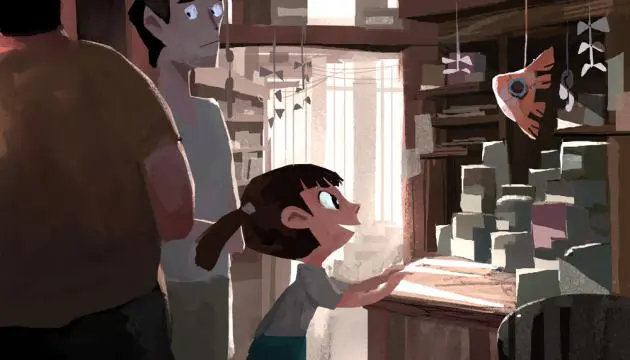
When he’s not working on "Grown Ups", Kompin has been busy creating character designs and says he’s come up with six or seven so far. One of them, which is inspired by the fish-shaped mobiles made from palm leaves that hang over a baby’s cradle, has been temporarily named "Pla Tapian Khwaen". The concept is to create a character based on a Thai folk story with "Pla Tapian" as a fish who dreams of swimming in the ocean but is stuck floating in the air, protecting the child when the parents are not around. His life changes when he watches a TV programme on paper folding and learns how to unfold himself.
Tapian becomes even more excited when he discovers he can fold himself using any household item and transform into a different kind of fish with special talents.
The two are planning to present a five-minute short in the hope it will attract funding.
Kompin notes that Thailand’s animation industry is no longer limited to movies or TV series but has spread to online games, TV commercials and infographics. Most leading animation companies like Kantana or TIGA are also receiving outsourced work from overseas, such as drawing the animation for pachinko.
"It’s good that the jobs are flooding in as it helps animators survive but in the long run it isn’t good for our creativity. We have to find a balance between outsourcing and creating our own intellectual property," says Kompin.
Win agrees, adding that one of the reasons he left DreamWorks was because of the number of projects rejected in the preliminary stages simply because the marketing department felt there was a risk that kids wouldn’t go for the ideas.
"Sometimes I wondered if there was really room for creativity, says Win, who studied animation at the Seattle Art Institute and worked for game companies and Lucas Films before moving to DreamWorks.
While he admits that his income has taken a tumble since moving back to Thailand, he’s happy to be closer to his parents and is enjoying working on projects in which he can get more involved.
"Working with Kompin also pushes me to deal with business aspects as well. That’s experience I didn’t get at DreamWorks," he says.
He would like to open an animation school and is planning to organise workshops and invite experienced Thai or foreign animators who work in Hollywood to teach young animators.
"The animation industry has gradually changed from 2D to 3D and it’s vital that animators keep updated with the new tools for creating works otherwise we will get left behind," he says.
