
Submarine saga surfaces in Shanghai


Play
US author Steven Schwankert prises open the lid on a sunken British sub and its crewmembers' history-making escape
It sounds like the plot of an underwater thriller: A British submarine collides with a Chinese cargo ship off Weihai, Shandong province, in 1931 and sinks. The crew risk a potentially suicidal dash to the surface using experimental scuba gear.
Four decades later, the government orders Shanghai salvagers to recover the wreckage from the seabed for unknown reasons, a move kept a secret from the rest of the world for the next 30 years. Weihai served as a British colonial enclave until 1930.
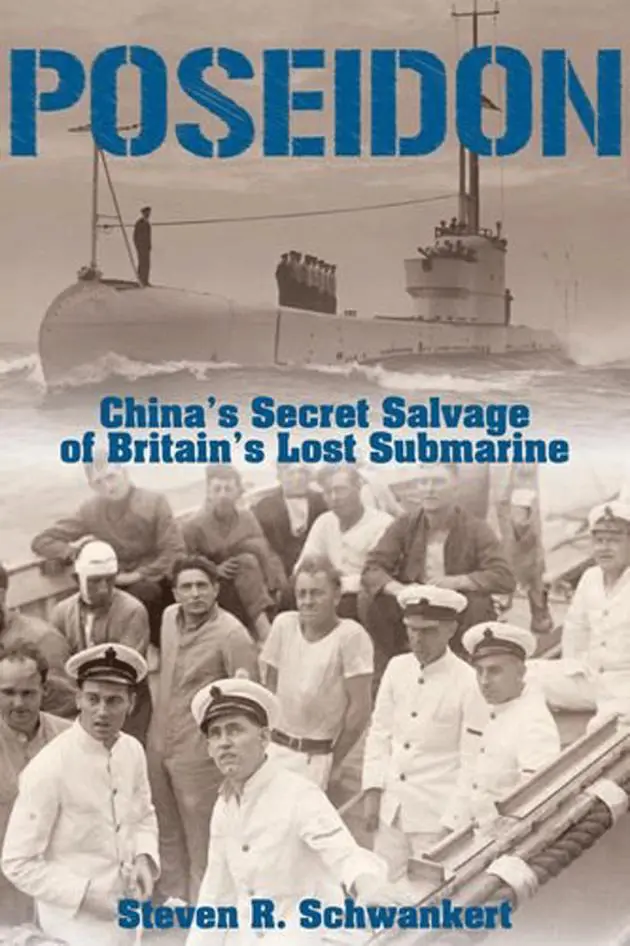
The full details of this gripping story are painstakingly researched and colourfully brought to life in Steven Schwankert’s “Poseidon: China’s Secret Salvage of Britain’s Lost Submarine”.
It pairs well with the 2013 documentary “The Poseidon Project” by British brothers Arthur and Luther Jones, which casts Schwankert and his project in a starring role.
The book “took me on a six- to seven-year journey, with lots of twists and turns”, Schwankert said in a recent talk at the Shanghai International Literary Festival.
Six of the 26 trapped crewmen survived, including one of two Chinese mates. The other, who reportedly panicked, failed to make it to the surface.
His body was never discovered.
The story made history as it was the first time stricken submariners had successfully escaped using the new Davis Submerged Escape Apparatus, which led to its widespread adoption by the Royal Navy.
Schwankert described how he brought the story to the attention of the British Navy while researching for his book.
He also discussed his sideline – diving submerged parts of the Great Wall. Schwankert founded SinoScuba, Beijing’s first professional scuba diving operator, in 2003 and says China has a growing interest in rediscovering its sub-aqua heritage.
“This is the dawning of a golden age of underwater discovery in China,” he says. “The stuff that’s going to come out of the water in the next five years is going to be amazing. There hasn’t been an archaeological renaissance like this anywhere in the world since the 1970s.”
The findings could rewrite history. “My guess is that local trade routes all go back way longer than we’ve estimated. It’s only a matter of time before we find an Arabian or African ship in the South China Sea.
“That will happen, and I think people will be surprised at the number of discoveries made,” he adds.
The South China Sea contains a treasure trove of wrecks for divers to explore. Highlights include Britain’s HMS Repulse and HMS Prince of Wales.
Schwankert says China can expect to salvage hoards of unspoiled pottery, porcelain, jewellery and silver from the Tang (618-907) to Qing (1644-1911) dynasties, “but probably not much gold.
“It will probably be very different from the ‘Pirates of the Caribbean’ stuff coming out of America – no treasure chests or pieces-of-eight – but no less interesting,” he says.
“I hope I can play just a teeny, tiny role in China’s rediscovery of its recent maritime heritage,” adds the New Jersey native, who believes such foraging can be used to shore up China’s territorial claims. President Xi Jinping called on Asean members to cooperate on building a new “maritime silk road” during his first official swing through Southeast Asia last October. He issued the remarks in Indonesia amid a climate of simmering territorial disputes in Asia, notably between China and Japan over the Diaoyu/Senkaku Islands in the East China Sea.
“We’re tightly following the 12th Five-Year Plan to carry out underwater archaeology work regularly to protect China’s heritage and reclaim its maritime history,” says Jiang Bo, director at the Centre for Underwater Cultural Heritage in Beijing.
In 2013, the centre successfully ferried the Nanhai 1, a Song Dynasty (960-1279) vessel, to the Guangdong Maritime Silk Road Museum for storage. Raised from the ocean floor south of the province in 2007, it ranks as the largest sunken cargo vessel discovered in Chinese waters to date.
Schwankert says China offers “wonderful” opportunities for divers, despite its chilly underwater climes. Highlights include a 1,000-year-old city submerged in Zhejiang’s Qiandaohu (Thousand-Island Lake), and parts of the Great Wall.
“The best thing diving in China offers is history,” he says. “You can’t dive the [Egyptian] pyramids, but you can dive the Great Wall, and it’s a much more intimate experience than hiking it. You’re not focused on the horizon, you look at the craftsmanship. And you get a 360-degree view – you can be on top of it, next to it, and sometimes even underneath it.”
Poseidon: China’s Secret Salvage of Britain’s Lost Submarine
By Steven Schwankert
Published by Hong Kong University Press
Available at major bookshops, Bt2,140 (Hardcover)
