
And the world turned to tea


Play
It's always been tea for Britons, right? Not quite, as Twinings explains in London
TEA IS hardly new in Thailand, but lounging about with an Earl Grey or Darjeeling and some sandwiches and scones never quite caught on until the recent arrival in Bangkok of trendy tearooms where java juice competes with the fine brews of tea. Thais with the wherewithal to sample such leisure learn that, like wine, tea can vary greatly in taste and flavour, even two servings of tea from the same plantation.
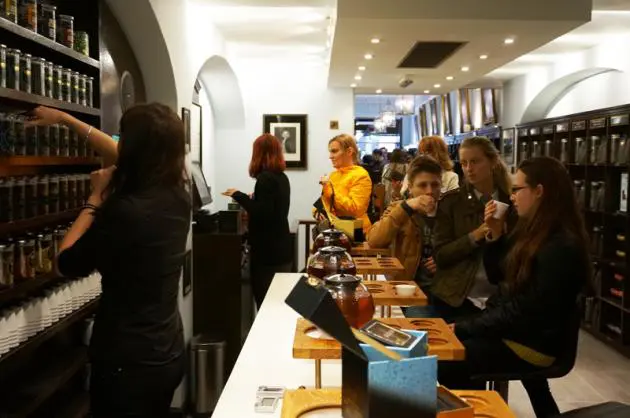
Somehow Bangkok was blessed with the world’s first and only full-scale Twinings tea boutique. It’s a calming oasis of porcelain cups where the tea is blended precisely according to your preferences. And, if you’re getting married, you can emulate Prince William and Kate Middleton and have a variation of their Royal Wedding blend prepared specially.
Twinings has been offering this custom service for 300 years, beginning with Earl Grey tea, so popular today, named in honour of the British prime minister of the 1830s who asked the firm to replicate the tea he’d received from a Chinese nobleman.
Bangkok’s Twinings salon has a “modern English” setting – comfy sofas, marble floor – yet the original Twinings shop on London’s Strand, which opened in 1706, is a tiny place by comparison. Grecian columns by the entrance hint at its rich heritage, though, as do the pair of carved Chinese men resting against a golden lion.
In this long, narrow former coffeehouse, Thomas Twining kept the shelves filled with dry tea from China and elsewhere. Today there’s a museum at the back lined with glass cabinets piled with artefacts, and a sampling counter, where customers can taste nearly 200 blends.
“English hospitality means welcoming guests with a cup of tea,” says Stephen Twining, a member of the 10th generation and the firm’s corporate-relations director. “What would you like to have – Earl Grey, English breakfast or green tea?”
We tried Ceylon white tea, with its light and delicate touch, the Chinese green tea Tai Ping Hou Kui, all long flat leaves, and a high-altitude oolong. All the while Stephen was tossing off such terms as “first flush”.
Everyone in Britain drinks tea by the litre these days, but three centuries ago it was so expensive due to shipping costs and taxes that only wealthy aristocrats could afford it. The price of a pound of tea equalled a day’s earning for a London tradesman. Coffee was not expensive, though, and London boasted at least 2,000 coffeeshops.
“Gentlemen met and did business over a cup of coffee at these coffeehouses,” Stephen explains. “They might also have brandy in the afternoon and carry on right up to dawn the next day. These weren’t places for ladies. Of course the ladies didn’t like the idea of their husbands drinking, gambling and smoking away from public view, so they started to use tea as a political and social weapon.”
In fact it’s a wife – King Charles II’s young Portuguese spouse Catherine of Braganza – who is credited with “officially” introducing tea to England, in 1662. It cost a fortune.
“The ladies would serve tea once or twice a week to show off their wealth. They invited their husbands’ business acquaintances, so their husbands would have to stay home too,” says Stephen, chuckling over one of the nine-or-so cups of tea he drinks every day.
The stuff finally became affordable in the mid-19th century. Twinings helped make it so. Today its tea is enjoyed in more than 100 countries. Its main factory produces 14 million teabags a day just for the UK. The firm buys 170 different types from 16 nations, along with hundreds of herbs and flavourings for the blending.
Stephen Twining is among 11 master blenders supervising the production of 14 new signature blends. His is called Jubilee and combines two of the most famous varieties of tea, Yunnan and Assam. Cups are passed around and he tells us the story of Anna Russell, Duchess of Bedford, who first got English society interested in afternoon tea.
“She was a busy lady-in-waiting to Her Majesty the Queen Victoria,” he says with a sip. “She had lunch at noon and dinner at 8 but found that her energy ebbed around 4 in the afternoon. So afternoon tea, served with snacks, filled the gap quite refreshingly.”
Pattariya Thammayutikan of AB Food and Beverages (Thailand), who serves as business-development director for Twinings, praises afternoon tea in London for its “expression of creativity and personal styles” through the tea set, the tea table and the blending methods.
“Londoners also enjoy the new fruit-tea blends like Passion Fruit Mango & Orange and Four Red Fruits. They also enjoy blends like lemon tea with sugar.”
British tea drinking culture does have variants as you move about the isles. Pattariya points out, for example, that tea truly suits the usually cold climate of Scotland, which is where the shipments first arrived from the east in the old days before being transported south to England.
Black tea with its bolder flavour – like English Breakfast, Prince of Wales, Ceylon and Earl Grey – is often served along with sugared biscuits to boost body heat and energy and Scots might add a few drops of whiskey, Pattariya says.
In Edinburgh we enjoyed an elaborate afternoon tea at Prestonfield House, a 17th-century mansion set in a vast park that’s now a five-star boutique hotel. While peacocks and highland cattle roamed outside, we lingered over a dizzying selection of leaf teas and great home-baked sandwiches, scones, macaroons and cakes.
Prestonfield House stands on the site of a well-to-do monastery that Henry Earl of Huntington – son of King David I of Scotland – founded in 1150. The manor house built on the spot became a hotel in the 1960s and has hosted Winston Churchill, Margaret Thatcher, Sean Connery and Elton John.
Afternoon tea is served daily, into the evening, in fact, amid wondrous grandeur – all antique decor, tapestries, the rose garden in summer, a gothic teahouse. You can have a shot of whiskey in your tea, too, though you might be advised to instead keep your whiskey separate and alternate with sips of tea.
