
Ground control to Major Koichi


Play
Japanese astronaut Wakata returns from space
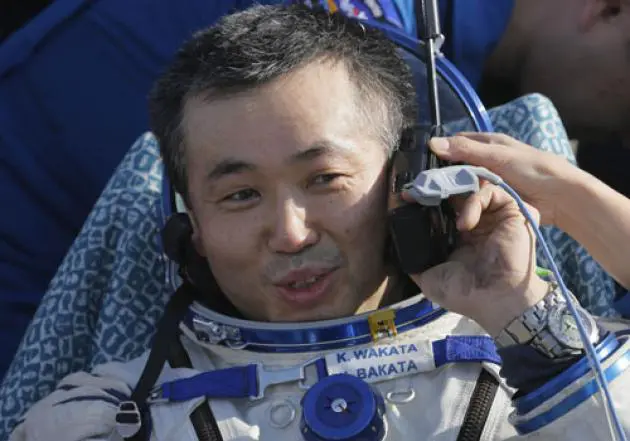
Astronaut Koichi Wakata, the first Japanese commander of the International Space Station, returned to Earth aboard the Russian Soyuz spacecraft last Wednesday, wrapping up a six-month mission.
At 10.58am Japan time on Wednesday, Wakata, 50, landed safely in Kazakhstan inside the Soyuz capsule. “I completed my duties thanks to great teamwork with astronauts from other countries,” Wakata said after he was carried out of the capsule and given health checkups. He appeared to be in good condition.
Wakata stayed on the ISS for 188 days, surpassing the 167 days spent by Satoshi Furukawa, 50, in 2011 to mark the longest stay in a single trip by a Japanese astronaut.
He stayed about 10 days aboard the US space shuttle twice, and also spent about four months aboard the ISS in 2009. He racked up a total of 348 days across four voyages, including the latest mission on the ISS.
After arriving at the ISS in November last year, Wakata carried out various scientific experiments and released an ultra-compact satellite into space. He served as the 39th skipper, a post he assumed in March, for about two months.
Wakata’s motto was to have “the Japanese spirit of harmony, or wa”. In this spirit, he supported the tasks carried out by the five other astronauts from the United States and Russia. He also communicated with ground staff.
The Soyuz spacecraft carrying three astronauts — Wakata, an American and a Russian —undocked from the ISS at an altitude of about 400 kilometres at 7:30am Japan time on last Wednesday. A capsule detached from the spacecraft, which measures about two meters in diameter and about two meters in height, then re-entered Earth’s atmosphere. A parachute deployed at an altitude of about 10 kilometres to slow the descending speed. The capsule successfully landed as scheduled.
There are currently three astronauts on the ISS with another three scheduled to arrive late this month. Astronaut Kimiya Yui, 44, will stay on the ISS for about six months from around June next year while Takuya Onishi, 38, is expected to spend about six months in 2016.
After the US space shuttle retired in 2011, the Russian Soyuz spacecraft became the only vehicle that travels between the ISS and Earth. The US is using private company initiatives to develop a new manned spacecraft, which is slated to be complete by 2017.
The operation of the ISS was initially planned to end in 2020, but in January the US in January decided to extend the period until 2024. However, Japan has not decided whether to agree with the US plan and continue participating in the ISS project after 2020.
Meanwhile, Russia on Tuesday implied that it might cease cooperation with the ISS project in the future, citing its dissatisfaction over reactions by the United States and other countries over the situation in Ukraine.
Chief Cabinet Secretary Yoshihide Suga praised Wakata’s achievements on the ISS, stating, “We Japanese are very proud of him.
“He exerted Japanese-style leadership and completed the mission honourably,” said Suga at a press conference on Wednesday.
