
Berlin's gallery scene is popping


Play
Bare strore-fronts are transformed - temporarily - for nightly exhibitions, cocktails and artful discourse
Sometimes the small grey-haired woman with two shopping bags in each hand asks herself what the purpose is of the empty shop on her street. She looks through the shop window and sees bare walls, a wooden ladder, an old school desk and nothing else.
“Hmmm. Looks interesting. But what is it?” she asks.
If she would knock on the door, Nuno Vicente, 32, would be able to explain all. Vicente is from Portugal and has been running the Joao Cocteau art gallery in Berlin’s Neukoelln district for two years, together with his girlfriend.
The gallery’s logo on the door is the only indication that the space is not merely undergoing redecoration.
Every couple of weeks a new exhibition moves in for a few days. People gather outside the gallery nightly, chatting with drinks in hand while contemporary works of art are displayed inside.
Pop-up galleries like Vicente’s are becoming a common feature of Berlin’s art scene.
So what exactly is a pop-up gallery’s function?
“There is no single definition,” says Thea Dymke from Germany’s Association of Galleries and Art Dealers. The main difference compared to a traditional dealer gallery is that there is less focus on profit. Dymke says regular galleries want to make money. Art studios like Vicente’s are non-profits, according to Anemone Vostell from Berlin’s Gallery Association.
“They’re more interested in having a discourse.”
Berlin has massive appeal for artists seeking cheap rooms to create work and express themselves, rather than make lots of money.
There are pop-up galleries in other German cities, such as Hamburg, Cologne and Munich. An estimated 100 pop-ups operate in Berlin alone.
“No where else in the world has so many spaces for artists as here,” says Tiny Domingos, 46, who belongs to a network of art project spaces in Berlin. Many pop-up galleries are in areas of Berlin that have low incomes and where real estate is difficult to rent out.
One of those areas is Neukoelln where Vicente’s gallery is – but times are changing.
“We’re really struggling because the price of real estate is exploding,” says Domingos, who also runs his own pop-up gallery in the Berlin district of Wedding.
Back in Neukoelln, Vicente and his colleague Marisa Benjamin, 33, are preparing the next exhibition.
“We’re not dependent on the market. We can experiment and try out different formats,” says Vicente. During the interview our voices echo through the shop. The previous tenants ran a kindergarten here.
In Germany, kindergartens tend to be small and located as close and as conveniently as possible to homes. An old shop is often ideal. There’s a studio in the gallery’s back room.
“We use the room at the front for events and share it with others,” says Marisa Benjamin.
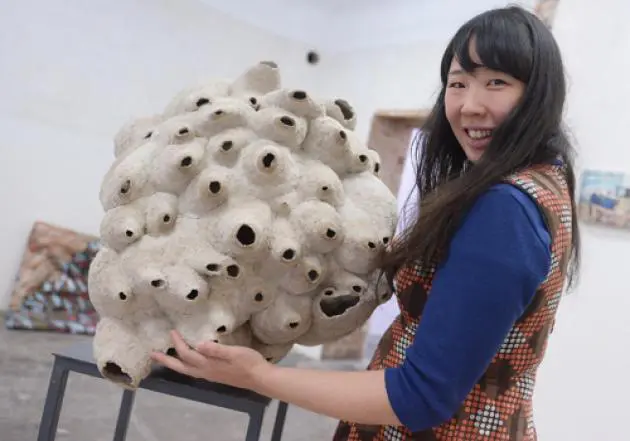
Two streets away, Eriko Yamazaki, 32, is standing in a white-walled room. In a few places the brickwork is exposed and the floor has been splashed with paint. A metal sculpture is standing in the middle of the room.
It’s a ticket machine that dispenses small chits of paper printed with the coordinates of places around the world.
Wooden beams are covered with fine scarves and projector screens hang from the walls. Yamazaki is a sculptor. Usually she shares the studio with other artists, but for this weekend it has opened its doors to the public as an exhibition space instead.
In the adjoining room, beer is being served and there’s a steady stream of interested people. About 20 artists have their work on display.
“It’s a bit less formal than an official gallery or museum,” says Yamazaki. Most of the artists have day jobs in restaurants or on flea markets, for example. A few keep their heads above water by waitering in bars.
They usually end up paying for the art spaces themselves despite their very low incomes.
Tiny Domingos from the gallery network says: “There’s a lot of self exploitation going on in this scene.”
