
Creative spaces, unsavoury places


Play
Yangon gets an upgrade as the demand for modern shopping venues spreads
Yangon’s streets have an air of cinematic unreality, with rain clouds hanging low and mildew lacing the facades of hundreds of fading colonial-era buildings as great crowds swarm the streets.
New retail businesses are moving in to Myanmar’s largest city as prosperity spreads and tourist numbers swell, creating both a threat and an opportunity to the old buildings, many a century old.
Many of the structures – originally built as depositories, libraries, malls and hospitals – no longer seem to be used for what they were intended, instead serving as makeshift shops, or as homes for dozens of families.
Others remain completely abandoned. Cracks are evident in walls, window glass is broken and the old elegance is only dimly visible.
In an effort to protect Yangon’s historic central business district, the city has deemed nearly 200 such buildings protected. The heritage status of hundreds of others has yet to be determined.
But without clear property development rules, the number of new buildings to accommodate the swathes of new small and medium foreign businesses is few.
That has not stopped entrepreneurs from making a home in Myanmar – creating modern spaces in what were once unsavoury spaces.
In the rising neighbourhood of Yaw Min Gee, at least a dozen new high-end restaurants and retail shops have emerged in the past year where once nothing stood.
Near the city’s Sule Pagoda, a number of other eateries have become staples – among them Yangon’s first modern Japanese yakitori-style restaurant, Gekko.
Decorated with refurbished teak chairs, fashionable Thai-imported ceiling fans and traditional Japanese seating, Gekko – which opened in March – represents a growing standard for modern taste in a city once closed off to the world.
“The first time I walked in, I was taken. There was something about it,” says Nico Elliot, managing director of the restaurant. “We’ve got this floor with its early 1900s caustic tiles from Manchester. I was caught by the mezzanine, and you’ve got these wicked steel beams.”
Though Gekko has quickly become a fixture in Yangon, it, like many new shops, did not open overnight.
“When we first came in, everything was clad in cheap plywood and plastic and there was no lighting – plenty of rubbish, plenty of dirt and plenty of rats,” Elliot says, adding that he and his partners poured more than US$200,000 (Bt6.48 million) into the 100-year-old building that once served as a stationery shop.
“It is very difficult when compared to places like Hong Kong and Singapore,” he says. “It is difficult to arrange the licences – you have to know the right people.”
But Gekko is not Yangon’s only success story, as new galleries, restaurants and retail shops open on a monthly basis.
The places include Pomelo, a popular local crafts shop that commissions the disabled to produce bags, furniture, jewellery and other trinkets. It opened its new downtown location earlier this year.
Though the space once served as a doctor’s surgery, with cheap wooden flooring and cubicles, products are now displayed in a wide open modern room with large bright white walls and its original flooring.
“I wanted to create a space that showcases our products in the best light, so that's why we created all these niches,” says Ulla Kroeber, a German national who co-founded the shop.
She said that though the renovations only took about three months to complete, the shop’s investors had to convince their new neighbours that opening a new shop in an old mixed-use building would not pose any danger to the structure.
“People were frightened the building might collapse when we were pulling up the floorboards,” she says.
The original urban development scheme for Yangon, called the Fraser Plan, was unveiled in the 1850s. It envisioned a grid, with several north-to-south streets and wide avenues running from east to west.
Most of the present central district was built over the succeeding hundred years, including several now-famous municipal buildings that are quickly becoming dilapidated.
Where some retailers have chosen to locate themselves more centrally, others have taken to the back streets.
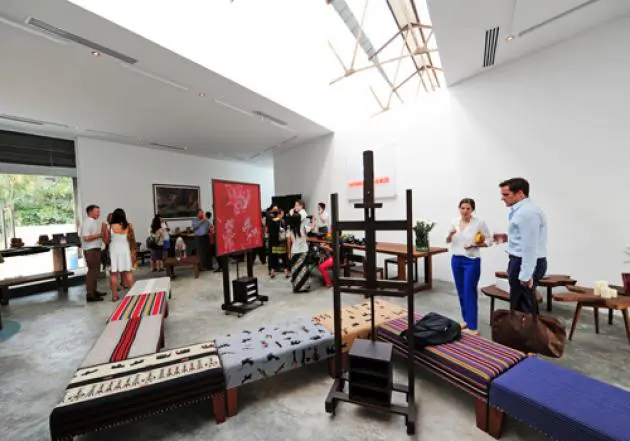
In Yangon’s hidden Jetty Wharf, which is filled with little more than cargo ships and hastily thrown together green-painted warehouses, Yangon’s newest premiere gallery, Myanmar Image, opened its doors last month.
Yangon’s social elite can navigate the otherwise busy wharf for a taste of modern art in this modern gallery, which was converted from an old transit shed.
“It’s really about using the existing shape of the transit shed and using the skylights to flood the gallery with light,” says the gallery’s architect, Dominic Leong, partner at Leong Leong Architecture.
The gallery, which doubles as a retail shop selling local crafts, took three months to put together.
“The space looks beautiful. It’s incredible to see it realised in such a short period of time,” he says.
With the future of most of the city’s original infrastructure uncertain, business owners are forced to sign short-term leases, making it difficult to justify large sums of investments in space they may not be able to retain.
“We have a pretty positive relationship with the landlord, so when it comes down to it, we hope they will be reasonable,” says Andrew Cashin, co-founder of Yangon’s first and only salad bar, Sprouts.
“The level of protection is definitely a little bit concerning, but we’ll just see where we’re at when it comes time to renew. Despite the risk however, Cashin says he’s glad to see a modern Yangon finally taking shape.
“Yangon is improving with momentum,” he says. “In this neighbourhood over the past year we have seen lots of new restaurants open.”
