
A glimmer of hope in 'Loss'


Play
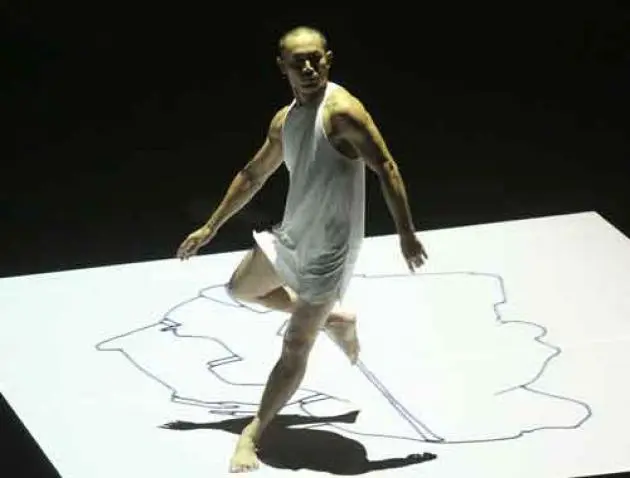
Our newly minted French "knight", Pichet Klunchun, helps kick off the dance programme of La Fete
Frech troupe A.lter S.essio and acclaimed Thai choreographer and dancer Pichet Klunchun kicked off La Fete’s dance programme last Wednesday with “Loss”, a much-anticipated collaboration between the two.
This audio-visual contemporary dance performance was the first of several co-productions between French and Thai artists slated to be staged this month as La Fete morphs from a showcase of French spectacles to a true French-Thai feast.
Originally performed as a solo by Japanese dancer Yum Keiko Takayama, “Loss” was fully re-choreographed in cooperation with Pichet during the troupe’s residency here. Using Fabrice Planquette’s video and sound designs as stimuli for their movements, the two dancers each brought their own perspectives and sentiments to guide the audience into unfamiliar surroundings.
The performance space inside the unusually packed Sodsai Pantoomkomol Centre for Dramatic Arts was marked with two white squares, positioned side by side against the darkness of the theatre. On each square lay a figure, camouflaged in white from head to toe and curled up a foetal position, looking vulnerable yet strangely peaceful in their own small isolated areas.
The show began with gentle notes from a string instrument and flickering lights, as projected colourful graphics started seeping in to touch the dancers’ bodies. Still grounded on the floor, the dancers moved their arms, legs and necks with elegance but also great resistance. The seamless balance of sound, image and body created exquisite shapes resembling ripples of waves and budding shoots.
The music then changed abruptly to a loud screech, sending the dancers into the air before scrunching back down, looking startled. Gradually standing up, they stripped off their costumes, revealing strong muscles in long white vests and fearful expressions. The dancers became more lost each time the strobe lights flashed on their faces. It was as if they had suddenly been thrown into a hazy, hostile world and ordered to cope.
The environment grew increasingly menacing as the performance progressed, from doodles to a pool of blood and criss-crossing black lines that trapped the dancers. It wasn’t until the very end that everything calmed down with the dimming of the lights. The dancers crouched down again, this time more at ease. The last image projected in front of each of them was a small rectangular puddle of water symbolising a tiny glimmer if hope in an antagonistic world.
While obvious that the choreography in this piece was mainly improvised within a loose structure, at no time were the movements messy or unsure. Both dancers were extremely skilled but never overwhelmed each other. They took turns speeding up and slowing down to display their technical prowess and sensitivity. Each dancer also had a distinctive style – popping and locking were incorporated into Takayama’s steps, while the circular motion and martial arts used in khon were evident in Pichet’s.
During the question-and-answer session after the performance, two audience members insisted on repeatedly asking Planquette what “Loss” meant exactly, this despite his repeated assertions that the meaning is in the eye of the beholder. This type of question has been raised time and again in post-show discussions I have attended in Thailand, but seemed foreign to the French director. He simply maintained that the audience should use their own imaginations.
Pichet, just before being knighted Chevalier of Arts and Letters by the French government, also urged the Thai audience to take comfort and confidence in their own interpretations instead of always seeking a safe and definite conclusion from an “authority”. After all, it’s his courage in consistently re-inventing khon in a contemporary context amidst harsh criticism from the traditionalists that has given him a repertoire of unique works deserving of international recognition.
In this current political climate of imposed submission and conformity, we should at least allow ourselves the freedom to feel the impact of art on us in our own individual ways.
HIP-HOPPING IN HIGH SPIRITS
La Fete’s next stage presentation is Pockemon Crew’s hip-hop performance, taking inspiration from the cinema of the 1930s and 1940s. It’s at 8pm on Wednesday at the Aksra Theatre in the King Power Complex, just steps from Victory Monument BTS.
Tickets cost Bt600 and Bt800 (Bt400 for under-25s) at www.ThaiTicketMajor.com.
