
The way it used to be


Play
The charming restaurant Rabbit in the Kitchen gives classic recipes of yesteryear a fun twist
A RABBIT has taken over the former premises of the famed Chinese restaurant New Light on Siam Square, in the form of the relaxing and friendly Rabbit in the Kitchen.
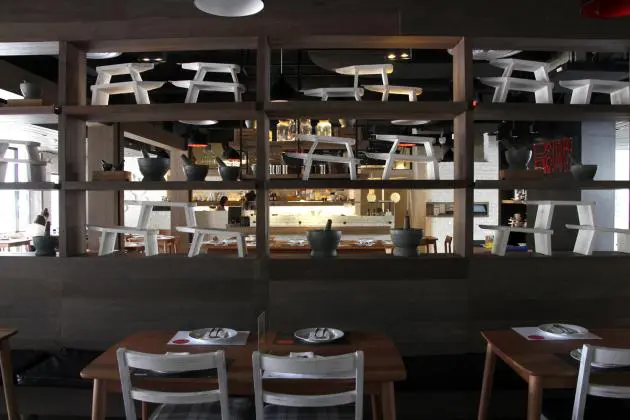
Wrapped in glass, it feels wide open, with the light streaming to illuminate what might appear to be a traditional house on stilts. Underneath such houses, between the stilts, is where the cooking is done, and that’s the case here too.
The wooden poles and beams have that authentic feel, as do the decorative items and classic kitchenware – mortars, pestles, cutting boards and the like – although the coconut graters are shaped like rabbits.
It’s all quite “contemporary” nevertheless, and with Siam Square being such a youth magnet, you might expect the three-month-old Rabbit in the Kitchen is a trendy fusion place, all very pretty but not particularly tasty. On the contrary, however, the extensive menu is full of old-fashioned Siamese dishes that are hard to find these days.
“We offer the wonderful recipes of yesteryear, but they’re adapted a bit for ease of eating and to improve the presentation,” says Kitti Kongpituk, the restaurant’s marketing strategist.
“Since chilli paste and vegetables are vital in Thai cuisine, our ‘rice bar’ has a selection of khao kluk – rice cooked with them – where you can order the house dishes or create your own.”
Take a tour of the country. If your taste buds fancy “something Central”, there’s khao nam prik pla too (the rice mixed with shrimp-paste sauce and served with fried mackerel and vegetables) for Bt90 and nam prik long ruea (with shrimp-paste chilli sauce and sweetened pork, fluffy tuna, salted egg and vegetables) for Bt120.
From the Northeast comes rice cooked with jaew bong, the spicy fermented-fish dip, and from the South and herbal khao yam – each Bt90.
Make your own one-of-a-kind dish for Bt75 with jasmine or brown rice, any of the five chilli sauces, various seafood, shrimp paste, garlicky nam prik na rok, budu fish sauce or nam prik long ruea. There are at least 15 choices of fresh, boiled and fried vegetables from shallots and cabbage to eggplant and baby corn.
Then add pork crackling, salted egg, fluffy tuna or crabmeat, each topping priced Bt15 to Bt45.
The menu affords a light starter that chef Peeraroj Siripanjana recommends: a Thai steamed dumpling (Bt90). The stuffing is from an old recipe and includes chopped pork tenderloin, shrimp, pork fat, onion and palm sugar.
“The dough used to be a mix of rice flour and tapioca flour and the fancy pleating took a long time using the thumb and finger or tweezers,” says Peeraroj. “We do things quicker here and just use Chinese dumpling dough.”
Good for a fiery kick is yum nuea yang sadej, a grilled beef salad (Bt180). Rather than mixing the sliced beef and condiments, they’re presented separately arranged, as if in the royal court. The beef is marinated in black pepper and salt. Alongside it are eggplant, shallots, lemongrass and mint leaves, a roasted-chilli sauce and a seafood sauce.
Another pleasing dish is kha nom jeen goong sod kab tod mun pla krai (Bt160) – rice-flour noodles with grilled shrimp and a fishcake made with featherback fish. The vinegar sauce is dressed with shrimp, diced tomato, red chillies and grilled-and-peeled shallots.
Next up is gai tsu-hsi (Bt180), boneless chicken wings stuffed with sticky rice mixed with stir-fried pork, mushrooms, dried shrimp, coriander root and pepper. The stuffed wings are both steamed and deep-fried.
Simple yet delicious is stir-fried vermicelli with crabmeat (Bt220). The noodles are tender and not at all oily, redolent with the aroma of a wok used often for stir-frying. It’s served with iceberg lettuce for you to wrap up the vermicelli, Vietnamese-style.
It’s quite rare to find the refreshing traditional dessert som chun, which is seasonal fruit in a bitter orange syrup. “We can use any fruit to make it, but the main fruit should be lychee,” says Peeraroj. “We serve lychee with shredded sour mango, jackfruit, shredded ginger and golden-fried shallots and with pandan syrup mixed with juice and shredded peel of the rare citrus fruit som saa for a piquant bitterness.” Som saa is elsewhere known as bigarade and Seville orange.
Equally tempting is kuay toon, a steamed banana in roselle sauce (Bt60). The unripe kuay nam waa is steamed for 30 minutes, peeled and then chilled. It’s served with roselle sauce and topped with fresh whipping cream.
HOPE ON OVER
>>Rabbit in the Kitchen on Siam Square Soi 11 is open daily from 10 to 10.
>>Call (02) 658 4200 or check out Facebook.com/RabbitInTheKitchen.
