
Michelangelo or balloon clown?
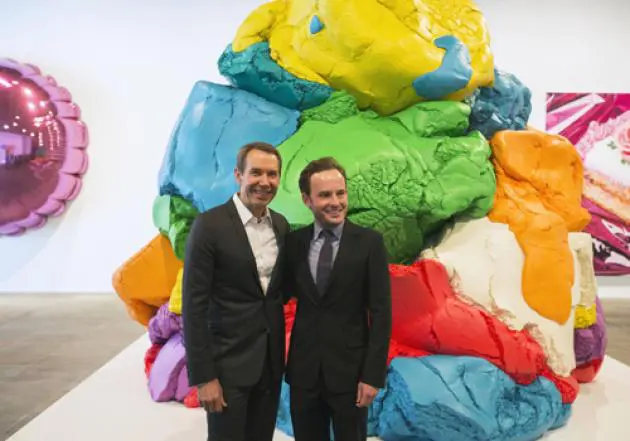


Play
You have until October to visit New York and decide if you should stop laughing at Jeff Koons
Jeff Koons, one of world’s highest-paid artists, unveiled his life work in New York on Friday, a chance to under
stand why his art is so celebrated, so loathed – and so expensive.
The Whitney Museum has devoted its entire four-floor premises to the city’s first retrospective of a 35-year career that sent Koons, the “king of kitsch”, into the celebrity stratosphere.
Famous for his short-lived marriage
to an Italian porn star and for channelling their sex life into explicit art, he is often compared to Andy Warhol and has even been lauded as a new Michelangelo.
His ex-wife is Ilona Staller, a former Italian lawmaker known in the porn world as “Cicciolina”, who once offered to have sex with then-Iraqi leader Saddam Hussein to avert the 1990 Gulf War.
Today Koons is married to a former assistant and divides his time between a farm in Pennsylvania and New York City, where an army of staff helps produce his giant, ultra-expensive sculptures.
Last year his “Balloon Dog (Orange)” smashed world auction records by selling for $58.4 million (Bt1.9 billion) – the most money for any work by a living artist and the most for a contemporary sculpture.
His fame resonates well beyond the art world, helped in part by collaborations with celebrities such as Lady Gaga, who made his art a centrepiece of her most recent album launch.
Koons, tanned and dressed in a sharp suit with his piercing eyes, revelled in the rock-star reception at the press preview for his retrospective, mobbed by TV cameras and photographers. “I’m enjoying every moment of this,” he said. “I believe completely in the work that we have here, and I hope other people can find meaning in it.”
The 59-year-old said he hopes to have another three decades, “maybe more”, to create art – which many will interpret as a clear nod to his hero, Pablo Picasso, who worked until his death in his 90s.
“I really believe in art, I really believe in the transcendence it’s given me... and it’s taught me how to enjoy ideas and also experience this very ephemeral realm of ideas,” he said.
The retrospective of 150 works continues through October 19 and then moves on to Paris. It’s the American museum’s last exhibition before it moves downtown to gleaming new premises.
The intention is to view Koons’ art as a whole, trace its evolution and gain a deeper understanding of how the iconic pieces, such as “Made in Heaven” and “Balloon Dog”, fit into
the whole.
Twenty years after its creation, “Made in Heaven” remains
his most controversial work. Stepping out of the Whitney elevator, visitors are hit by the enormous lithograph of a fresh-faced, naked Koons embracing a writhing Staller, dressed in fishnet stockings and white lace lingerie.
Koons intended the graphic, kitsch depictions of the couple having sex to foster emancipation from shame, but they were slammed at the time and branded “dreadful” by Britain’s Guardian newspaper this week. “Great, good, bad and terrible art” read the Guardian’s headline on its review of the retrospective.
The Whitney heaped praise on its star. Director Adam Weinberg said Koons “redefined what art and an artist can be”. Yet the retrospective is unlikely to quieten his detractors.
The late critic Robert Hughes lampooned Koons for thinking he is a Michelangelo of the modern day and collectors for believing it. “He has the slimy assurance, the gross patter about transcendence through art, of a blow-dried Baptist selling swamp acres in Florida,” he wrote.
