
The price of happiness


Play
Bhutan's policy of Gross National Happiness is touted as a recipe for success but what does it really mean?
So many questions go through my mind as I travel through Bhutan, a country that is isolated from the rest of the world but has its own well-developed culture and is fiercely protective of it.
The tiny mountain kingdom, which is sandwiched between China and India and has a population of just 725,000, is the only country in the world that keeps tabs on its own “Gross National Happiness” index to gauge the success of its economy and to measure the standard of living. That has traditionally meant maintaining its unspoiled natural environment and cultural heritage.
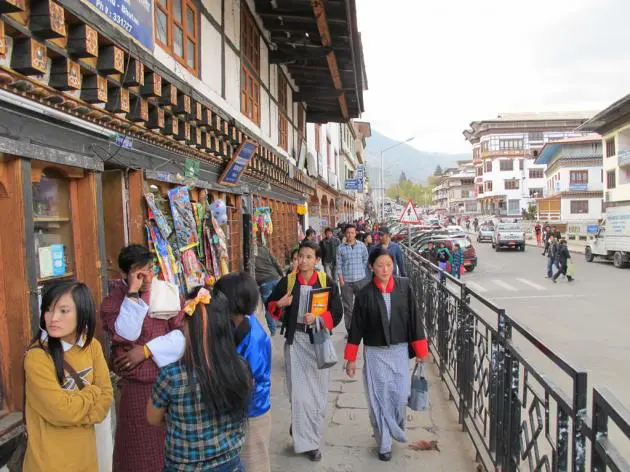
Today though, Bhutan is being increasingly forced to find a happy balance between modernisation and ancient culture under the guiding philosophy of GNH. Development, as progress arrives in the country through direct international flights, the Internet, mobile phone networks and cable television.
“The country may or may not be happy. What we have is an overall development philosophy that’s based on gross national happiness. And the aim of the philosophy and all the policies that come from it is that the conditions are in place to make everyone happy. Whether we are achieving it or not is a different matter,” muses Bhutan’s Prime Minister Tshering Tobgay during an interview with Thai reporters at his office in Thimphu.
“In defining GNH our fourth king, His Majesty Jigme Singye Wangchuck [the father of the current monarch], noted that we need our economy to grow but at the same time economic growth must be balanced with spiritual well-being through a strong environment and a vibrant culture.
“I believe development and happiness can go together; it doesn’t have to be one thing or the other. The whole purpose is to grow, is to develop in a holistic manner where everybody feels a better sense of wellbeing. We can be prosperous and happy,” he adds.
Happiness or unhappiness is of course subjective. Many would argue that happiness comes from simplicity while unhappiness is influenced by the need to own imported products like cosmetics and mobile phones. It thus seems inevitable that the expectations of the Bhutanese are rising because of the country’s development.
The PM agrees. “We need to expand, deepen and strengthen our economy while being mindful of the principles of GNH, mindful that our people need social development and that each and every one of them must be given economic opportunity. Otherwise the gap between those who have and those who do not have will be very big. How do you foster economic growth while remaining mindful of GNH principles? That is the challenge,” he says.
During my brief sojourn, I tour Paro and trek to Taktshang, or the Tiger’s Nest, the country’s most famous tourist attraction, before driving to Thimphu, the capital, and going on Punakha to see the most photogenic dzong. That gives me plenty of opportunity to find out firsthand from that some Bhutanese whether they are happy with their simple life.
“Happiness is not about having a simple or stylish lifestyle but how you adapt to the simple or stylish lifestyles. Happiness is not about using imported cosmetics. For me, it is having the basic necessities like food, shelter and clothing as well as a balanced life with values,” an official at Terma Linca Resort and Spa tells me.
“But I agree that the Bhutanese are changing because of the country's development. However, the majority of us are changing while still keeping in mind our culture, traditions and values. Our government cannot control our happiness or unhappiness but it can facilitate the right environment for a happy society. We will be happy providing our basic necessities are met.”
More signs of progress can be found in the bars and clubs that are springing up in and around the capital. Here, while enjoying a quiet beer, I see more than one person smoking, despite the fact that Bhutan prides itself on being the world’s first non-smoking nation and declared the sale of tobacco illegal in 2004. Punishment is harsh with smokers caught puffing away in public spaces fined US$232, the equivalent of two month’s salary for the average civil servant.
Convenience stores have arrived here too and I’m amused to find an 8-Eleven, presumably a take on 7-Eleven on a Thimphu street.
Disposal of garbage in such a pristine environment is another problem the mountain kingdom is having to face. One of its solutions is apparently the “Collect Garbage Competition”, which awards prizes to anyone who picks up 100, 300 and 500 plastic bags and wrappings. In Punakha, the signs read “This is your town, keep it clean” while two blue-painted trash cans in Sobsokha Village scream out the more amusing “clean environment, abuse me”.
“We have a very small population but there is still plenty of garbage. So we must clean our garbage, we must not have unnecessary waste. If we must have waste, we must be able to segregate, recycle and manage our waste but we should never, ever throw garbage. We started a movement called ‘Clean Bhutan’ to clear the garbage and hopefully in the future, we will be able to sustain the cleanliness not by continuing to clean it but by changing the attitude of the people,” says the Prime Minister.
With Bhutan attempting to move away from cars to electric vehicles, the bicycle is a popular way of getting around.
“There are the good mountain biking trails in Bhutan,” the Prime Minister confirms. We have a race called the Tour of the Dragon on the first Saturday of every September. It’s a 268-kilometre race that starts at 2am and crosses four passes. Each of the passes is above 3,200 metres. Three of the passes are higher than 3,400 metres and the last pass, 3,200 metres, is Dochula,” says the PM, who is also an avid cyclist.
“Bring a Thai team. We’ll ride together! But you must come early to acclimatise.”
Bhutanese bargains
_ The Kingdom of Bhutan has a promotion for Thai tourists through the end of August. Travellers booking their flights will receive a 50-per-cent discount on the airfare and pay $65 a night for their stays.
_ Independent travel is banned – itineraries with authorised tour operators are required.
_ Find out more about the Tour of the Dragon at www.TourOfTheDragon.com.
