
The price of precious metals


Play
People in Phichit say a goldmine is putting their health and safety at risk. The court isn't convinced
THE VILLAGE OF Ban Khao Mor in Phichit was home to about 400 people a century ago. It’s said, perhaps somewhat nostalgically, that they lived contentedly, in harmony with nature. Today the place is almost a ghost town, with no more than a dozen households, all shrouded in ill health. For many of the residents, the blame for the community’s appalling change in fortunes rests squarely with the goldmine cut into the adjacent hills by Akara Resources PCL.
The farmers of Ban Khao Mor, many of them fourth generation, sold their land to Akara and moved elsewhere as the Chatree Mining Complex expanded to fill the human void left in Tambon Khao Jed Look, Thap Khlo district.
Executives at Akara claim the firm has thus far paid the government Bt3 billion in royalties from the 6.2 million tonnes of precious metals extracted each year – including 1.3 million ounces of gold and 5.8 million ounces of silver. The Phichit land it now owns contains an estimated 35 million tonnes of material containing both gold and silver. Each tonne can produce 1.2 grams of gold and 12 grams of silver, for an anticipated total of 42 tonnes of gold – worth Bt30 billion.
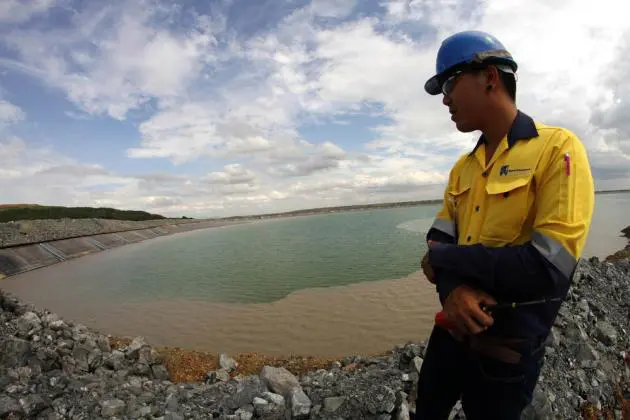
Akara can quite rightly point out that the mine has brought hundreds of decent-paying jobs to the district and, for some, actual wealth. Many of the residents, though – particularly those living in Moo 9 in Thap Khlo – say they’re suffering the ill effects of noise, dust and toxic leakage involving arsenic, cyanide and lead.
Wutthipong Fan-sanoh, 52, says his three years in the mine, ending in 2006, left him chronically fatigued, often struggling to breathe and covered in “black spots”. Doctors found a level of arsenic in his urine of more than 110 micrograms per litre, double the safe level of 50. The manganese level in his blood was almost 15 micrograms, a third higher than safety allows.
“All of the villagers were affected and many have fallen sick,” Wutthipong says. “But their children worked in the mine, so no one complained for fear of the kids losing their jobs.” He says a Bt1-million-a-year fund was established to safeguard the residents of three adjoining sub-districts, but no money reached the sick “because it was spent on buildings”.
“We want them to take care of us. These days we’re even scared to drink surface water or well water.”
Three lawsuits filed on behalf of the citizens are before the Administrative Court. The first, lodged in 2010, called for Akara’s Phrase 2 lease to be revoked. The court on March 27 gave the firm a year to conduct an environmental health impact assessment (EHIA), but meanwhile allowed mining to continue.
The mining should have been halted, says Eco-culture Study Group coordinator Lertsak Kamkongsak, but the court agreed with Akara that a Committee of Experts must first reject the completed EHIA. While the failure to conduct an EHIA at the outset rendered the lease illegitimate, the court decided, its revocation would have a financial impact on the firm, the state and local
people who were benefiting from the mine. Expert witnesses also insisted the groundwater had not been contaminated and met safety standards.
Lertsak says other nearby communities affected by the “unauthorised” mining filed another suit with the same court late last month. Anti-mine sentiment is spreading, he says. Most local people want the mine shut down.
In 2012 a group of residents sued officials for negligence for allowing the mine work to expand with the establishment of a mineral-storage pit. The court ordered Akara to halt further expansion, but the work continues while that ruling is being appealed.
Thanut Meesomchai, in charge of Akara’s “corporate social responsibility”, blames the complaints and lawsuits on personal conflicts and the citizens’ lack of trust in state agencies and businesspeople. He believes misperceptions have arisen due to news reports about substandard mines elsewhere.
Thanut points out that Akara created at least 1,000 jobs and established a Bt100-million insurance fund to guard against any risks posed to the environment or the community. The miners undergo annual health checks and none has been found sick from contamination by metals or toxins.
The firm’s environment manager, Yaowanuch Chandung, says an “environmental management system” is in place and it has never indicated any toxic contamination. “The manganese and iron are within safe levels and the mine keeps the cyanide level under 20 milligrams per litre, as required by law, before disposing of it in the two mineral-storage pits, neither of which has shown levels above the safety limit,” she says.
Asked about residents’ claim of being contaminated with toxins, Yaowanuch says some people have come down with rashes, but hospital tests have yet to provide a clear answer. The suspected cause, cyanide, could come from various sources, she adds. Akara last year conducted health checks on everyone living within five kilometres of the mine and intends to do so every year.
Another issue for the residents, says Seukanya Theerachatdamrong, involves four public roads traversing the concession area. Akara is legally required to seek permission and public agreement before setting off explosions near those roads. He says the noise and the dust damage people’s homes. (Yaowanuch says the explosive charges are detonated only twice a day – at noon and 5pm – and water trucks make the rounds to control dust.)
Akara did seek the permission of the Khao Jed Look Tambon Administrative Organisation – at a public forum a year ago – but was turned down. In September, however, the tambon officials granted permission, says Seukanya, as did Phichit Governor Surachai Khan-asa. Surachai later said he’d been unaware of any dissent in the tambon. He suggested the residents petition the province to stop the detonations.
On June 18 some of the residents led officials of the Department of Primary Industries and Mines and the local tambons and districts on an inspection tour to demonstrate their concern over possible damage.
While many citizens are in a combative mood, others are resigned to their fate. Ban Khao Mor grocer Thongyoo Sindee, 55, endures a nasty rash all over her body but declines to join in the protests. She has no choice, she says – nowhere to go and no money – and only hopes that Akara will buy her some property elsewhere so she can move.
GOLD BY THE NUMBERS
Akara Resources PCL, a Thai-Australian venture, was licensed in 1993 to mine gold in Phichit, Phetchabun and Phitsanulok. It began operations in 2000. South Chatree, Phase 1 of its open pit mine, opened the following year, and North Chatree, Phrase 2, in 2008.
The Chatree Mining Complex is 10,600 rai, including a 3,700-rai buffer zone.
Around 1,100 people are employed at the mine, 77 per cent of them from Phichit, Petchabun and Phitsanulok and 99 per cent Thai.
Akara holds 14 mining leases for 3,726 rai, nine of them extending to 2028. Renewal of a 94-rai lease that expired in 2012 is being sought, as is one new lease.
Akara paid Bt3.2 billion in “royalties” to the government between 2001 and May this year. It also pays corporate income tax, value-added tax, duties and various local taxes on buildings and land.
