
All in the numbers


A German professor brings his "Hands on Maths" concept to Bangkok
ONE OF THE most disliked subjects in the school curriculum, mathematics is nonetheless vital to our daily lives. It is often described as the language of science through which we understand the natural world and its kaleidoscope of patterns and principles. But it’s also abstract and for that reason teachers are increasingly turning to puzzles and games in an attempt to enforce learning.
There are of course those who love maths, among them Professor Albrecht Beutelspacher, director of Mathematikum Museum in Giessen, Germany, the world’s first – and only – mathematics science centre. He was in Bangkok last week to present an interactive maths exhibition in Thailand at NSM Science Square.
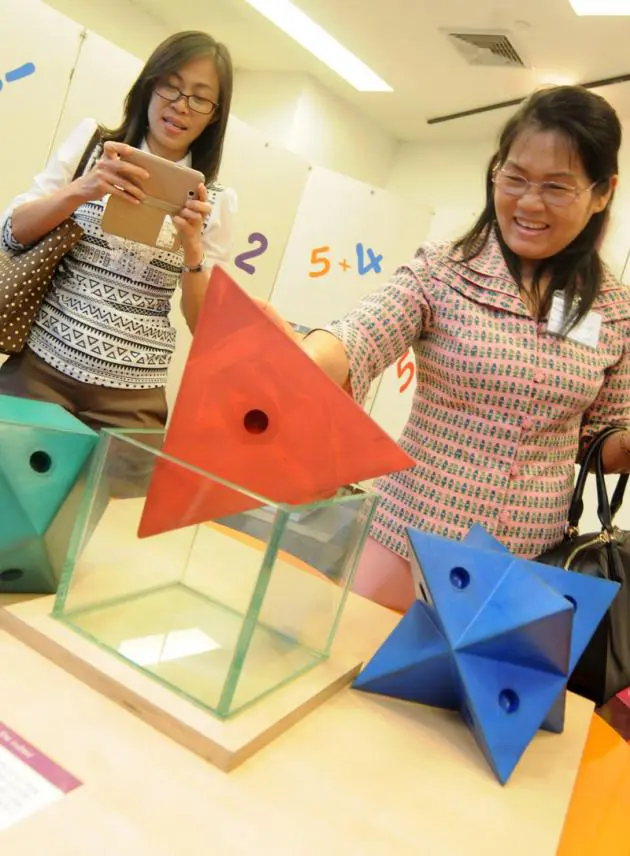
Organised in collaboration with the Goethe Institut and Nanmeebooks, the touring exhibition offers a hands-on experience of mathematics and invites people of any age, gender and education to learn mathematics by personal experience. Visitors can learn a different mathematical experience from each of the 20 exhibits on display, whether by making giant soap bubbles, solving tricky puzzles or building a bridge.
Beutelspacher defines his “hands on mathematics” philosophy as doing something with the hands, explaining that experience has shown that working while thinking enforces learning in a very strong way.
“You start by working with real objects. You investigate them before describe them in words. This is the second level. The mathematical description is the third level. Working with real objects makes the brain function in a remarkable way. In traditional maths, you attempt to develop a theory then come up with an example. I think the bottom-up strategy works much better: handling the real object, describing it, and then turning it into mathematics,” he says.
“The idea of mathematics is to get results through your own thinking. But most kids are not taught that way. They are told to do things a certain way and that other methods are wrong. No wonder they feel bored. But if you let children investigate and reach their own conclusions, then they are enthusiastic about mathematics.”
The interactive experiments in the museum as well as in Beutelspacher’s two books, both already available in Thai, are designed to stimulate children, parents and educators’ interest in a particular mathematical phenomenon.
“We provide lots of experiments in the book so that you can do them by yourself. We encourage people to see mathematics everywhere like in patterns on the floor or on a flower. This is the hands-on approach. We teach the simple rules of addition, subtraction, multiplication, and division by formulating them as exercises.
“The problem we face today is that maths is taught by rote. Mathematics is a process of adventurous thought that demands investigation, not a formal, rigid subject. The first experience with mathematics should be simple. It can then become more difficult and sometimes very difficult. What’s important is that it is always a challenge, always a mental adventure,” he explains.
Those adventures, he adds, eventually culminate in the “aha moment”, that instance when everything becomes and the children comprehend concepts, ideas and solutions.
“Basically you take a child’s curiosity and satisfy it through an experiment. It must be clear enough so that he or she immediately knows what to do. Children hate reading instructions. As the child starts working on the experiment, he’ll notice it is more difficult than he first thought. But he’ll keep on going until he conquers the problem. Taught in this way, mathematics strengthens personality,” he says.
The 20 exhibits on display in Bangkok cover geometry (forms and patterns), algebra (numbers and their properties), calculus (functions), and statistics and probability (the theory of randomness).
The “Wonderful Soap Skins” experiment is probably the easiest as it involves no more than putting one of the frames into a pail of soapy water then carefully pulling it out to see the fantastic structure that has been created.
“Who Extends Out the Most?” challenges you manage to place objects one above the other, so that one object is fully above the abyss.
“What Goes in the Cubes!” is more difficult. Dealing with the cubic root, it offers tips and tricks for inserting geometric pieces into a cube.
“Pythagoras for Laying” challenges the viewer to place the red slides on the yellow ones and then sort the plates with the red and yellow slides and place them in the field with the appropriate coloured frame. The idea is to calculate how many plates fit into the frame in each case.
“Leonardo Bridge” involves the construction of a bridge using bars. You begin with a small bridge then try to extend it. The question to answer is how many parts are needed at the minimum for a small bridge?
“The 2nd Pyramid” meanwhile challenges visitors to build a pyramid from the two pieces so that a triangular base is formed. Notice what happens to the square surface.
While convinced that hands-on maths is the way to go, Beutelspacher wonders if the new generation’s reliance on technology won’t have a negative impact on their powers of concentration.
“Kids today live with virtual reality. They don’t respond to making their minds work with just a simple game in the way we did. They don’t seem as eager to investigate. I’m not against technology but I don’t know what will happen in the long run if new technology continues to feed a short concentration span. Mathematics takes a long time to solve problems: minutes, hours, sometimes years. I worry this attitude won’t survive.”
ADDED UP
AND MULTIPLIED
n In Bangkok, “Hands-on Mathematics” continues through Wednesday at NSM Science Square in Chamchuri Square (MRT: Samyan). Schools can make bookings at (02) 577 9999 extension 2122/2123.
n In Chiang Mai, the programme runs from August 12 to 28 at the International Convention and Exhibition Centre Commemorating His Majesty’s Seventh Cycle Birthday Anniversary on Cholprathan Road. Call (02) 108 8234
n The exhibition wraps up in Nakhon Si Thammarat, running from September 3 to November 30 at the City Learning Park in Namuang Park, Thachang Road. Call (075) 340 943-4.
n Three books by German mathmaticians have been translated into Thai – Beutelspacher’s “How to Fit Through a Postcard” and “Why Cows Like to Graze in a Semi-Circle and Other Mathmatical Brain Teasers” and Carla Cederbaum’s “How to Catch a Chocolate Thief”. They are in shops for Bt148 to Bt168.
