
China's hair-raising economy


Play
Human hair collected and processed in the town of Taihe is exported around the world
Sacks bulging with long, black and lucrative human hair spill onto the streets of a rural county whose farmers have helped make China the world’s biggest exporter of products made from the material.
As dawn breaks over the morning market in Taihe, vendors bringing hairy wares from across China haggle with dozens of buyers, and tempers fray. “We have to bargain for hair,” says buyer Liu Yanwen, 35, who sports a buzzcut. He arrived at the market at 5.30am in search of deals.
“We have a factory where we turn it into products for export overseas,” he adds, clutching a head’s worth of straight, thick black locks.
Gao Pu, a vendor whose head is also shaved, opens a knapsack containing dozens of bunches of hair and declares, “It comes from the heads of ordinary Chinese folks.”
Prices can go as high as 5,400 yuan (Bt28,000) per kilogram for cuts of 20 inches.
Taihe, in the eastern province of Anhui, is home to more than 400 private firms processing human hair into an array of curly extensions, wigs and other products that end up on heads in the United States, Europe and Africa.
Fu Quanguo, 64, pioneered the trade in the 1970s and now sports a crop of white hair. “We used to collect the hair locally,” he says, “but now it comes from all kinds of countries – Myanmar, Vietnam, countries like that. In the past, making hair products was tough, and we did it all by hand. Now we’ve gone from small to big and are selling internationally.”
China exported nearly 75 per cent of the world’s products made from “bird skin”, feathers, artificial flowers and human hair in 2012, according to the World Trade Organisation’s International Trade Centre.
The humble hair-markets, ramshackle workshops and factories dotting the cornfields of Taihe generated US$88 million (Bt2.8 billion) in exports in 2012, nearly half the county’s total, says the local government.
It’s one of many “industrial clusters” – areas specialising in single kinds of product – that have sprung up in recent decades as China’s export economy boomed.
They’re especially common in the country’s east, where poverty-stricken farmers have pioneered small businesses since the 1980s, and now entire areas are dedicated to creating light bulbs, socks, cigarette lighters or bra hooks.
Fu’s heir, his 36-year-old son Fu Qianwei, has a company with the English name Anna and export sales of $8 million a year, mostly to the US.
“Each country has different demands on length, thickness and quality,” the closely-cropped Fu says as workers sew and curl clumps of hair destined for Africa – often seen as primarily a source of raw materials for China but which also buys its finished goods.
“As Africa’s economy grows, the market is growing and moving towards higher quality,” he says, standing beside boxes filled with “Afro Curly” extensions, featuring illustrations of smiling black female models.
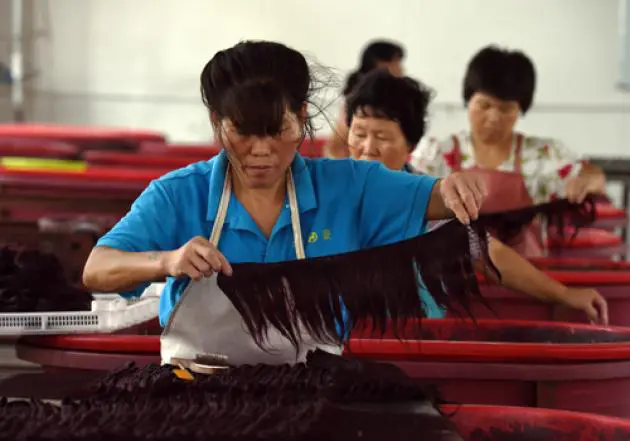
In the factory the hair is first disinfected in two huge barrels before workers use paddles to stir clumps of strands in vats of steaming water. It’s dyed in colours from blonde to black – via red and purple – before being dried in ovens, brushed and sewn into hair extensions by the mostly female staff.
“I thread parts together – in a day I can do 1,500,” says Zhang Qing, 23, as she feeds bunches of hair into a clattering sewing machine.
Zhang Hongmei’s low stool is surrounded by piles of dyed red hair that she straightens with a large brush. Like most in the factory, she used to be a labourer in the fields. “If I wasn’t here I’d be working on the farm, but this work is less tiring and earns more money,” she says.
Hair-product manufacturing is “by far the biggest industry” in Taihe, says the younger Fu, and now local authorities plan to create a huge industrial park devoted entirely to the sector.
Fu recalls growing up in the 1980s, “when we would be happy if we had rice rather than corn”. Now he employs more than 200 full-time staff and escorts foreign clients to dinners at pricey local restaurants in an imported car.
“I owe my income to the hair industry,” he says. “Because the value of hair is so high, people call it black gold.”
