
Heavens above and below


Tokyo's new TeNQ space museum is only the latest in a string of starry-eyed facilities you can visit
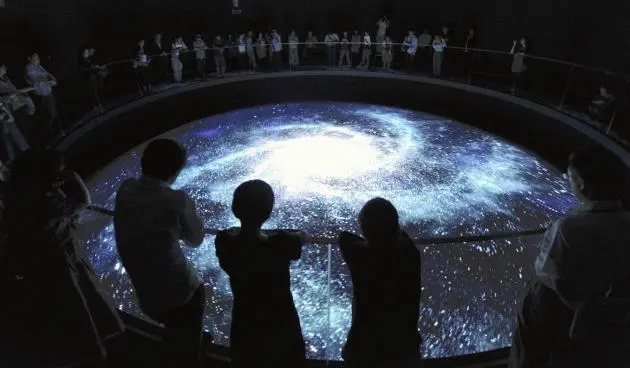
BELOW THE VISITORS swirl heavenly bodies and other spectacular images of space, projected on a circular screen 11 metres in diameter. The screen shows breathtaking views of the starry night sky in Hawaii and beautiful computer-generated images of the solar system and the Milky Way.
Photos of Earth shot from the International Space Station make our planet appear glittering like a blue gem floating in the universe.
The 10-minute movie is one of the highlights at TeNQ, a space museum that opened last month inside the Tokyo Dome City entertainment complex in Tokyo’s Bunkyo Ward. It’s screened at Theatre Sora inside the museum.
Various meanings can be discerned within the museum’s name. For example, the Japanese word ten means “the heavens” as well as “an exhibition”. The letter Q comes from the English word “quest” as well as from the similarly pronounced kyu, which means “exploration” or “study”. Thus the name suggests that visitors can learn about the latest findings about space.
Another highlight is the Science corner, where data such as the characteristics of the solar system and the latest results from space exploration are comprehensively explained using displays and panels.
One such example is reports from probes exploring planets and other satellites within the solar system. More than 170 probes are observing at least 70 heavenly bodies and sending back data. Visitors can view the latest images of the surface of Mars, transmitted by America’s Mars Odyssey now orbiting the Red Planet.
There is an achievement report from the Japanese space probe Hayabusa, the world’s first probe vehicle to fetch rock samples from an asteroid. You can learn what the particles told about the mysterious Itokawa – how it was formed, for example. It’s now believed to be made of debris from a bigger asteroid that was somehow destroyed.
“To continue work with planetary probes, it’s important that people understand their significance,” says Hideaki Miyamoto, an associate professor at the University of Tokyo’s own museum, which mounts these displays. “I hope visitors can truly experience science through the exhibits.”
The brightly lit, glass-enclosed Research Centre, the university museum’s satellite office at TeNQ, is a full-scale lab complete with a meteorite analyser. Specialists in planetary science, including Miyamoto, examine data from space probes and discuss the next explorations, all seen by visitors outside the room.
Miyamoto is asked whether he feels self-conscious being watched. “I do in some way, but I’d be glad if children saw us and think they could be researchers, too.”
Schoolchildren can easily find an appropriate topic for their school summer study projects. Miyamoto recommends finding out how many planetary probes there are at the moment and what they’re doing.
As for Japanese probes, Hayabusa II is scheduled for launch this winter. Which planet is Hayabusa II heading for? What type of research will it conduct?
Another research topic recommended by Miyamoto is comparing astronomical objects in the solar system. There are not only the sun and planets, but also much smaller asteroids worth studying.
“There are surprisingly few diagrams showing astronomical bodies on the scale of 1:30 million to 1:40 million on one sheet,” he says. “It would be interesting to make your own diagram, adding information like the size of each object and the appearance of its surface, as well as information on space probes that have visited the object.”
If you are interested in learning about Japanese space development, the best place to go is the Japan Aerospace Exploration Agency (Jaxa). At its space centre in Tsukuba, in Ibaraki Prefecture, rockets and man-made satellites are on public display. There is currently an exhibition on the history and mechanisms of rockets.
Visitors are also welcome at the National Astronomical Observatory of Japan in Tokyo’s Mitaka district. A meteorite found in Antarctica is on view at the National Institute of Polar Research in Tachikawa, Tokyo, while the planetarium dome at the City Science Museum in Nagoya is the largest in the world, 35 metres in diameter.
At Nishi-Harima Astronomical Observatory in Sayo, Hyogo Prefecture, which boasts the country’s largest reflector telescope, Nayuta, with a diameter of two metres, stargazing parties are held every night.
WE HAVE LIFT OFF
TeNQ is on the sixth floor of the Yellow Building in Tokyo Dome City.
The museum is open from 11am to 9pm from Monday to Friday and 10am to 9pm on Saturday and Sunday.
Admission is 1,800 yen (Bt560), less for seniors, students and children.
For further details, see www.Tokyo-Dome.co.jp/tenq.
