
Our friend the robot


Play
A robotics developer has a possible solution for providing round-the-clock care for the world's ever-greying population
When Chalermpon Punnotok started his robot development business six years ago, fellow academics, businessmen and friends thought he was crazy.
“What on earth are you thinking?” they asked. “Surely you realise you can’t compete with Japan.”
Today the chief executive of CT Asia Robotics is enjoying the last laugh.
“Still think I can’t do it?” he asks the lecturers, engineering students and reporters attending a recent press conference hosted by the Faculty of Engineering at King Mongkut Institute of Technology Ladkrabang (KMITL) to introduce its own Robotic Research Centre. CT will be working closely with the new facility in exploring and developing the building of robots for commercial use.
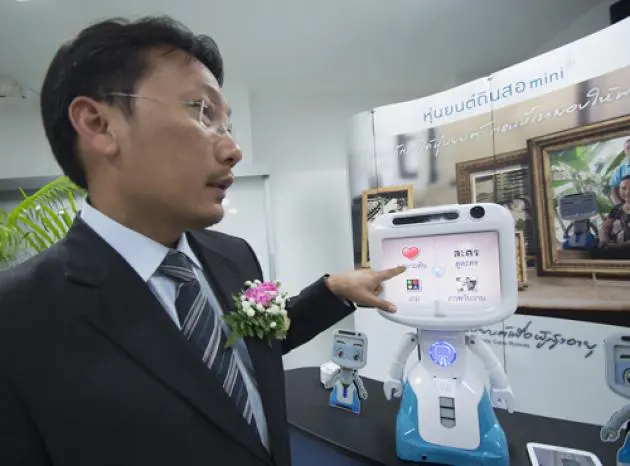
Chalermpon’s third-generation version of his robot Dinsow – the Thai word for “pencil” – is designed to care for the elderly.
Dinsow serves as a nurse assistant. It has a panic button on its head, which can be pressed to call for an ambulance as well as alert the patient’s caregivers of trouble.
Throughout its six years in development, Dinsow’s artificial intelligence has been constantly upgraded and now includes a movement detector that announces a fall or, conversely, if its user hasn’t moved for a long time. The alarm goes to family and caregivers by way of a smartphone app.
Chalermpon says that the function is a big help to old folks who live alone, something he was reminded of recently when a man told him that if Dinsow had been with his father five years ago, he might not be paralysed today. The elderly man was left helpless on the floor for more than five hours before he was discovered, by which time it was too late to help.
“We also try to simplify the technology so the robot is easy to use and to interact with, especially for the elderly who tend not to like hi-tech gadgets,” Chalermpon says.
Dinsow looks friendly, with the screen displaying a smiling face. Users can also use the robot’s computer screen to play games or have video conferences.
Research and development costs for Dinsow were less than Bt100 million, which is relatively low and far less expensive than in Japan, Chalermpon says. Now, with the academic support of KMITL, work will focus on making Dinsow intuitive.
“We’re not after a smart machine for the home but a friendly gadget that can make the elderly laugh and also look after them,” he says. “Thailand is greying and we now have about 8 million elderly people. We hope that Dinsow will help to take care of them,” says Chalermpon.
Dinsow, which stands 1.2 metres, has a little brother called Dinsow Mini. He’s about half the size, standing 52 centimetres, and isn’t moveable like his bigger sibling. While the original Dinsow was designed for hospitals and elderly care, the Dinsow Mini is more of a desktop robot and can be leased for about Bt9,000 per month. Relatives can hire the Mini to oversee their parents while they are alone at home.
Some Dinsows are already providing services at Kluaynamthai Hospital’s Elderly Care Department and at a hospital at Tokyo. These are part of a pilot project that will provide feedback on the needs and demands of the elderly so that more functions can be programmed in the next generation.
The company has already decided to focus solely on Dinsow rather than invent new robots.
“I don’t want to come up with a lot of things that are good for nothing,” Chalermpon explains.
Dinsow has also shown his skills as a waiter. Ten of the first-generation robots were purchased by the MK suki chain to bring food to tables, and 14 of the latest-generation models were recently shipped to Sweden where they are on duty at an Asian Taste restaurant.
Over the past decade or so, Thailand has hosted a number of robotics competitions with participants coming from secondary schools, colleges and universities. Thai teams have also taken part in overseas competitions, bringing home trophies. However, most of the winners end up working overseas.
“Some are recruited to work with robot companies in Germany and Japan,” says Chalermpon. “I find it ironic that they worked so hard to beat their competitors from other countries only to accept jobs from them once they graduated. I asked myself ‘why we didn’t build our own robot commercially?’”
Kant Weerakant, manager of the Innovation Strategy Department at the National Innovation Agency, adds that Thailand has very few businesses working on developing innovatory products because of the amount of research and development involved.
“Many people start but give up after just a short while,” Kant says.
He adds that the trend is slowly changing and more investment is going into tech start-ups as commercial concerns realise that it is the only way to survive in a highly competitive world.
For his part, Chalermpon points out that the new collaboration between CT Robotics and KMITL follows the model of big companies like Mitsubishi and Sumimoto, which work closely with universities and institutions with support from the government.
“It’s the only direction to take. It connects academic knowledge with commercial savoir faire and brings benefits to the country in economic terms, and that’s much better than relying on outsourcing or exporting natural resources,” he says.
On the Web:
www.CTAsiaRobotics.com
