
More than just a place to read


Play
Two libraries in the northern part of the country have become community centres for villagers
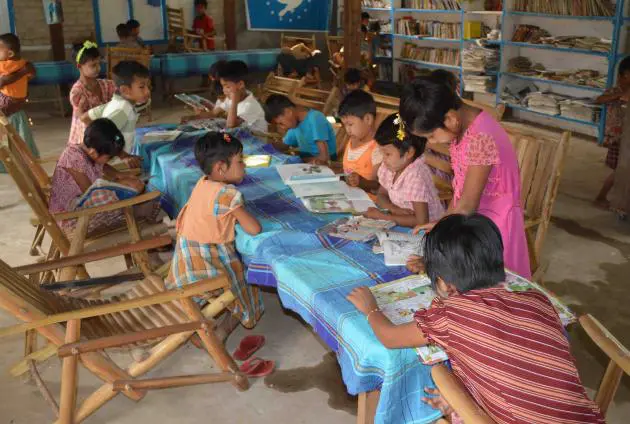
In Tha Bye Aye, about 50 kilometres northwest of Monywa in Sagaing Region, a library has changed the life of every villager.
Initiated by Ashin Sopaka – a monk who was arrested in Mandalay in 2011 and confined in his home village for public speeches he had made – the Peace Library has transformed the community, as the monk has been able to use the library to provide electricity for most of the village.
Through donations from German supporters, photovoltaic panels have been installed on the library’s roof, allowing electricity to be generated and stored in batteries, then distributed to households to power lights and appliances. In the village where people earn a living by growing a variety of crops, such as legumes and vegetables, residents were previously reliant on candles in the evenings.
The library itself has around 2,700 books, primarily in the Myanmar language, enough for the 1,080 or so people from the village’s 190 homes.
Graphic novels and other illustrated materials are particularly popular with younger readers, who are eager to use the library as a place to “hang out” and read. The library also provides the village with its first access to newspapers and journals.
Poor roads between the village and Monywa mean that sometimes the papers are a couple of days late, but through the library’s efforts they do arrive. Its space also provides a community meeting place, and it serves as a training centre. Seven computers have been donated and are powered by the solar electric system. Ashin Sopaka uses these to provide computer training to youths. In addition, basic English language lessons are provided. These courses are very popular – more than 120 students aged 10–15 have enrolled in them so far.
One villager spends a lot of time reading at the library. To Ashin Sopaka, it was almost worth building the library just for him. He had previously struggled with alcoholism but has stopped drinking and become addicted to reading instead.
“Some surrounding villages have seen what we have done here and are keen for their youth to have similar opportunities,” Ashin Sopaka wrote in an article for the Burma Study Centre Newsletter.
Clerical work is undertaken by a few young women of the village who refuse Ashin Sopaka’s offer of pay – they want to volunteer so that more resources for the library can be purchased. They are in charge of book and paper binding, as well as circulation and record-keeping. As yet, no formal catalogue system has been set up, but materials are on open access and patrons seem happy to browse.
“We have begun to offer training to other villages and are encouraging monks in other villages to undertake similar projects. The future vision for the library is that it will offer not only education, but also health functions, with the hope that a small health clinic can be set up to assist the villagers,” the monk says,
The Peace Library is now a member of the Burma Study Centre network, an organisation devoted to development in Myanmar. In February 2013, it also opened the Green Library in Hsipaw, Shan State.
There, basic English and environmental conservation classes are offered to more than 30 students. It will be expanded to computer training capacity and local environmental awareness-raising activities.
On June 8, the villagers commemorated World Environment Day. In partnership with the Gaihahita Youth Environmental Network in Yangon, the students planted more than 150 trees and shared information about sustainable living with locals. Seventeen young people joined the scheme to plant 30 trees in five different villages.
“This activity was the first of its kind in our area. We hope this activity will be the seed for the villagers to understand the value of trees and our natural environment,” Thum Ai, the library manager, writes in her article in the newsletter.
The library recently welcomed a French lecturer.
“As it is very rare to have Western lecturers or experts join us in Shan State, our event helped our attendees understand the big picture of our own country’s situation. There were many questions from our attendees about democracy in France, minority rights, and social welfare. In the future, we hope we will have more visitors to share their knowledge, experiences, and insights at our library again,” Thum Ai says.
