
FAREWELL to the prince of prints


Tears well again for the loss of another national artist, this time Prayat Pongdam
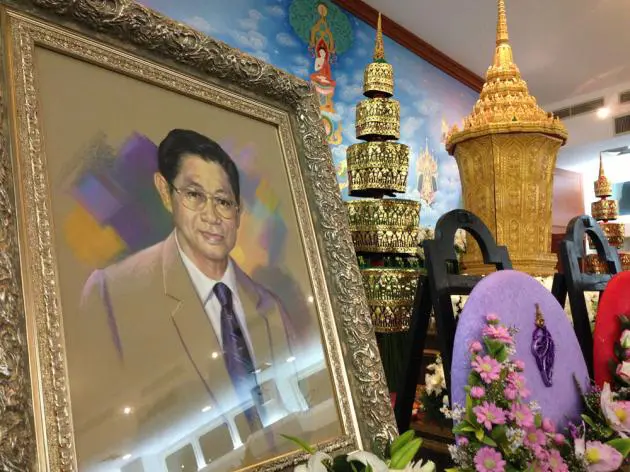
A PORTRAIT OF National Artist Prayat Pongdam, clad in a gold-hued business suit, is on display in front of the gilded coffin presented by His Majesty the King for his funeral this week at Wat Thepsirin.
The painting is by Panya Petchoo, a master of portraits and a lecturer at the Poh Chang Art Institute. He completed it soon after hearing that Prayat had died last Friday from heart failure.
Surviving Prayat, who would have turned 80 on October 28, are his wife and three sons.
The funeral on Tuesday night, held under the patronage of Her Royal Highness Princess Maha Chakri Sirindhorn, drew a substantial gathering of friends, relatives, fellow artists and students. It was a virtual “reunion” of alumni from Silpakorn University, where Prayat studied under Silpa Bhirasri, the university’s founder and the man regarded as “the father of Thai modern art”.
One of the country’s pioneer printmakers, Prayat was one of six artists chosen to illustrate His Majesty’s book “Mahajanaka”. His stylised rooster, owl and mother with child have appeared on postage stamps.
Prayat had been present last week for the cremation of another National Artist, Thawan Duchanee, at the same temple where his own funeral would be held. They were close friends.
“After Thawan passed away we never heard our father laugh,” his daughter-in-law Sumontra Pongdam said. “But he never stopped creating art.” Prayat was just finishing a 2.4-by-two-metre woodblock depicting a lotus and bodhi tree when he died.
“He started on it just a few months ago,” his younger son Saksayam told The Nation. “It’s a huge woodblock depicting a tranquil landscape. He painted over top of it and was in the process of applying gold leaf to some areas.”
Saksayam, who assisted his father in making prints since childhood, will finish applying the gold leaf and the work will then go on view at the artist’s museum, Palazzo Pavone in Nakhon Ratchasima. “He was at work on more than a dozen other things,” Saksayam said. “One he just finished in August shows cocks fighting.”
The new pieces remain at Prayat’s home-studio in Thonburi’s Bangkhae district and had begun already drawing the interest of Thai art collectors. To begin with, at least, they’ll be hung at Palazzo Pavone, the museum in the Northeast that his architect son Sayompoo designed.
“Ajarn finally got to open the museum to the public, with no admission charge,” Prayat’s widow Prapasri told The Nation, referring respectfully to her husband as “teacher”. “He wanted to educate the younger generation and spend his retirement there, showing them how to make art.”
Prayat gave the news media a tour of the formerly private museum when it opened to the public last March 15. “I’ve been a teacher all my life,” he said. “My students visit me even now that I’ve retired.”
Prayat was born in 1934 in Sing Buri province and earned his bachelor’s degree in visual arts at Silpakorn University in 1957. Five years later he had a diploma from the Accademia di Belle Arti de Roma in Italy and later also accepted an honorary degree from the Accademia delle Arti del Disegno in Florence.
On his return from Europe and until his retirement in the mid-1990s, Prayat taught at Silpakorn, thereafter serving as frequent guest lecturer. His recognition as a National Artist came in 1998, a tribute to his printmaking mastery.
“We regret losing one of our great National Artists,” Chai Nakornchai, director of the Culture Ministry’s Cultural Promotion Department, said at the funeral. “Professor Prayat devoted himself to the Thai art scene.” The department will contribute Bt20,000 from its National Artist Fund toward the cost of the funeral rites and spend another Bt150,000 to produce books on Prayat’s work.
Silpa Bhirasri had a motto that is always evoked on such occasions, never losing its resonance. “Ars longa, vita brevis,” goes the Latin proverb. “Art is long, life is short.”
FURTHER GLIMPSES
- Funeral rites end today at 7pm. Royal cremation will follow in 100 days.
- Most of Prayat’s art is on display at his private museum, the Palazzo Pavone, in Nakhon Ratchasima’s Pak Chong district. Find out more at Facebook/SayompooPongdam
- Prayat’s art, as well as works by Thawan Duchanee. is also featured at the Museum of Contemporary Art. Call (02) 953 10057 or visit www.MoCABangkok.com.
- The Department of Cultural Promotion is updating its exhibition on Thawan at the Supreme Artist Hall on Pathum Thani’s Klong 5. It’s open daily except Monday from 9.30 to 4. Call (02) 986 5020-4 or see Facebook.com/artist.hall.
