
Treating illnesses, both suspected and unexpected


Play
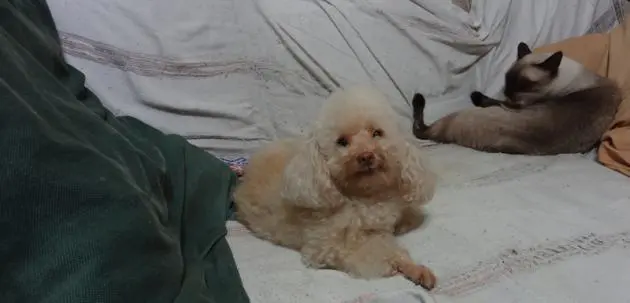
Manohra and Wan-Wan learn to take their medicine
PERHAPS I’M over-protective, but when one of my animals looks sick or uncomfortable, I wait a few days, and then take him or her in for a check-up. Sometimes, we find something wrong. Sometimes, we don’t.
Because Wan-Wan, my poodle pup, often suffers from bladder infections, I watch her carefully. When her urine begins to darken, when she doesn’t urinate as often as usual, I begin to worry.
My vet usually performs an easy check on her. If Wan shows any pain when her abdomen is gently pressed, then we can suspect an infection.
Here’s the problem. Wan loves going to the vet’s. At the clinic, vets, assistants, and owners of other animals all reach out to her, playing with her, petting her and telling her how cute she is.
By the time the vet presses her little belly, Wan is too busy kissing her face to pay much attention to what’s going on.
“Laurie,” says my vet, “Wan is acting like a perfectly healthy dog.
What can I say? Wan is an active little dog with her usual happy personality.
Last year, when Wan began showing all sorts of discomfort, my vet, after checking her entire body, decided to arrange for her to have an ultrasound.
In veterinary medicine, the ultrasound can show what an X-ray cannot, any soft tissue and tendon problems. It can even indicate possible infection.
Wan had her ultrasound, and the vet didn’t find any problem – except a tiny kidney stone and an unusually large presence of fat around her liver. She was not yet in danger, but he recommended another ultrasound the following year.
A few weeks ago, Wan had her second ultrasound. Her little belly was shaved, the vet performed the ultrasound. The results were distressing.
The small kidney stone is still the same size, but she has more of that fat around her liver.
The vet recommended another ultrasound in three months. He also phoned my vet to ask, “How can a dog with health problems like this be so friendly and active?”
The ultrasound also shows a possible infection. Wan has to have a urine test to find out where it is and what kind of antibiotic to take.
At the same time, I send the kitten Manohra for a urine test too. The hormone shot that the Wild Child had last month has made her gentler and friendlier, but she still continues to urinate all over the place.
I’ve assumed that the urination is probably Manohra’s instinct to claim territory, but it’s always better to make sure.
The results show that the Wild Child does have an infection, and because she’s been urinating everywhere for so many months, she must have had the infection for a long time. That infection has made it too painful to urinate. She holds the urine, but then, the pressure forces her to let it out, wherever she is.
Her infection is now chronic, as is Wan’s. The two girls have to take antibiotics for at least 20 days.
Wan’s antibiotic is a liquid, which she takes twice a day through a syringe, and she enjoys it. Manohra’s is a pill once a day, and from Day One, it’s been a real struggle to make her swallow it. Her little body is so flexible that it’s difficult to hold her.
Finally, I crush it and mix it with a vitamin gel, which is much easier to shove into her mouth.
The trick is to catch her. The Wild Child knows precisely when medicine is in her immediate future and disappears.
Sometimes it’s difficult to know when to test for illness – and even more difficult to solve the problem afterwards.
