
A tiny turtle fights pollution!


Play
Fumes from passing motorbikes as well as from house renovations affect the health of the household's young generation of Indian roffed turtles
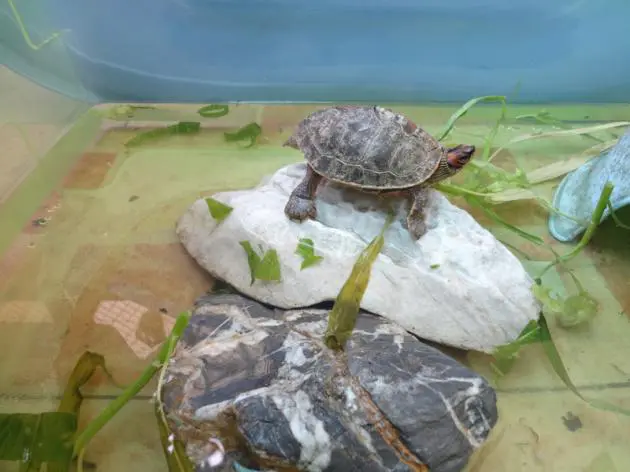
As I look into the tub of young turtles, my heart falls. Among the eight pretty creatures, three or four are on their basking rock. When they see me, they jump into the water – all of them, except one.
This one watches me but doesn’t move. I can see that his shell is extremely dry, as if he hasn’t been in the water for hours.
At first, I’m not too concerned. This species of turtle – Indian roofed turtles – loves to bask. It’s a real treat to watch them as they lie on their stomachs, stretching their front and back legs out to enjoy the sun’s rays.
The little turtles are real charmers. They’re quite small. The boys don’t reach beyond seven cms in length, and the girls around 10 cms. Their colourful markings – their striped necks and round eyes – make me think of a Walt Disney cartoon.
They’re omnivorous. Mine eat vegetables, red worms and sometimes a bit of shrimp.
They do like to wander, jumping out of their tubs to check out their surroundings and sometimes even bouncing down the stairs. I’ve even caught some of them climbing up vines and bushes, apparently looking for other escape routes.
Articles on the internet indicate that these turtles are difficult to breed, but I haven’t found them so. They do enjoy sex, so much so that I’ve separated the boys from the girls: birth control the natural way. There’s just no room for more turtles in my house.
I’m beginning to wonder about the offspring, though. The first few generations have grown up strong and healthy, but the last few don’t seem to be thriving.
They remain quite small, compared to their older siblings. Usually, after the first few months, juvenile turtles are ready for the world, but just a few months ago, one of the young turtles from the tub downstairs stopped going into the water and gradually died.
Now I see another from the same generation showing the same behaviour. I watch for a few days, but the kid is spending more and more time out of the water.
These turtles, like most water turtles, usually eat food that’s in the water, not on land. If he doesn’t go into the water, he’ll starve.
I try to think of how these younger turtles are different from the older ones. Could there be some kind of inbreeding going on? It’s possible. Apart from the oldest, I really can’t tell the difference between individuals, and mothers may have been mating with sons, fathers with daughters.
What about the location of the tubs? The older, healthier turtles are on the second-floor patio, while the younger ones are on the ground floor, in a huge tub in a corner against the gate nearest the soi.
“It could be pollution,” I think in horror. These kids are hit by emissions from any passing car or motorcycle. With renovations continuing on neighbouring houses in our soi, this tub is also the first in the patio to receive any dust or paint fumes.
The water in the tub looks clean, but I can’t be sure. I immediately move the suffering turtle to the second floor and place him in his own small tub. I change his water every day.
As for the big tub on the first floor, I’m changing the water three times a week, instead of the usual one time.
Already I’m seeing changes. The sick turtle is paddling in the water, eating a little bit.
It’s still early in the treatment programme, but I have hope.
Businessmen tell me that the three keys to success for a hotel or restaurant are: location, location and location.
Perhaps it’s the same for turtles.
