
Dreaming with the fingers
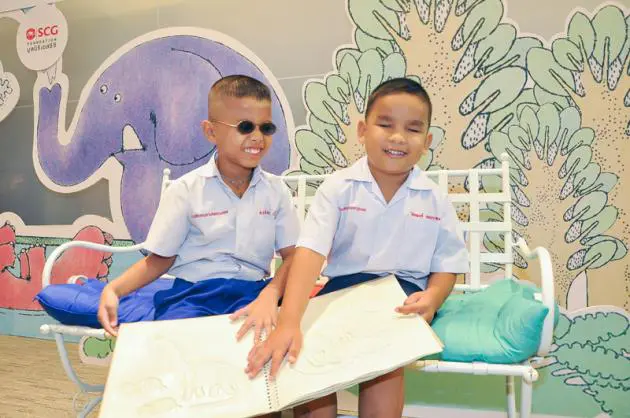


The SCG Foundation launches a second Braille and tactile picture book for visually impaired youngsters
Southeast Asia has long trailed behind the West in providing education for blind children despite the innumerable studies that show how well visually impaired youngsters respond to an ordinary learning environment.
Thongyoi Chengthong, who has been teaching blind children here for 17 years, is only too well aware of the difficulties imposed by society. “The physical impairment is not an obstacle to the development of these kids,” she says. “It’s the lack of proper teaching materials and equipment like books that causes the problems.”
Now thanks to the SCG Foundation, blind kids can enjoy picture books every bit as much as sighted children. For the last decade, the Foundation’s “Bring Good Books to Thai Children Project” has been promoting early reading by arranging for the translation into Thai of five internationally acclaimed picture books every year and last year expanded the programme by bringing a Braille edition into the mix.
The first title to hit library shelves was “Deung Deung Deung Deung” by renowned children’s author Cheewan Visasa.
Cheewan recently launched his second picture book for blind children. Titled “Two Turtles Who Are Not Afraid of Dinosaurs” it’s available in two editions: the first of which uses the traditional embossed paper and the second, developed by Thongyoi herself, a special silk-screen embossed technique.
“Last year’s experience taught me that ‘Deung’ was a little complicated and had too many details for blind children. For example, the lead character has a face, hands, feet and tail yet none of the youngsters were able to identify what kind of animal it is,” Cheewan explains.
“This year’s book is simpler. It is an adventure story about two turtles who come across different types of dinosaurs. I have made one turtle completely blind – he has no eyes – while the other is visually impaired with just one eye. The dinosaurs on the other hand have excellent eyesight and represent sighted kids.”
“When I went to observe blind children at school, I was amazed at how much they enjoyed walking around and demonstrated no worry about hitting something. They are like turtles with a shell for protection. So my story is about two determined turtles who don’t become discouraged by obstacles but press on until they meet their goal – in this case, finding their mother. The dinosaurs are interesting too. They have unique features like a long neck, huge body and sharp teeth,” Cheewan adds.
Because children learn through interaction with the people who raise them and through their environment by watching, listening and touching, storytelling and reading can stimulate the development capacity of their young brains. A tale often ends with a life lesson, encouraging children to think and develop learning skills that will stay with them for life. A picture book is a simple, affordable and efficient tool to help develop intellect, imagination, emotional quotient and ethical behaviour. It is also a way of augmenting love and warmth in the family.
“The picture book is a precious form of entertainment for young children. Just 10 to 15 minutes of reading each day helps children to learn and to concentrate,” says Achara Pradit, a specialist in children’s literature attached to Srinakharinwirot University.
“Picture books do more than spell out words in the Braille alphabet; they also fascinate young minds through drawings,” Thongyoi adds.
“They open the world not only to sighted children but to visually-impaired kids too. Just think how tired your eyes get reading page after page of text. Blind kids have to read textbooks with their fingers every day and that too is tiring. Exploring a long-necked dinosaur with the hands is exciting and also promotes curiosity, which in turn leads to communication. ‘How long is it?’ they ask. “Long like your little finger,” I reply, and this opens the door to other learning activities like science,” Thongyoi explains.
“When the first book came out last year, one of my students, a child who rarely speaks, suddenly raised her hand and asked a question. She’d connected with the drawing and since then has been far more curious. Now she’s much more ready to learn,” Thongyoi says.
“For kids who suffer from severe visual impairment and will go blind in the next 5 or 10 years, there’s something very special about large-format picture books in bright colours. The images and the story form an imprint on their minds that will stay in their memories long after they can no longer see.”
Five hundred copies of the new dinosaur story in Braille are to be printed and handed to libraries and schools for blind students nationwide.
Visually challenged youngster Chaiyapong Saipratum, 6, and Thitikorn Neungkham, 8, say they love reading picture books. “It’s so enjoyable,” says Chaiyapong. “There are four types of dinosaurs and I can remember all of the names.”
Thitikorn reads his copy every day bur says he never gets bored.
“My message to the parents of these visually-impaired children is ‘don’t be discouraged’. As a teacher, I always ask myself what can I do to make blind children learn like sighted children. If we try and treat them differently, they run the risk of becoming objects, not people. Just because they can’t see doesn’t mean they are lacking in inspiration. They understand feelings and emotions perfectly well but they do it not by looking but through listening and other skills. So be patient. All the knowledge we impart to these youngsters will be beneficial and that’s what counts,” Thongyoi concludes.
Between the lines
>>> The picture books are available at leading bookstores and buyers are encouraged to make a donation to “Bring Good Books to Thai Children Fund”.
>>> All proceeds from the sale of the book will be used by the SCG Foundation to support needy children nationwide.
>>> The schedule for this winter’s “Story telling in the Park” activity will be announced soon.
>>> This year’s picture books are “The Elephant Happy” by Hirotaka Nakano, translated by Marina Kobayashi, “The Apple and the Butterfly” by Iela and Enzo Mari, “The Runaway Bunny” by Margaret Wise Brown, illustrated by Clement Gazzam Hurd and translated by “Satita Songwittaya, “The Cat Buys Turnips” by Cheewan Visasa, and in Braille, Two Turtles Who Are Not Afraid of Dinosaurs”, also by Cheewan Visasa.
>>> Find out more from the SCG Foundation at (02) 586 2547, e-mail [email protected] or visit www.SCGFoundation.org and Facebook/SCGFoundation.ECD
