
Out with cars, in with cycles


Play
A new network sets out to turn the country's students into avid bikers
Two decades ago university students in Bangkok and other major towns in Thailand would inevitably use their pushbikes to get around campus but in recent years the mighty motor has taken over, with the majority of students arriving in cars, taxis or on motorbikes.
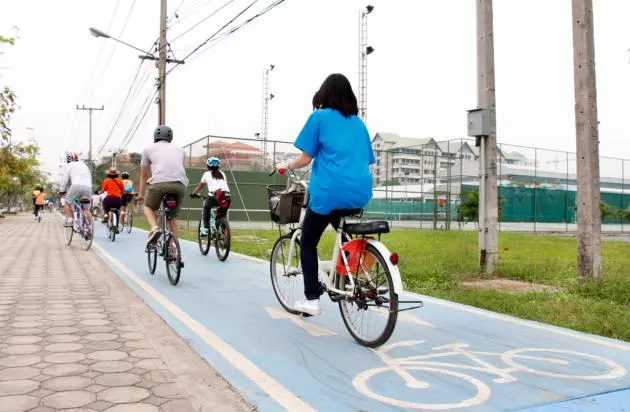
Now a new project is aiming to bring back the humble bicycle as a viable and sustainable means of student transport. Dubbed Active Campus Network, it’s the brainchild of A Day magazine and Coca-Cola Thailand and is being launched on 12 campuses.
Active Campus Network’s mission is to develop the bicycling culture across all university campuses and encourage students nationwide to switch from horsepower to pedal power.
“Bicycles and campuses go together,” says Dr Navin “Tar” Yaowapolkul, a singer, actor and lecturer at Kasetsart University, which is taking part in the scheme.
Other universities in the network are Chulalongkorn, Chiang Mai, Thammasat, Silpakorn, Mahidol, Maha Sarakham, Songkhla Nakarin, Muban Chom Bueng Rajabhat and King Mongkut’s Tech in North Bangkok, Thon Buri and Lat Krabang.
“Bikes used to be necessary as students had to travel a long way from their dormitories to the various buildings on campus. Kasetsart was once considered a bicycle-friendly university with more than 1,000 bikes on campus. That number has been steadily decreasing for the past five or six years and we are seeing a larger number of private cars and motorbikes. That’s not good either for student health or the traffic, so we are working hard to bring the cycling culture back to life.”
“Lifestyles have changed,” adds Surapont Toomnark, a lecturer in computer engineering at King Mongkut’s University of Technology Thon Buri.
“Today, the bicycle is regarded as a tool for exercise, tourism and even student projects. Here on campus, we have volunteer-minded students offering free rides both on pedal bikes and motorbikes from the main gate to the buildings. We also offer showers, safe parking and surveillance cameras.”
Nuntivat Thamhatai, public affairs and communications manager of Coca-Cola Thailand, says the network’s aim is to spread to communities outside the campus.
“In the past five years, we’ve looked closely at the cycling trend and seen that many more people are taking to two wheels. We started the project by organising a cycle activity on the Mahidol University’s Salaya campus and followed up with similar campaigns at Thammasat University Rangsit and Dhonburi Rajabhat University. Now, we are expanding to more universities and communities,” he says.
Also pushing hard for increased pedal power is Zcongklod Bangyikhan, A Day magazine’s editor-in-chief.
“Through the network, students will acquire more knowledge about bikes. We are organising workshops by professional cyclists and cooperating with the Bangkok Metropolitan Administration for a session on bike law. We want these youngsters to learn how to be good cyclists. We intend evaluating the project at all participating universities after one year and looking hard at the results,” he says.
The project’s website offers news about upcoming trips and workshops, along with statistics on the number of students riding bikes, distances covered and calories burned.
Navin is pleased with the feedback. “It’s good that we have this project and now we need to focus on providing complementary services. We appreciate that riding a bike in a tropical climate is much harder work than sitting in an air-conditioned car, so we also need to provide showers, dressing rooms and lockers. To me the best indicator of a highly developed society is not the poor being able to purchase a car but the rich happily turning to use bicycles and public transport,” he says.
Actress Arunnapa “Wan Wan” Panichjaroon, who came fifth in the recent Hua Hin International Triathlon, and author Sean Jindachot were among the celebrities who turned out to Siam Center for the Active Campus Network launch.
“I started riding a bike in my fourth year of university. Back then, I used to enjoy heading out of Bangkok to cycle in Pattaya, Rayong and Khao Yai,” Wan Wan says. “Today I see many more women cycling around town. Skin care firms have responded by adding new sunblock products to their ranges and there are more accessories than ever before, including arm warmers and long trousers to prevent sunburn. Biking helps our axial skeleton to be stronger and builds the muscles. I find it very relaxing,” she adds.
Sean rode while a student at Thammasat University’s Rangsit campus. “We had an activity called ‘Tour Rangsit’ which saw the freshmen being woken around 3am by seniors for a tour of the university buildings,” he recalls. “It was a great way of making new friends. Today, I ride whenever I can. What’s really good about cycling is that there is no age limit – anyone can do it.”
Cycling to and around campus is undoubtedly a fun, practical and productive way of making exercise a regular part of student life but does the network have any loftier goals?
“We would like students to work together to make the cycling culture a permanent fixture of campus life as well as promoting it in the surrounding communities, Nuntivat says. “We expect to attract 8,000 people a year to be part of our network.”
On the Web:
ActiveCampusNetwork.org
