
Movements for the mind


Play
Butoh fever brings the curtain down on Bangkok's stage season
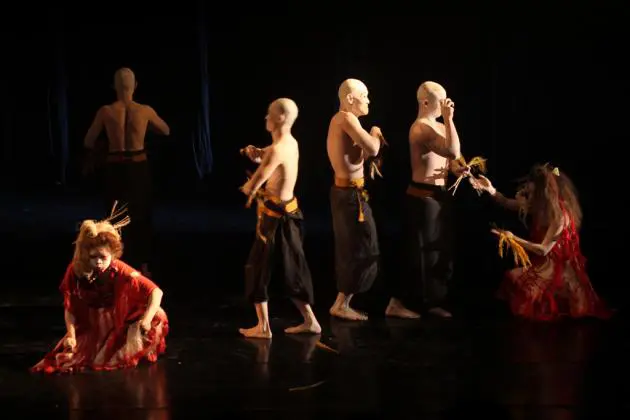
The Bangkok Art and Culture Centre’s third Performative Arts Festival comes to a close this month with Butoh Fever: The Ninth International Butoh Festival Thailand. While contemporary Thai dance and theatre remain off the radar, at least in the eyes of many international performing-arts lovers, there is always surprise that Bangkok has been holding an international butoh festival for almost a decade and is showing no signs of slowing down.
Terry Hatfield, director of the Butoh Co-Op Thailand, reintroduces this form of Japanese dance theatre to us, saying, “During the cultural revolution of the 1960s, many artists were experimenting with ideas similar to that of butoh’s worldwide. Tatsumi Hijikata gave it the name butoh and people recognised it as an art form with a particular style. Artists began to emulate this style as a method to create works.
“Worldwide butoh and butoh influences are drifting into other art forms like film, photography, poetry, and music,” he continues. “However, those influences have not been connected to the origins of butoh. Butoh is being used as a type of dance therapy in some places because it triggers forgotten memories and allows artists and audience to release suppressed emotions. Butoh is in a constant state of metamorphosis.”
As for the International Butoh Festival Thailand, he says, “It’s based on a model that I worked with at the San Francisco Butoh Festival for nine years before relocating to Thailand. The original concept was to provide different styles of butoh and collaborate with Thai artists to build an international network of artists. Each year, there’s a different theme. For example, the focus of the first year’s festival was on first generation artists, meaning artists who practised directly with Hijikata and Kazuo Ohno, the founders of the art form. In the second year, we began to introduce second generation artists – those who practised with students of Hijikata and Ohno – to show the evolution of the art form. In last year’s festival, titled ‘Butoh Tua Mae’, we showcased women artists in butoh. This year’s festival is dedicated to Charlotta Ikeda, a butoh artist who passed away earlier this year.
“With workshops, performances, exhibitions, film and symposiums by a variety of artists who work in various styles, the festival presents a varied interpretation of how the art form differs in various cultures. However, there seems to be a universal element that translates to all cultures. In Thailand, I see more artists incorporating butoh techniques into their work. Thai artists have been able to work outside of Thailand due to their connections with the festival. There is much talent in Thailand, but it rarely gets seen outside the country. Butoh is an art form that adapts well to Thai culture and philosophy.”
With support from the Japan Foundation, Ray of Light Productions, British Columbia Arts Council and the Canada Council for the Arts, “Butoh Fever” is welcoming a host of foreign artists like Takita Takayuki from Japan; Salome Nieto of pataSola Dance (Mexico/Canada); Valeria Geremia of Sicula Butoh in Italy; Russia’s Valentin Tszin of Poema Theatre and Canada’s Paul Ibey. Thai artists are B-Floor Theatre and Butoh Co-op Thailand, who are also the co-organisers of the festival.
“I generally pick artists I’ve worked with before or have been referred by artists I’ve worked with in the past,” Hatfield explains. “The Butoh Festival is like a family reunion to me. It’s a unique community of artists who have the same vision of keeping butoh alive.”
One such artist is Teerawat Mulvilai, B-Floor’s artistic director, whose solo work “Satapana: Iceberg” was the biggest winner at the recent Bangkok Theatre Festival, garnering four awards. Teerawat staged “Rice Goddess and the Fields” to high acclaim at the Asian Performing Arts Festival in Tokyo last Friday and Saturday and is now back in Bangkok to stage the revival of “Sandan Ka”, the big winner with four awards at last year’s Bangkok Theatre Festival. The work was also invited to a festival in Mexico, but due to lack of travel support from our Culture Ministry, it couldn’t leave Thailand.
“Sandan Ka” was inspired by Anupong Chanthorn’s painting ‘Phikkhu Sandan Ka’ (‘Crow-natured Monks’) which, in a controversial move, won the gold medal at the 53rd National Exhibition of Art.
Last year I wrote, “In terms of physical movements, it’s highly influenced by butoh, but this was butoh that had been processed and adapted to fit the story as well as the Thai audience. The message was clear and poignant and the pace didn’t make anyone’s eyelids heavy, thanks to the roof-raising performance of the cast members as well as the set, costume, lighting and sound designs, which fitted well with the space and its limitations.”
And so I will not miss this second revival, not least because I am sure it will be considerably different from the last one.
Prescribed performances
_ Butoh Fever: The Ninth International Butoh Festival Thailand runs from Thursday to December 21 in the fourth-floor studio of the Bangkok Art and Culture Centre.
_ Performances are at 7pm on December 12 to 14 and December 18 to 20, with three different programmes. Tickets cost Bt600 each or Bt1,500 for all three.
_ Admission to each of the five workshops this weekend is Bt1,000 and Bt 4,000 for all five.
_ The photo and installation art exhibition starts December 9 and has no admission charge.
_ The “Rite of Passage” film screening and a Butoh jam with all artists and musicians on December 21 cost Bt200.
_ For details, call (085) 160 1677, e-mail [email protected] or search on Facebook for “The International Butoh Festival Thailand”.
