
From the grave to the Internet


Play
How technology is providing a new way to grieve
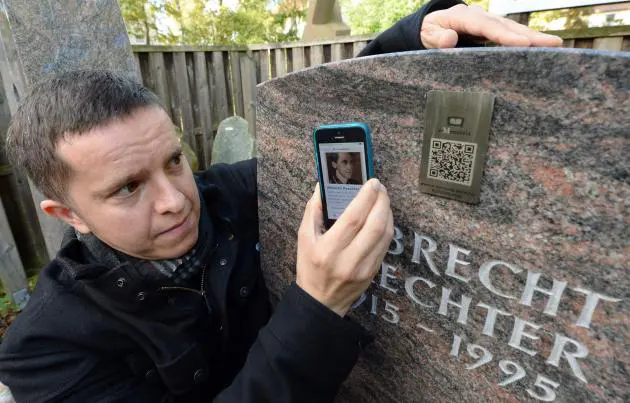
QR (Quick Response) codes, the black and white pattern of pixels that allow a smartphone to connect to a relevant website, are familiar from advertising, movie ticket and other products, but now they’re even appearing in graveyards.
The codes can be found on brass plaques or engraved on gravestones. Using a smartphone app to read the QR code, a visitor can get more information on the deceased than could ever fit on a gravestone. It’s even possible to express condolences via an online comments box.
The change is just arriving in Germany, where people spend heavily for tombs of the highest quality, and some people seem to worry it could lower the tone at cemeteries.
In a Berlin cemetery, a QR code can be found on the gravestone of an East German civil rights activist, Baerbel Bohley (1945-2010). Visitors who activate the code are directed to a website where they can see biographical information and a picture gallery.
Another example can be found at the grave of Anja Niedringhaus, a German war-zone news photographer shot dead in Afghanistan in April 2014. The code leads to the website she set up herself, maintained at the wish of her family.
Ultimately, it’s up to the dying people or their families – and not the authorities – to decide whether to use the technology, insists Volker Schirner, director of the parks, cemeteries and forestry office in Stuttgart, Germany.
Regulations that would ban QR codes as sacrilegious are not being considered, he says.
The city is currently examining to what extent the graves of prominent people interred in the past could be provided with QR codes in the interests of furthering knowledge. “We support that,” Schirner says.
Stuttgart undertaker Marc Ramsaier offers QR codes as a service, but acknowledges that the demand isn’t large so far.
“Tomb 2.0” will probably only prevail in time, but it fits the trend of grieving on the Internet via mourning and memorial pages. The development is progressing but slowly. To “light a candle” in memory on the Internet or to actually stand at a grave and remember are completely different things, says Ramsaier.
“One must always keep in mind that the bereaved come to us in an extremely stressful phase and in a short time face a lot of decisions, questions which as a rule they had not previously faced.”
Given that, QR codes are not generally a priority.
Nevertheless he has at the request of customers printed obituaries with QR codes. One can even use them to navigate to the grave.
How the content is maintained over the years is down to the relatives. There could even be a link to the dead person’s Facebook page.
For Oliver Wirthmann, chief executive of the German Funerary Culture Foundation, QR codes represent a significant change in the handling of grief.
He see such innovations as positive and not a threat to the dignity of cemeteries: “The sorrow needs a concrete place,” he says, adding that he believes such new trends and evolving forms of mourning will complement traditional ways of grieving.
