
Silk you can wear ANY DAY
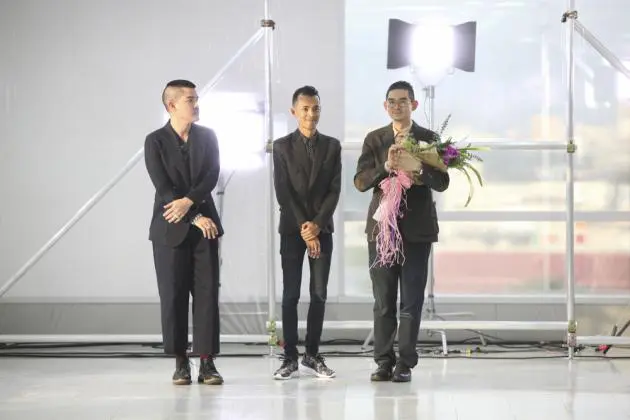


Three top designers come up with splendid ideas to bolster the industry in the culture ministry's "Weaving Dialogue" campaign
OFFERING FURTHER proof that silk deserves a place in everyone’s everyday wardrobe, a campaign called “Weaving Dialogue” gives the fabric a modern twist that promises to change people’s perceptions. This is not material for “old-fashioned clothes”, as the common stereotype would have us believe, and nor is it for just special occasions like weddings.
The Ministry of Culture’s Office of Contemporary Art and Culture (OCAC) and Srinakharinwirot University’s Centre for Academic Services have established the “Weaving Dialogue” to preserve and enhance this important part of Thai culture. It aims to “add value” to the silk industry by making people more aware of its significance and to foster new ideas that can benefit society and the national economy.
Fashion designers Platt Pladhi of Realistic Situation, T-ra Chantasawasdee of T-ra and Wisharawish Akarasantisook of Wisharawish have travelled to 22 destinations around the country scouting the textiles and craft techniques used locally and tapping weavers’ wisdom. Having formed a “knowledge pool” for coming generations of designers to utilise, they each then came up with an exquisite collection of clothes made with silk.
Platt’s “Realism” line primarily employs “native” weaves along with little-known crafting methods. His outfits take on androgynous forms thanks to remarkable tailoring and are lively with polka dots, stripes and geometric shapes, all simplified versions of motifs commonly found on hand-woven silk.
Platt is known for experimenting with textures and materials, and here his silk thread is woven alongside snakeskin, strips of leather and embroidered stones. It’s a subtle way of breathing new life into Thai silk.
“Silk should be used in daily life, just like any daywear,” he says. “It should be treated like any fabric, not necessarily work just for special occasions.”
In a runway presentation last week, Platt matched a while silk shirt with trousers in a nod to a typical worker’s uniform. The humdrum top is far more interesting when it bears the striped pattern of a traditional silk skirt, elegant yet cool. “This is something I’d like to achieve for Thai silk blends in everyday life,” he says. “It’s so easy to mix and match and to clean.”
Hilltribe clothing provided the inspiration for T-ra’s “Revival” collection, which uses material collected in Nakhon Ratchasima’s Pakthongchai district . He loved “doing the research” and always wanted to do something with the hilltribe patterns. Here, though, he says, you have to look closely to see any trace of the mountain people. “This is the art and culture of their daily lives,” T-ra says. “Their way of life and the story behind their textiles are finely integrated.
Oversize smock tops are made with the brocade of classical Thai floral motif. The colourful floral prints alone are perhaps enough to revive the vast heritage pf local weaving wisdom.
But T-ra has also created new patterns, inspired by the fine details of different species of birds. Birds have a symbolic meaning in hilltribe beliefs, and he’s added geometric lines to the original patterns that are further complemented by pairing bright and earth-tone shades.
“The silhouette and pattern are very important,” he says. “Knowing that helps in creating a unique character, like in my flared pleated skirt, which is different from any others because I learned to do the weaving myself, whereas designers tend to just hires pattern tailors.”
A full-time lecturer in fashion design at Chulalongkorn and Bangkok universities, T-ra laments to younger designers aren’t as devoted to research as they should be.
“Thai textiles haven’t improved much over the years, but the charm is there for anyone to see. New designers should look at silk with a fresh attitude and twist around the idea of using the fabric in our everyday lives. The classic Thai outfit isn’t ‘minimal’ – it’s an ensemble and the colours are very distinctive, so we have to learn |to design them |properly.” Wishara|wish says he approached his “Roots” collection with “the right amount of wrong”. He notion was to mirror the abstract concepts of wrong, right, beliefs, the act of giving and the assigning of value to the past and present.
He’s combined materials such as mudmee silk with tie-dyed silk in a “body-conscious” top and flared skirt. Techniques of layering with transparent materials and the use of illusionary lines create fresh, interesting patterns. Dark brown, grey, light pink, purple, green and blue take turns among the overlapping layers.
Wisharawish, who normally works in monotones, had a lot of fun with the colour palette. Here too he’s applied a leopard print especially created for him by a weaver in Mahasarakham. “This is actually made of Thai silk!” he says.
“So if designers keep using Thai silk and applying modern designs, you can’t call this ‘old-fashioned’ any longer.
“And, most importantly, when there’s demand for Thai silk, the producers can carry on with the process of raising silkworms and hand weaving the cloth. People just need to remember that they don’t have to wear Thai silk all the time – just 5 or 10 per cent of the time – and that will really make a difference.”
