
A trip to the moon with Nasa


Play
With nods to the Soviets and Thailand too, the American space agency shows its wares in Bangkok
WITH BANGKOK movie buffs having whet their appetites seeing the sci-fi blockbuster “Interstellar”, it’s now time for a more intimate space voyage in “Nasa – A Human Adventure: The Exhibition”.
John Nurminen Events, in cooperation with the US National Aeronautics and Space Agency, is presenting 350 artefacts from America’s venture into the heavens. The show continues at the Bangkok Convention Centre at Central Plaza Lat Phrao all this month and through January.
The interactive, educational exhibition is touring the world and arrives in Thailand courtesy of Central Pattana, BEC-Tero Entertainment and Thaicom.
“BEC-Tero wants the children and the Thai people to see interesting exhibitions from around the world,” says Neil Thompson, the firm’s deputy managing director, recalling its first such extravaganza, “Titanic”, a collection of mementoes from the doomed passenger ship.
“We spent many millions of baht on this project. You’ll see the rocky moon and the lunar landing vehicle in an interactive environment.”
It was Bt100 million, to be more or less precise, but the investment seems sound, complete with rides, a souvenir shop and a “space cafe”. Some of the artefacts come straight from the Kansas Cosmosphere and Space Centre and the US Space and Rocket Centre, including models of all of the manned spacecraft from Mercury to the Space Shuttle.
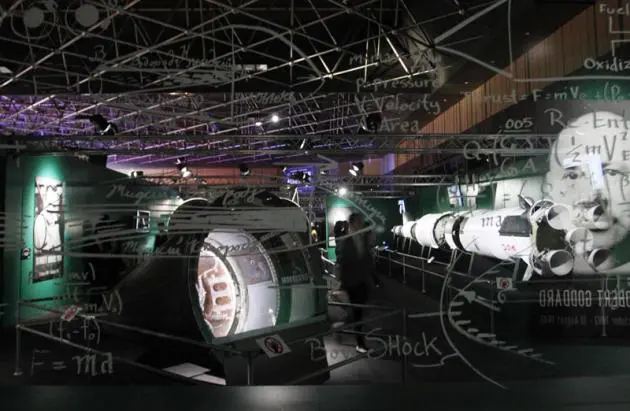
There’s a replica of Neil Armstrong’s space suit, a pair of Titan 1 rocket engines, a mock-up Apollo Command Module and an actual training simulator. (Yes, you can get inside and fly.)
“This is the real history of the space programme,” says Dr Deborah Barnhart of the Space and Rocket Centre. “People under 45 weren’t around when we walked on the moon, so this is a chance for them to bring their children and see artefacts like the Gemini capsule and the shuttle personnel capsule.”
Astronaut Charles Duke, who rode Apollo 16 to the moon 42 years ago, was in Bangkok for a subtler sort of launch – that of the exhibition. He’s 79 now.
“I had brown hair back then,” he quipped. “Now Apollo seems ancient. But it was very exciting. We had six hours on the moon’s surface. I remember how I felt when I first stepped on the moon. I said to myself, ‘I’m here – I walking on the moon, and nobody has ever been to this particular spot!’
“The surface was very rough and dusty and the contrast between the bright moon surface and the black of space – wow!”
Duke’s voyage to the Plain of Descartes was in April 1972. Seven months later Apollo 17 paid what turned out to be man’s last visit to the moon. But Duke is optimistic that there is much more adventure to come.
“For children it’s not too much of a dream to prepare to be an astronaut. It’s a long, hard process. You need to keep your focus on education and good physical conditioning.”
A tour of the exhibition’s Space Technology zone begins at “Gantry”, where you encounter the mighty Saturn V rocket that hoisted the Apollo missions out of Earth’s gravity, then moves on to “Dreamers”, a theatre showing two classic silent space movies. George Melies’ “A Trip to the Moon” from 1902 and Fritz Lang’s “Woman in the Moon” from 1929 were whimsical, ridiculous – and inspirational for generations to come.
America’s “space race” with the Soviet Union cannot be ignored, and sure enough the “Go Fever” hall offers up a replica of little Sputnik, the first man-made satellite, which put the Soviets far ahead right from the outset.
You can see the machmeter from the Bell X-1, the first aircraft to break the sound barrier, and a plastic briefcase owned by Russian cosmonaut Yuri Gagarin, the first human in space.
Elsewhere are the first long-range ballistic missile, a nosecone from a late-1950s Jupiter rocket recovered from the sea, and one of the early mouse habitats that carried the test animals into space.
Other vehicles on display include 1:72-scale models of the Redstone rocket, designed as a ballistic missile but re-purposed to drive manned capsules aloft, the Saturn V used on all the lunar missions, and the Space Shuttle Columbia, the first reusable orbiting spacecraft.
The zone called “Endurance” is about how the astronauts live in space and cope with zero gravity, complete with some of the spacesuits, like the 11-layer A7LB, weighing 82 kilograms once the helmet and life-support backpack are added on (but happily much less on those space walks).
Another fascinating device is the model of an Apollo Lunar Roving Vehicle, the battery-powered, four-wheel rover the astronauts used on the last three missions there.
The Soviets’ remote-controlled Lunokhod 2 is on view too. Several of them roamed around the moon from 1969 and 1977, beaming high-resolution television pictures back to Earth.
More such “innovation” comes to the fore in the zone of that name where the US Mercury programme (1959-1963) is highlighted. You also get to see the immense parachute that eased the Apollo 17 Command Module more or less gently into the Pacific Ocean. You can even observe how the Apollo fuel cells worked, mixing hydrogen and oxygen to produce thrust as well as water.
The exhibition makes room for “Thai Innovation” with a look at the Thaicom satellite and the Geo-Informatics and Space Technology Development Agency.
The show leaves you hankering for a ride of your own to the moon but, failing that, there are other fun rides. The G Force simulator shows you what the astronauts undergo at tremendous speed, whipping around in the gondola of a centrifuge.
Another ride, Five Degrees of Freedom, demonstrates Newton’s Third Law of Motion (every action has an equal and opposite reaction) by pitching you forward and backward, side to side and head over heels. Somehow all of the Gemini, Apollo and Skylab crewmembers endured a great deal of this while training, if not actually in space.
WE HAVE LIFT-OFF
“Nasa – A Human Adventure: The Exhibition” continues through February 1 at the Bangkok Convention Centre on the fifth floor of Central Lat Phrao.
Passes cost Bt500 (Bt350 for children) at (02) 262 3838 and www.ThaiTicketMajor.com.
