
Dancing their way to peace


Play
Young Palestinians and Israelis join up to dance the swing
You can already hear the music from far away: a rhythmical trumpet solo, backed up by a little saxophone and clarinet. It floats out of the restaurant, and echoes down the valley.
The sound doesn’t really fit the scenery. Not far from the valley is an army checkpoint and an Israeli-built wall snakes over the land.
“Swing is cheerful, easy,” says Birte Brodkorb. “And we’re in Palestine.”
The Berliner is teaching young Palestinians in the West Bank to dance swing, a dance style that developed during the Roaring Twenties in the United States and is especially revered in modern Germany.
The project isn’t just about learning the steps and the rhythms. Brodkorb lives in Tel Aviv, where swing dancing has already taken off. And she wants her Palestinian students to meet up with Israelis as often as possible – she has called the idea “Swing for Peace”.
That’s what she and her class are practising for on a Wednesday night in a restaurant in Bayt Jala, a small town south of Jerusalem near the road to Bethlehem.
After the wooden tables have been pushed to one side and the chairs stacked up to make room, Brodkorb switches off the Arabic music and replaces it with her own playlist. The lesson begins: “Kick, step, kick!”
Brodkorb demonstrates the steps and her students copy.
“It’s like aerobics,” jokes Yussuf, a doctor who has come straight from work and has been dancing for several months.
Before that the theatre-lover also took part in acting lessons. When he heard that there was going to be a new dance course in Bayt Jala, he came by the restaurant and has been coming almost every week since then.
“I like learning new things,” he says, adding that life in the West Bank can often be monotonous. “It’s nice to meet new people.”
He isn’t bothered by the fact that most of the Middle East has never heard of swing, or that the aim of the classes is for Israelis and Palestinians to mix. It’s an important gesture, he says.
“Then they’ll see that we’re not violent. That we just want to dance.” But he still prefers partners who support the Palestinian cause, he adds. Not all Palestinians approve of such mixing.
The dancers want to remain anonymous for fear of possible attacks and abuse.
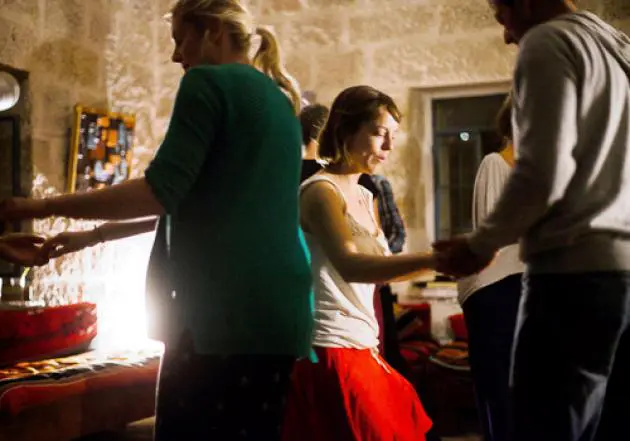
The group pairs off to practice the steps together.
They hold each other by the hands or stand shoulder to shoulder – this sort of physical contact is frowned upon in their conservative Muslim society and also means that there are hardly any female Palestinians who actually take part in the lessons.
Brodkorb has had to ask another female German teacher to help out this evening.
Germans have a special affinity with swing, because the Nazis unsuccessfully tried to stamp out jazz and the associated dance styles. Current western interest in swing dates from 1998, when there was a short-lived revival.
Brodkorb has lived in Israel for more than two years and is working on a PhD in international criminal law. In her free time she dances as much as possible. “You’re totally free and relaxed when you’re dancing,” she says.
But it made her sad that she couldn’t share her hobby with her friends in the West Bank – there is no swing community in the Palestinian territories. So she decided to found one herself.
She found a place to hold the classes and invited friends via Facebook. She needs two hours to get from Tel Aviv – just 50 kilometres away – to Bayt Jala every week.
Palestinians are rarely allowed to leave the West Bank. “So it’s only fair that the world comes to them,” says Brodkorb.
Although the restaurant is in “Area C”, which is under Israeli control, few Israelis dare to go there. That’s why Brodkorb dreams of holding a dance event in Israel. She applied to the Israeli army three times for a travel pass for her students and was rejected three times.
But suddenly, one Monday in November, she received the all-clear. Yussuf and his fellow students are given permission to go to Tel Aviv, where a swing meet-up will take place at a bar in the south of the city.
When the day comes, everybody is nervous. The past few weeks have seen riots and terrorist attacks. The relationship between Israelis and Palestinians has not been so tense for years. Some of the Palestinians back out of the trip in the morning, afraid of being attacked by radical Israelis.
So it is just three Palestinians who meet up with around 20 Israelis to dance swing one Friday afternoon. The Palestinians are shy at first, standing nervously around the edges, a little intimidated by the more practised Israelis.
But after a while they can’t resist the invitations to take to the floor.
“Cheers! Fi sahatek!” say Adnan, a Palestinian from the West Bank, and a young Israeli woman to each other as they clink glasses. Later they sail across the room in each other’s arms.
When the young woman goes to leave several hours later she holds out her hand to Adnan. He hesitates. And then gives her a hug.
