
The men who saved the world


Play
Thailand honours the biochemist who invented the statin and the doctor who eradicated smallpox
The Grand Palace was, as usual, a hive of activity last Wednesday afternoon as Chinese tourists jostled to take photos of each other and the spectacular architecture to which the complex is home.
Less usual was the presence of security guards blocking off the Chakri Throne Hall from other parts of the Grand Palace. The officers of the Royal Palace gave the Chinese an apologetic look and explained the throne hall was off limits, as Her Royal Highness Princess Maha Chakri Sirindhorn would soon be arriving.
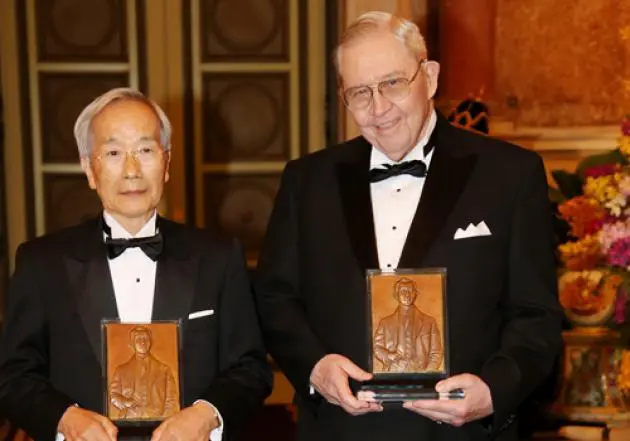
Those same officers of the Royal Palace guided a small number of accredited journalists into the Chakri Throne Hall where the VIP guests, two leading scientists, were already waiting for the Princess in the brown leather antique chairs.
One is a heart saver, another a smallpox eradicator. Both are Prince Mahidol Award 2014 laureates.
Japanese biochemist, Professor Akira Endo, discovered the first statin drug in 1967, extending the lives of millions of potential coronary heart disease victims. His fellow awardee, American physician and epidemiologist, Dr Donald Ainslie Henderson, is credited with the successful eradication of deadly smallpox a decade later.
“It’s a great honour for me and for my family to come to Thailand and receive the Prince Mahidol Award,” Endo told the press, adding that this was his first visit to the Kingdom.
“The prince himself contributed a great deal to Thailand. He went to study Public Health in America before introducing modern medical care and treatments to his country.”
The Prince Mahidol Award was established on January 1, 1992 in commemoration of the centennial birthday of His Royal Highness Prince Mahidol of Songkhla, the father of the current Monarch. The award is given annually to individuals or institutions “in the field of medicine for mankind” and for outstanding contributions to the field of public health for the wellbeing of the people.
The first two awardees were English physiologist, Sir William Richard Shaboe Doll, and Chinese Chen Minzhang. Four Thais – among them “Mr Family Planning” Mechai Viravaidya – have been recognised to date.
Endo’s award was in the Field of Medicine.
Inspired by a childhood fascination with poisonous mushrooms and fungi that killed flies but spared humans, Endo studied biochemistry at Tohoku University. His research into the relationship between fungi and cholesterol biosynthesis led to the development of the first statin and gave birth to generations of cholesterol-reducing drugs, shifting the paradigm in coronary heart disease from unpreventable to preventable.
At 82, the Japanese biochemist is hardly a walking advert for the typical sufferer of high cholesterol. Slim, elegant and discreet in his tuxedo, he doesn’t seem to have gained any weight in his entire life.
Yet at his annual check up back in 2000, his doctor – who had no idea of Endo’s invention – told him his LDL or “bad” cholesterol level was of concern.
“The doctor said: ‘Don’t worry. We have very good drugs to treat the condition’,” said Chiga Matsuda, Endo’s daughter, who along with her mother Orie, made the journey to Bangkok last week.
Endo, though, refused to take any statins. Asked why, he says he preferred instead to try and get the condition under control through exercise and diet. Eventually though, he was forced to concede defeat and agree to the medication.
“My wife takes it too,” Endo said applause and laughter.
Bulkier and decidedly more outspoken than his fellow Japanese laureate, Dr Donald Ainslie Henderson was accompanied to the Chakri Royal Palace by his wife Nana and son Douglas. At 87, he looks more like kindly grandpa than a man on a crusade to fight mankind’s war against the deadly smallpox virus.
Believed to have emerged in humans around 10,000 BC, smallpox is said to have been responsible for an estimated 300 to 500 million deaths during the 20th century alone. In 1967, Henderson became director of a worldwide campaign to eliminate this disease from the face of the earth.
Henderson and his team launched their eradication campaign in Western and Central Africa in 1966 following a vote some years earlier by the World Health Assembly to undertake a global eradication programme against the disease.
In much the same way as physicians and epidemiologists are today chasing the deadly Ebola virus in Sierra Leone, Liberia and Guinea, Henderson and his team had to cope with civil wars, floods, impassable roads, and refugees as well as formidable bureaucratic and cultural obstacles, shortages of local health personnel and meagre budgets.
In an interview with World Health Organisation, Henderson said he was initially reluctant to join the Smallpox Eradication Campaign. It was too challenging and the budget of just US$ 2.7 million wasn’t enough to buy the vaccine.
“Twenty orphans, one of whom was vaccinated, were put on board a ship. On the eighth day, when a pustule had developed, a second orphan was vaccinated, and so on. When the ship reached its destination, the transfer of vaccinia was made to local residents and the vaccination chain continued,” Henderson wrote in his book “Smallpox: The Death of a Disease”.
The eradication programme took 10 years to reach a successful conclusion with the last case reported in Somalia in 1977.
But it seems that not all the stocks used for research have been destroyed. Last July, vials containing the smallpox virus were discovered in a cardboard box at a Maryland laboratory.
So has the virus really been eradicated, I ask the doctor.
“How can we really sure,” answered Henderson. “They never really throw anything away.”
Henderson Endo receive medals, certificates and a cash prizes of US$100,000 (Bt3.25 million).
