
Traditions under threat
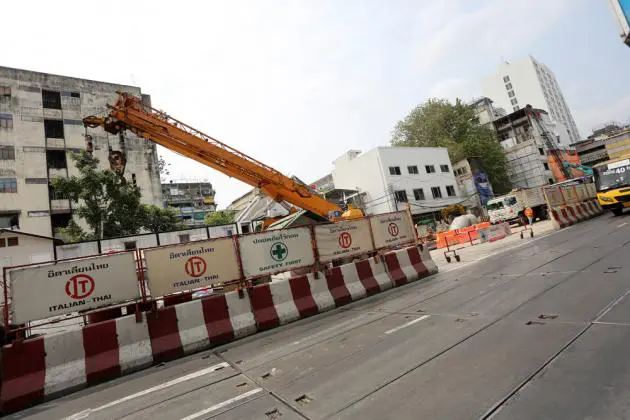


The old Chinese community of Charoen Chai struggles for survival as underground trains and new development move in
TODAY MARKS THE start of the Year of the Goat and even as Thailand’s Chinese communities join their kin all over the world in celebrating, residents of the old Chinese community of Charoen Chai in Bangkok will be hoping against hope that this Lunar Festival is not the last they will spend in their homes.
Located in a small soi off Charoen Krung Road and surrounded by five famous Chinese temples and shrines – Wat Mangkorn Kamalawat or Wat Leng Noei Yi, Canton Shrine, Lee Tee Biao Shrine, Leng Buai Ia Shrine, and Tai Hong Kong Shrine – Charoen Chai has long been the country’s main hub for the materials used in traditional ceremonies. It is to here that retailers and shoppers flock for such essentials as joss paper, paper lanterns, incense sticks, candles and the red and gold embroidered decorations synonymous with births, weddings, paying respect to ancestors, and funeral rites. They also come to enjoy such delicious specialities as ba-mee-jabkang, ta-lae noodles and Jae Kung’s kway tiew load (brown saurce noodle).
But now its future is under threat. The extension of MRT’s blue-line underground link that will link Bang Sue to Tha Phra, and Hua Lamphong to Bang Khae is under construction and the exits for the new Wat Mangkorn station have already resulted in the demolition of shophouses that used to sell traditional Chinese wedding clothes and utensils. And more shophouses are slated to be knocked down shortly to clear the way for a new property development.
Complicating matters further is that the land for the underground project belongs to two landlords – the Chumbhot-Pantip Foundation and the Crown Property Bureau. The first the community knew of the development plans was when its landlord – the foundation – discontinued the leasing contracts, first by reducing the lease term from three years to two and then eventually to one year.
“Since 2008, the people in this area have been living month by month with no contract, no agreement and no dialogue with the landlord,” says Sirinee Urunanont, one of the leaders of the Charoen Chai Conservation and Rehabilitation group, which was formed in 2010.
“It’s not only our lives and businesses that are under threat but also our rich cultural heritage and decades-old buildings. The spirit of the community will be gone for ever when the people move out.”
Two years ago, the group opened a local museum Baan Kao Lao Rueng, to showcase the items and artefacts associated with traditional Chinese livelihoods. Sirinee is currently looking for ways to renovate this old building so that it can prove to the outside world that property development need not lead to the destruction of culture.
“In just one block of our community, we had three lots of vendors working at different times of day,” says Chatchai Termteerapot, a tenant and member of the conservation group who grow up in the neightbourhood.
“In the early morning, it was and still is a fresh market so we never needed a supermarket. In the afternoon, the space is occupied by dressmakers and other professions and in the evening, it’s the home of food vendors. But now that the bus stop has moved, many of the vendors have gone. The arrival of the underground will see the destruction of even more small businesses. Perhaps more people will come to the area because of the more convenient transport but I don’t see then carrying red joss paper, boiled chickens or ducks, ceremonial decorative items and fireworks on the train. I don’t think it will even be possible.
“We do not object to the development of modern infrastructure and bustling economic activities. Our worry is that we can be kicked off our land at any time. The current town plan allows for high-rise buildings to be constructed within a 500-metre radius of underground exits. The landscape will be gone forever and we don’t know if we can pay the higher rental fees that will doubtless be demanded,” he says.
Pimploy Purithongrat, 73, has lived in Charoen Chai for more than 60 years and makes her living selling kong-tek banknotes, the spirit money used for burning at funerals and ancestor ritual ceremonies. She loves the Chinese New Year celebrations in the area but admits that spirits this year are at a low ebb.
“People here really enjoy selling the offerings to deities, to ancestors, to everybody in the house. But development is part of progress.”
Tipmanee Taecha-Anantpipat, 55, of Jae Kung’s noodle shop, agrees.
“I born here and have never left this community,” she says. “Progress has to be given priority but it is also important that old Chinese cultural values are recognised and maintained.
“I am happy to work, and happy to cook delicious and good food. I don’t need a big restaurant. Chinese think of work as exercise. So they enjoy it, they make money, and life is good.”
The Chinese traditionally burn incense sticks and joss paper at this time of year in the belief that the smoke rising from the flames will reach their deities and thus grant their wishes.
Perhaps then those burning the paper produced by the Charoen Chai community can add their voices to theirs and pray to the deities to allow this unique cultural business to be preserved.
