
Scheeren bids high with auction house


Play
The German architect who built Beijing's CCTV tower is now adding a vast art centre
German architect Ole Scheeren, co-designer of Beijing’s high-profile cubist CCTV tower, takes on Chinese history and identity with his latest project, an art centre for China’s Guardian auction house.
The large art centre in Beijing’s historic heart will house the new headquarters of China’s oldest art auction house. Building work has already begun, but the finished designs for the Guardian Art Centre near the Forbidden City were revealed for the first time last Sunday.
“With this building I want to show how considerately I can work within a historic context,” said Scheeren, 44, better known for the futuristic, gravity-defying tower he designed for China’s state broadcaster, CCTV, together with his former partner, Rem Kolhaas.
Scheeren declined to comment on the cost of the centre taking shape across from the National Gallery of Art, but a source estimated they would be almost US$100 million.
Rising from the old quarter of central Beijing, the centre will combine a museum, event space and cultural centre, with several multipurpose spaces. Guardian ranks fourth among the world’s auction houses behind Christie’s, Sotheby’s and the Chinese Poly Group.
The building is designed as “a sensitive architectural interpretation that fuses history and tradition with a contemporary vision for the future of a cultural art space”, says Scheeren’s website.
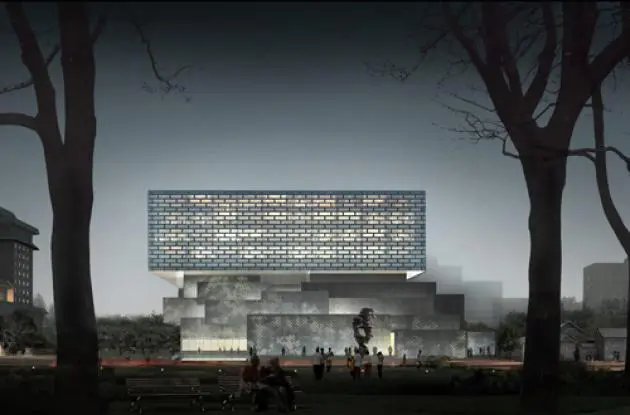
The lower, disjointed portion in muted tones reflects the organic, low-rise hutong of the historic quarter, while the more modern-looking, monolithic upper portion responds to the surrounding contemporary city. It is “supposed to release the tension between history and presence”, Scheeren said.
An inner courtyard further echoes the traditional Beijing house layout.
“The Art Centre will be a tangible link between past, present, and future,” China Guardian’s chairman and founder, Chen Dongshen, says on Scheeren’s website. “It celebrates history and tradition while also representing an important social and civic amenity for the capital.”
The location itself is also an apposite “intersection between commerce and culture”, Scheeren said. “Beijing’s most famous commercial street Wangfujing and Wusi Dajie, the site where the New Cultural Movement originated after the Qing Dynasty.”
At the centre of the building is a 1,700-square-metre open exhibition-and-event space with surrounding smaller, interconnected rooms for support functions. It includes several restaurants and a 120-room hotel in the floating ring of the building, with views over the Forbidden City.
The upper ring of the hotel is made of oversize glass bricks. The brick is a “symbol of modesty, not of pomp”, the architect said. The grey stone-like pixels of the lower portion of the building are perforated by several thousand circular openings.
It is also intended as an abstract projection of one of China’s most renowned landscape paintings, “Dwelling in the Fuchun Mountains”.
