
Rooms with a Mediterranean feel


Play
No 9 Thompson, an offshoot of Jim Thompson, brings warmth and rich colour to home furnishings
INSPIRED BY the textile crafts and traditional ceramic tiles of Central Asia and the Mediterranean coastline, British designer Richard Smith has come up with a stunning new collection of printed and woven fabrics for No 9 Thompson – a sister brand of well-known silk company Jim Thompson. Hand-woven nineteenth-century Caucasian carpets, the traditional zelig ceramic tiles of Northern Africa and ancient Moroccan rugs have been reinterpreted with a fresh twist for both indoor and outdoor fabrics in the Anatolia collection, which is named after what was once known as Asia Minor.
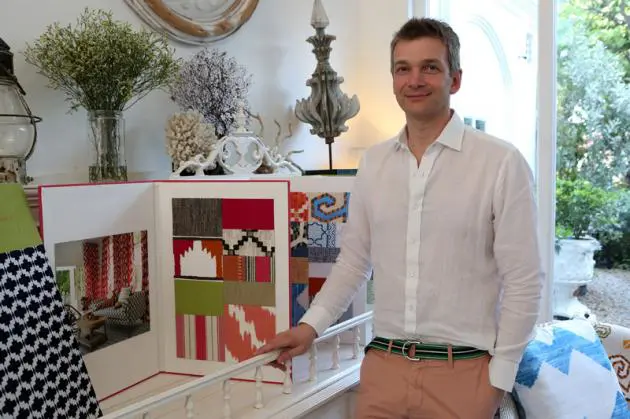
“I love drawings and paintings. I also love texture and colours and try to create layers of texture with different colour palettes. The collection is based on simple designs that can combine with other previous collections in many different ways. I don’t want to be too dictatorial about how it’s used, ” says Smith, looking relaxed in white shirt, salmon-pink trousers and lime sneakers.
There are 10 designs for the indoor collection and six for outdoors. His Karapinar fabric made from 100-per-cent linen takes inspiration from a Caucasian carpet from the nineteenth century. The abstract motifs, particular to the villages in which this genre of rugs was woven, take on a modern quality with areas of graphic detail rendered in saturated colours.
Smith showcases a picture of a room set where he uses Karapinar fabric for the bedspread and cushions on a white bed. Other cushions are covered with the Torba geometric pattern in orange hues and Cabana irregular zigzags.
Named for the traditional ceramic tiles of Northern Africa, the Zelig line, made from 100-per-cent cotton, is a fresh and crisp interpretation of a centuries-old craft. All three colourways are printed on white cotton twill, which enhances the modern, tailored feel and is redolent of the original inspiration. Anatolia Stripe is a combination of hand-woven hemp and cotton textile – a true evocation of a traditional flat weave textile found throughout the Mediterranean. It comes in two complex yet useable colourways - soft turquoise with flashes of lime and chocolate and a deep pink and orange punctuated with black and white. The combination of softly irregular yarns, both in terns of colour and texture, brings an authenticity to any piece of furniture.
Smith also presents a room set picture where the Aisha pattern – a combination of cotton and linen - in orange is used for the curtains while the sofa is upholstered in black-and-white Torba. Another completely authentic fabric, Aisha is entirely made by hand. This is a one-colour warp print where the vertical cotton yarns of the fabric are printed before weaving. The fabric is then woven with horizontal linen weft yarns, giving a soft look and underlining the double-sided quality of the design.
“The room looks modern but gives off a soft, lively and friendly feel. You can mix different colourways to give different dimensions,” he says.
Continuing the success of last year’s No 9 borders collection, the brand is now launching another two embroidered tape borders made from cotton and polyester that can give dimension to plain curtains and blinds. The Meknes pattern is inspired by the zelig tile borders of North Africa and its large-scale interlocking shape is embroidered in a combination of colours and interpreted with matt yarns using a rope stitch. The other design is Casablanca, which boasts a geometric pattern in a combination of colour palettes like orange with rose and fuchsia, royal and navy blue with turquoise, as well as apple and bottle green with beige.
From the thirteenth century, the Moroccan city of Fez was renowned for its textile crafts and was home to hundreds of embroidery workshops. The latest outdoor embroidery collection made from 100-per-cent polypropylene is named for this heritage, and the pattern is a simplified version of a traditional motif from flat weave carpets.
