
Building it BIG


Play
China's Huang Yong Ping and Thailand's Sakarin Krue-on join for a huge exhibition at the Bangkok Art and Culture Centre
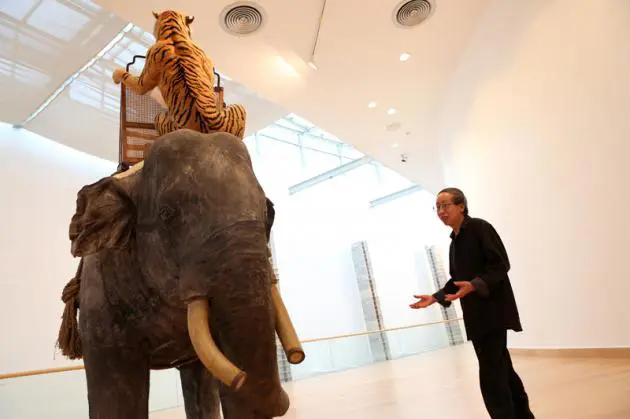
VISITORS TO THE eighth floor of the Bangkok Art and Culture Centre could well be forgiven for thinking that they have entered a playground for wild animals, so lifelike are the elephants, tigers, vultures and rats lying around the floor. They are soon disabused of this notion, however, by the Buddha statues, a giant Buddha’s head and even unfinished concrete towers that stand alongside.
Created by French-Chinese artist Huang Yong Pin and Thai artist Sakarin Krue-on, these works are part of the exhibition “Imply-Reply”, organised by the BACC in collaboration with Tang Contemporary Art. A year in the making, the show has received support from the French Embassy for the works from France and from the Faculty of Painting, Sculpture and Graphic Arts at Silpakorn University for those that have been brought from China. The exhibition highlights the collaboration of two artists from different generations and different nations.
Huang Yong Pin plays the key role in this exhibition, with works on loan from the Centre Pompidou in Paris and private collections.
Among them is his masterpiece “Nightmare of King George V” (2002), a monumental sculpture of an elephant mounted by an attacking tiger, which offers a commentary on imperialism and the hunting safaris of bygone colonial days. Also on show is “Ombre Blanche” (2009), a sculpture of a white elephant which has meanings in both the Thai and global contexts.
“I chose these works depicting elephants, as the elephant also has many meanings in Thailand. While some of the meanings may overlap, I would like viewers to feel free to interpret my works as they see fit,” the 61-year-old artist says.
Huang was one of the key figures in the mid-1980s Xiamen Dada movement, a collective of artists interested in creating a new Chinese cultural identity by bridging the framework of reference in Western modernism with Chinese observances and contemporary reality.
As a young artist, Huang incorporated many different Chinese philosophies into his works, like Buddhism, Taoism, Western philosophies and Dada, and this led to the forming of the Xiamen Dada group.
A self-taught student, Huang educated himself by learning from three well-known men: the German artist and theorist Joseph Beuys, American contemporary-classical composer John Cage and French surrealist Marcel Duchamp of the Dada movement. He graduated in 1982 from CAFA in Hangzhoue and in 1986 he formed Xiamen Dada.
In 1989 at the age of 35, Huang went to Paris for the “Magiciens de la terre” exhibition and ended up immigrating to France where he has lived ever since. Many of his pieces today are on a large scale, making them difficult to auction.
A good example of this preference for size is “Tower” (2014), a new installation created specifically for this exhibition. The 2.5-metre-high concrete columns line a curved corridor from the seventh to the eighth floors.
“I was inspired by the skeletons of skyscrapers on Rama III Road when I was in Bangkok last year. This set of sculptures is reminiscent of tall abandoned buildings and reminds us of the leftovers of an economic calamity,” he explains.
For his part, Sakarin both implies and replies to the senior artist. The 50-year-old has selected earlier works and also created new installations that relate to Huang’s masterpieces.
Sakarin exemplifies various views on his continued interest in the capitalist forces, the material orientation of the Buddhist-influenced society, and the underlying illusion that connects Thai narratives and capitalism and which impact on our environment.
Among the works on show are “Yellow Simple” (2006), a sculpture of Buddha with an over-sized human head, and “Rat House” (2014), a sculpture inspired by an old Chinese gambling game that features a silent film projected inside the piece.
His new installation “Monkey in the House” (2015) replicates a group of monkeys who hang around his house. It features a reading room filled with piles of books and shows the monkeys having fun with the titles. One monkey rests on the top a wooden cabinet while another sits expectantly on the ground.
“I’ve had to adjust to living in harmony with these monkeys. More than 1,000 monkeys live near my house and they come every day to play. I didn’t like them at first as I can’t control them. Then I realised that I can’t control external conditions, but I can control my inner mind. In line with my Buddhist beliefs, I realised I had to deal with the chaos through achieving inner peace,” Sakarin explains.
RESPOND QUICKLY
“Imply-Reply” runs until Sunday at the Bangkok Art and Culture Centre. For details, check www.BACC.or.th.
