
From partition to perdition


Play
Navin Rawanchaikul traces his life's journey in a new Chiang Mai exhibition
AFTER A long journey of self-discovery, Thai-Indian artist Navin Rawanchaikul has come full circle. His new exhibition, “A Tale of Two Homes”, is a personal narrative, one that celebrates both his origins and identity and where and what he is today.
Spread between the Rawanchaikul family fabric shop – the OK Store in Chiang Mai’s Varorot market – and his new studio, StudiOK on the banks of Ping River, the show brings together a multitude of art forms. They range from old-fashioned movie billboards, video installations and short films to life-size sculptures, hand-written letters, memorabilia and comic books that look just like the 10-satang novels of yesteryear. His works are funny yet sarcastic and filter his autobiography through a touch of fiction.
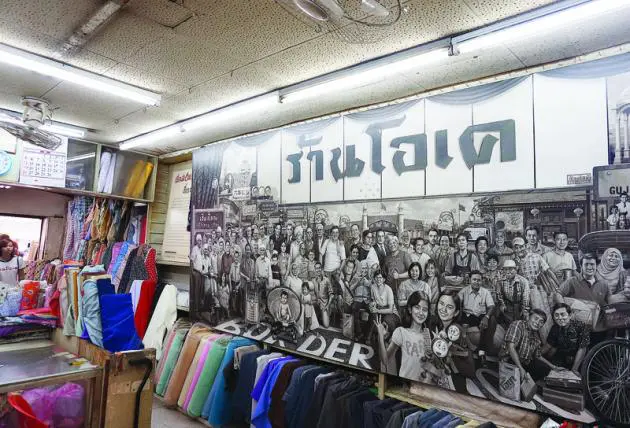
The works at his family fabric shop deal solely with his personal odyssey. The four-storey shop has been turned into a site-specific installation that conveys memories through an expansive range of media. On the first floor, amidst the abundance of fabric rolls is a stunning panoramic canvas of a monochrome mural. His father, now 80, is in the centre, surrounded by family members and friends who helped to set up the shop that was founded by his great grandfather in the 1940s.
“My goal through these works is to create a dialogue around the notions of home and a sense of belonging,” says Navin, a graduate of Chiang Mai University who today mostly lives in Japan with his Japanese wife and teenage daughter.
“Art can be something that tracks the past, depicts the present and illustrates the future.”
The higher floors, the family’s residence until 1983, are alive with nostalgic references. Abandoned for 30 years, Navin and his team cleaned up the space and turned it into a treasury of found objects and childhood possessions.
His parents’ former bedroom has been redecorated like a room for newlyweds. The bedspread is covered with heart-shaped roses and hanging above the bed is a monochrome canvas of his parents recreated from an old photo that he found while cleaning up the room. The painting is framed in red to look like an Indian wedding invitation.
“I found an old and torn studio photo of my parents, which I assumed was captured after their wedding. I didn’t know when they got married so I wanted to redecorate the room to celebrate their life as a couple,” he says.
Though the two never met, his late mother’s wardrobe is home to a black-and-white painting of her dressed in a sari with his young daughter Mali in a kimono. His father’s wardrobe is filled with old stuff along with a black-and-white painting of his father and his late uncle.
As a tribute to his mother, who passed away 20 years ago, he asked jewellery artist Rongkakorn Anantasanta to use his mother’s old dentures as a mould to cast a necklace in the form of the jasmine flower. The necklace is showcased on the dressing table and will one day be passed on to his only daughter, whose name means jasmine in Thai.
Another drawing made from dust collected from the house shows a simple white vest, the one his father would hung up to dry after his morning jog, next to the radio cassette player on which he would listen to the news. The recording of the loud voice of late anchorman Preecha Sabsopha plays in the background, evoking childhood memories. Representing his family’s long journey from post-partition Pakistan is a painting of his great-grandfather’s wooden walking stick standing side by side with the old metre ruler that was used to measure the fabrics of the OK shop.
The former playroom is piled high with old toys, books and discarded household utensils. One wall is home to a painting of his daughter as a small child playing on a seesaw against the black-and-white background of a train station in Gujaranwala from where his mother and great-grandfather travelled to Thailand. The sound (in Japanese) of his wife reading a bedtime story that she penned herself to young Mali bonds the childhood memories of Navin and his daughter.
Navin is also celebrating the 20th anniversary of Navin Production with the opening of studiOK on a three-rai plot in the Fah-ham area. It’s home to his huge 2004 canvas “Super(m)art”, which features portraits of recognisable people from the local art scene and will soon be flanked by another two canvases. The canvas on the right is already nearly completed and depicts what has happened in the modern art arena in the 10 years since “Super(m)art”. The other piece has not yet been created but Navin says it will track back to the Sukhothai era – the golden age of Thai culture and art.
Also in the large cement studio is Navin’s 1993 installation “There is No Voice”. Inspired by his mentor, the late Montien Boonma and his concerns for the rural poor and the environmental damage stemming from rapid economic development, it features stupa-like stacks of medicine bottles, each containing a photo of an elderly person, the voiceless rural poor.
In 2006, Navin set up the quasi-political Navin Party by uniting people named Navin. After Google turned up hundreds of Navins all over the planet, the Chiang Mai artist travelled to Bombay and toured the rest of the world in virtual time, “frisking” every other Navin he met to ascertain how they fit into the grand scheme of Navinism. In Bombay alone he met 20 more Navins. His 2008 old-fashioned movie billboard-like painting “Navin of Bollywood (Navin Party)” is crammed with Navins, among them a wig maker, a tailor, an optometrist, a taxi driver and a sumo wrestler. Next to it is a life-size fibreglass sculpture of him in Indian attire, surrounded by banners bearing his name in different languages.
“I’m trying to explore a new ethnic group that has emerged through the inter-linking of identities surrounding a single name,” he says.
Also on show is his series of four newly completed paintings. Three are monochrome to depict the scene of his own funeral and each gathers Navin in all his artistic guises together with the objects he has created throughout the careers. The last piece, however, focuses on the red spider lilies or higanbana in Japanese, and relates to the annual Japanese ceremony of Higan wherein the spirits of the dead move from the world of suffering to the world of enlightenment.
Bangkok-based art collector Disaphol Chansiri, who owns many of Navin’s works, adds to Navin power by showing off his collection at his Chiang Mai residence-cum-gallery DC Collection on Maneenopparat Road – once the home of Prince Inthanond Na Chiang Mai.
Held concurrently with “A Tale of Two Homes”, “Tales of Navin” invites visitors to spend time in Navinland – the project with which Navin represented Thailand at the 54th Venice Biennnale in 2011.
The gateway to Navinland begins at a checkpoint based on the infamous Checkpoint Charlie that once separated the two Germanys. His land, however, breaks down all prejudices of race, gender, religion and geography. Here there are life-size sculptures of Navin holding a passport and his daughter Mali holding a flag mocking the postures of Indian and Pakistani soldiers on parade on the Wagah border, “the Berlin Wall of Asia”.
Visitors can also enjoy “Navins of Bollywood”, the 2006 movie in which he bops about the streets of Mumbai searching for his namesakes to a soundtrack of Hindi, French and Korean music. Another 200 Navins and would-be Navins pack the panoramic painting “Paradiso di Navin”, the entire gang gathered in front of the restaurant-gallery Paradiso with Venice’s lagoon in the background.
Adjacent is a monochrome mural depicting portraits of more than 200 members of the community living around Varorot market that Navin Production painstakingly created during the 2011 “Mahakad: Epic Arts in the Market” to celebrate the market’s 100th birthday.
NAVIN AT HOME
>>> “A Tale of Two Homes” continues at both venues through July 31. The OK fabric shop in Varorot market is open daily except Sunday from 10am to 4pm. StudiOK on Sammakorn Housing Project in Fah-ham is open by appointment only.
>>> “Tales of Navin” at DC Collection on Maneenopparat road continues until October 31. The exhibition can be viewed by appointment only.
>>> Call (081) 111 9621 or e-mail to [email protected].
