
Leader of the pack


Play
"Dog Whisperer" Cesar Millan drops into Bangkok to tell us how to live in harmony with man's best friend
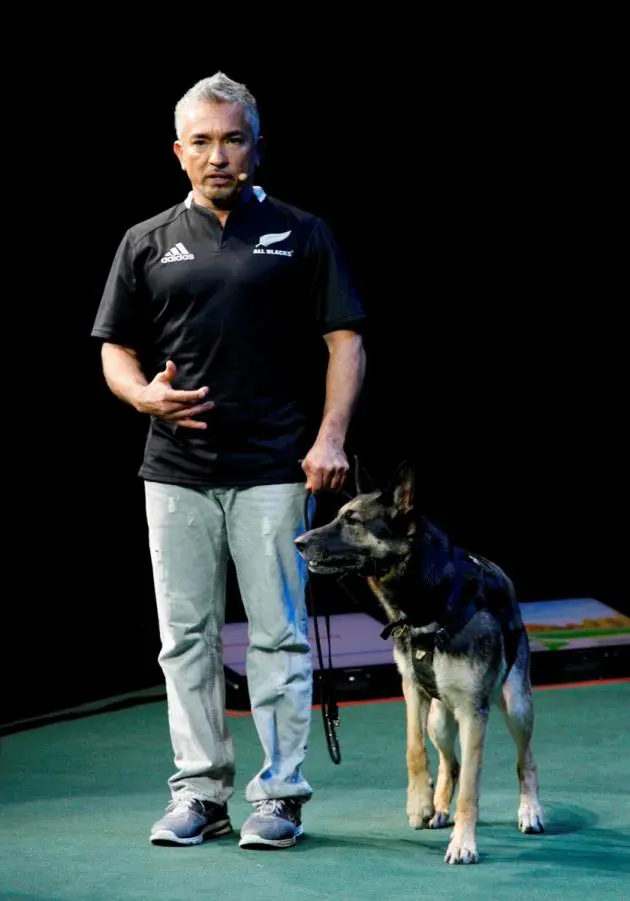
Dog-behaviour expert Cesar Millan will be in town next week on the Asian leg of his Love your Dogs Tour to share his philosophy for creating balanced relationships between humans and their canines.
Best known for his hit television series “Dog Whisperer with Cesar Millan”, he can currently be seen in the second season of his new show “Cesar to the Rescue”, which has been airing on the Nat Geo People and National Geographic channels since last month.
A pre-eminent authority in the field of dog rehabilitation, he will talk about trust, respect and love in this entertaining live show where he reveals the key to happier, healthier relationships between man and dog.
We had a chat with him about his expertise and the show.
WHEN DID YOU REALISE THAT YOU HAD AN ABILITY TO REHABILITATE DOGS?
I think my relationship with dogs is something I was just born with. My mother has told me stories of how drawn I was to all animals, but especially dogs, even as a tiny tot. And, of course, I had a lot of opportunities as a child to observe a working pack of dogs on a farm and study how they interacted.
WHAT WAS YOUR FIRST PET DOG LIKE?
My first pet was an Irish setter named Saluki, who was given to me by our doctor neighbour. She was my constant companion for almost 10 years, and taught me a very interesting lesson. Although she was purebred, she didn’t behave any differently from the mixed-breed dogs I’d known from the farm. I like to think of purebreds as ordinary dogs wearing designer suits.
DO YOU HAVE A FAVOURITE DOG BREED?
Well, I love pit bulls, but my favourite “breed,” really, is a mutt. A lot of times, people focus too much on breed and forget that dogs all have the same psychology, so people will treat a big dog very differently than they do a little dog. With a mutt, it can be hard to see what breeds the dog actually is, and so they help people to focus on the species instead.
WHAT IS YOUR REHABILITATION STYLE LIKE? WHAT IS THE FOUNDATION OF YOUR PROCESS?
The foundation of my process is understanding dog psychology, which allows me to understand what the dog is telling me – that is, to see what’s causing the unwanted behaviour. “Style” is more like technique, and that varies from dog to dog, depending on the issue. If a dog is timid, then I’ll work to build his self-confidence. If he’s aggressive, then I’ll work on lowering his energy and redirecting his aggression.
DO YOU NEED TO STUDY THEIR BREEDS AND SPECIFIC TRAITS OF THAT BREED’S PERSONALITY TOO?
The dog psychology I mentioned is the same, whether a dog is a Chihuahua or a Great Dane. Where breed comes into it is if I need to use a specific instinct in order to remove a misbehaviour. For example, if an over-excited dog is a herding breed, then I can use agility training because this mimics the process a herding dog goes through. If it’s a working breed, then I may use a backpack or have the dog pull a cart to get the same result.
SOME COUNTRIES BAN IMPORT OF SPECIFIC DOG BREEDS. WHAT IS YOUR VIEW ON THAT?
I am working very hard to end what they call “Breed Specific Legislation.” There are no bad breeds, only people who fail to fulfil a dog and cause them to be aggressive. Solving the problem really starts with people understanding what kind of dog is right for them. Some people will never have the confidence and calm, assertive energy necessary to have a Rottweiler, for example, but they might be fine with a small terrier. There’s a saying I’ve seen online about the issue that I think sums it up perfectly: “Punish the deed, not the breed”. Instead of banning specific breeds of dog, we need to make the owners responsible for their dogs’ actions.
HAS THERE BEEN A DOG THAT YOU COULDN’T SAVE?
There have been very few dogs I couldn’t rehabilitate. One case that comes to mind was two dogs who came from a puppy mill and had been severely inbred. They had neurological problems that made it impossible to rehabilitate them. Notice, though, I say I couldn’t rehabilitate them. I always try to do what I can to save a dog in that situation, which in that case meant finding a suitable place where they could stay, away from all but the most highly trained humans, who could handle them.
WHAT HAS BEEN YOUR WORST BITE SO FAR?
That would be Holly, which ironically happened while I was shooting my last episode of “Dog Whisperer.” She got hold of my hand and I wound up in the hospital, although it was really my fault because I was distracted for a moment just enough to misread her intentions. Getting bitten comes with the job, though. The important thing when it happens is to remain absolutely calm.
ARE THERE PEOPLE THAT SHOULD NOT KEEP PETS TO BEGIN WITH?
People who adopt dogs as substitutes for human children and then treat them that way do more harm than good. Dogs don’t need or want constant affection. They need rules, boundaries and limitations. As pack animals, they want their leaders to tell them what to do. The only time rehabilitation doesn’t work is when the people don’t follow through.
THANKS TO SOCIAL MEDIA, PETS NOW CAN BECOME CELEBRITIES AND THAT INSPIRES MANY FIRST-TIMERS TO A POOCH. WHAT SUGGESTIONS CAN YOU GIVE TO THEM?
Do not pick a dog based on the breed. Look for a dog with the right energy level, one that’s compatible with your own energy and lifestyle. Every time a particular dog breed becomes famous, people run out and adopt that breed without considering its specific needs. When they find out that the Chihuahua they adopted because of Paris Hilton or the Dalmatian they got after the Disney film is a very high energy dog and they can’t take the time to exercise it, that’s when we see those breeds flooding the animal shelters.
YOU ARE ALSO AN AVID SUPPORTER OF PET NEUTERING AND SPAYING. WHY IS IT SO IMPORTANT?
It’s so important because there are 600 million unwanted or abandoned dogs in the world, and this happens because un-fixed dogs can create a lot of puppies. I don’t know why neutering and spaying are not popular in Thailand, but in my home country of Mexico people didn’t like to get their dogs fixed, and particularly didn’t want to neuter their male dogs, because they saw it as a macho thing to keep dogs intact. But a male dog doesn’t know what he’s missing if he’s neutered, and a female dog can avoid things like ovarian cancer if she’s spayed.
WHAT CAN THE AUDIENCE EXPECT FROM “LOVE YOUR DOGS”?
You can expect a lot of fun with a lot of education. I cover my techniques, especially the fundamentals, in a lot more detail than in the TV shows, and deal with behaviours like separation anxiety and aggression (which is very misunderstood). I teach people how to respect species and let a dog be a dog, and I help people understand how their energy affects the human/dog dynamic. For the Bangkok show, we will be doing audience Q&A, giving people an opportunity to write their questions before intermission, and I’ll answer some in the second half.
FROM YOUR 25 YEARS EXPERIENCE WITH DOGS, WHY DO YOU THINK DOGS ARE PEOPLE’S BEST FRIENDS?
Dogs are pack animals. They want to belong, and in letting them be part of our pack, we fulfil that need in them. Dogs are also naturally affectionate, and bond with us easily. And most of all, they don’t judge us based on who we are. Dogs don’t see any difference between a head of state or a homeless person. They just see our energy.
CANINE COMMANDS
- “Cesar Millan Live – Love your Dogs” is at 7.30pm next Wednesday at Royal Paragon Hall. No dogs are allowed at the venue.
- Tickets are Bt2,000 and Bt2,500 at ThaiTicketMajor. Call (02) 262 3838.
- Find out more at www.CesarMillanLive.com
