
Wise words from the Subcontinent


Play
Six well-known Indian authors drop into Bangkok to share their literary views and experience
VIKAS SWARUP became an international star three years after writing his first novel “Q&A” when the story was turned into the 2008 film “Slumdog Millionaire” and won eight Oscars (including Best Picture) and seven BAFTA Awards. Since then he’s written two more novels – “Six Suspects” (2008) and “The Accidental Apprentice” (2013) – but no matter where he goes, he is inevitably only asked about the first book, which came out 10 years ago.
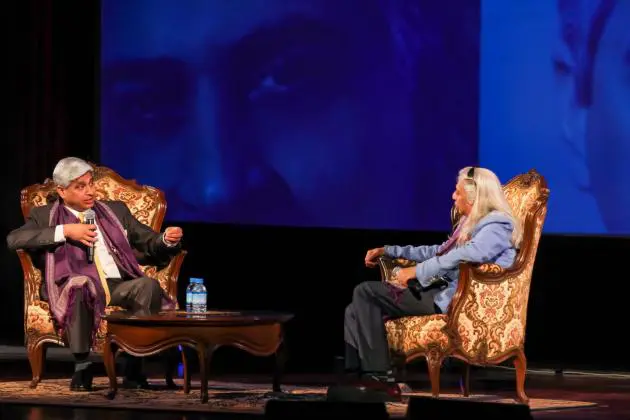
Fortunately, he never tires of talking about it as evidenced last week when Swarup joined “Words on Water”, a literary event held at the auditorium of Chulalongkorn University, Bangkok as part of the Festival of India in Thailand.
“The book is my daughter and the film is like my son-in-law, and there’s no way I’m going to be speaking ill of him,” the author told an enthusiastic audience.
He was being more than a little diplomatic as it is common knowledge that director Danny Boyle made substantial changes to the novel when it was being adapted for the film version.
But then Swarup is a professional career diplomat and since last April has been serving as spokesman for India’s Ministry of External Affairs.
Indeed, his trip to Bangkok was part of Indian Prime Minister Narendra Modi’s Act East Policy that aims to forge and strengthen India’s relations with Asean and its East Asian neighbours. And Swarup is expected to be a lot busier in months to come given the ministry’s several planned high-profile missions.
“As spokesman, I have to give out information to the media regarding India’s external engagements with the rest of the world, especially with the US, China and Southeast Asia,” he tells The Sunday Nation after the discussion.
Swarup regards himself a diplomat who writes rather than a writer, much less a full-time one. As an Indian Foreign Service officer, he’s served in Washington DC, Addis Ababa, London, Pretoria, Ankara, Osaka and Kobe.
A career in the Indian Civil Service was an ambition even as a child. Born in Allahabad into a middle-class family of lawyers, Swarup was told by his parents to be anything but a lawyer in his younger days. Given India’s limited career choices while he was growing up, Swarup aspired to a career in the Indian Civil Service.
“Job options were limited in the 1960s and 1970s. There was no media industry back then and not much in the way of television. Four or five choices were available to you: doctor, engineer, lawyer and civil servant. My mother would have kicked me out of the house if I’d wanted to become a lawyer,” he laughs.
He adds the ICS continues to “attract the best in the country, having come a long way from the days when it was populated by Indian nationalists and when a British sojourn was the ultimate rite of passage before one’s eventual ascent up the bureaucratic ladder.
“The ICS has its own image now. India is an independent country, has its own domestic requirements. What we need to do is to bring India into the top league of nations, to reduce poverty. The ICS is geared towards achieving these kinds of projects.”
He attended Allahabad University, India’s fourth oldest and known for its vibrant academic scene. The city prepared him well for the journey to the world of bureaucracy.
Allahabad is famous for two things, he says. The city is the birthplace of many Indian prime ministers including Jawaharlal Nehru, Indira Gandhi and VP Singha. Secondly, it’s a holy place marking the confluence of three sacred rivers: the Yamuna, the Ganges and the Saraswati. Every 12 years, it hosts the 45-day Kumbh Mela, a mass Hindu pilgrimage attracting 70 million faithful.
“During the pilgrimage, it’s like new cities are springing up on the river banks. But I am not a religious person. I believe there’s some sort of higher power. But I don’t believe in the anthropomorphic force of gods, gods that look like us giving out rewards or punishment. Basically I believe, whatever happens, happens according to your own efforts. What happens to you happens in this world, not another. I don’t believe in hell and heaven,” he says.
Swarup was a good student, earning his degree in Psychology, History and Philosophy.
“I grew up in Allahabad at a time when there was no cable TV, no Internet. The only pastime was reading books. Luckily we had bookstores and libraries that lent out books for 25 paise (about Bt12) per day. So I would get a book and read it in one day. I read everything of course, thrillers and mysteries by Agatha Christie, Erle Stanley Gardner and Alistair MacLean. I remember reading Albert Camus and Franz Kafka too. But what fascinated me the most were the thrillers,” he says
But when Swarup looked around for Indian thriller writers, he found none. Most Indian writers tend to write about Indian society, he says, perhaps because the themes appeal to an international audience.
Swarup sought to fill the void by marrying social issues (his personal interest) with the thriller genre. The result was “Q&A”.
“I call it a social thriller, one that offers a glimpse into society in a thrilling sort of way that makes one want to turn the page.
The novel has been translated into 43 languages.
“Q&A”, he says, was inspired by the Hole-in-the-Wall project initiated by the National Indian Institute of Technology (NIIT) that encourages learning through self-exploration by providing slum kids with access to computers and an Internet connection.
“These children are illiterate. But the experiment has shown that they have a natural curiosity to learn things on their own. In three months, children in the slum start using the computers on their own despite their not knowing English. Learning by curiosity is a powerful tool. It seems they have innate talent,” he says.
“Q&A”, he adds, was written in eight or nine weekends towards the end of his two-year London posting.
“In one weekend, I managed to clock up 20,000 words. I usually wrote during weekends as I had to work at the embassy during the week. But it was done quickly because by the time I started writing, my wife and children had gone back to India. You see, behind every successful man there is an absent woman!”
Swarup wrote his first novel just to extend the boundaries of his existence. Quite a few of his colleagues are writers and authors, so Swarup wanted to put his literary interest to good use. And London was the right place to be a writer.
“Every week, there’s a book launch, a new author is born. I found myself attending most of the book events there. Many of my contemporaries have written a novel. They acted as an inspiration to me. I wondered: ‘do I have a novel inside me? Can I do something different?’” he says.
His novels reflect his high social consciousness. “Six Suspects”, a murder mystery, is about Vivek “Vicky” Rai, the playboy son of the Home Minister of Uttar Pradesh, who killed a bartender at a trendy New Delhi restaurant because she refused to serve him a drink. He’s never been brought to justice.
“The Accident Apprentice” is about a sales assistant at an electronics showroom in New Delhi chosen by a pious billionaire to take over his business empire.
When asked when the fourth novel will come out, he says: “I’m quite busy in my new role, which is based in New Delhi. And I’m travelling to Bangkok later on a mission with the foreign minister. So I don’t really have time to think about my next book. I just don’t have any mental space to conceptualise. Maybe when I get an overseas posting, I might be able to start thinking about it,” he says.
ABOUT THE AUTHORS
Five other well-known writers attended the Festival of India in Thailand’s “Words on Water” event
NAMITA GOKHALE
The author of “Paro: Dreams of Passion” known for its candid sexual humour, Gokhale has also written books that tackle the meaning of the Indian epics like the Ramayana and the Mahabharata. Gokhale is also the founder and co-director of the famed Jaipur Literature Festival with William Dalrymple, and an advisor to the literary festivals in Nepal and Bhutan. She’s the secretary of Indian Literature Abroad (ILA), whose aim is to promote contemporary Indian literature abroad, by translating works into many international languages.
SHOBHAA DE
The best-selling author of 18 books, a widely read celebrity-columnist, and social critic, De is regarded as an authority on popular culture in India and known for her strident criticism of social and political issues. She founded and edited three of the country’s best-known glossy magazines: Stardust, Society, and Celebrity. She appears regularly on news programmes and panel discussions on TV. She started her career as a model before crossing over into journalism.
ARSHIA SATTAR
Sattar is known for her acclaimed English translations of Valmiki’s Ramayana and the Kathasaritsagara, which are among the Penguin Classics. The holder of a PhD in South Asian Languages and Civilisations from the University of Chicago, she teaches classical Indian literature at various institutions in India and writes for many journals and magazines. Her interests include Indian epics, mythology and the story traditions of the subcontinent.
AMRITA TRIPATHI
Formerly a journalist, Tripathi is a young and rising star. Her second novel “Sibius Knot” chronicles the highs and lows of the 1990s, with racy details.
SHAILENDRA GULHATI
Gulhati is a spiritual author from Jammu best known for his book titled “The Yogi and the Snake”, a modern mystic classic about a man’s journey in search of life’s purpose and self-discovery. His second book “Naam Roop – a Tribute to the Divine” is a collection of poems and paintings that portray the unity of diverse cultures and religions.
