
Drama on the menu


Play
Black is the shade of the moment at restaurants in Singapore
IN THE PALETTE of the food world, diners are normally attracted to buns baked to a golden brown, cakes studded with colourful berries, meats jazzed up with leafy greens and sauces that add pops of colour to a dish.
But, sometimes, black has its allure.
Chefs and bakers are rolling out black food, ranging from buns to macarons to sushi, with the colour derived mainly from charcoal powder or squid ink. It is the black sheen that chefs have taken a shine to.
Snack chain Shihlin Taiwan Street Snacks, with outlets at Nex, the Clementi Mall and Tampines Mall, has introduced squid ink seafood tempura, with squid ink in the batter.
Japanese restaurant Oceans of Seafood at Pasarbella is introducing kuro goma tamago sushi. Black sesame (goma) paste is used to colour the Japanese omelette and it may well be used to colour the rice in future.
Burger King’s BK Black burger, a bamboo charcoal bun with turkey bacon and a choice of beef patty or chicken thigh that was introduced last year for a limited period, is back again until early next month, while stocks last.
Most of the time, restaurants offering black food do it because the colour makes the food look dramatic.
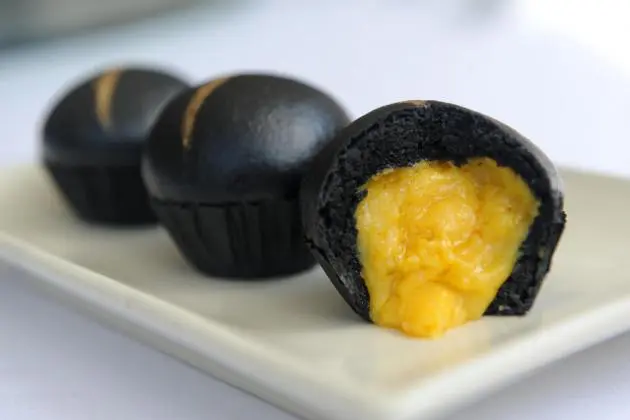
Master chef Chan Hwan Kee of Min Jiang at the Goodwood Park Hotel, who created a mini black charcoal egg custard bun for the restaurant’s dim sum menu that launched on May 1, says: “We wanted to add a glamorous twist to the humble dim sum item. The contrast between the bright yellow centre and glistening black bun makes the otherwise simple salted egg yolk custard bun very eye-catching.”
Tiong Bahru Bakery introduced squid ink buns in 2012 when the first shop in the chain opened. A spokesman says: “The black tone makes food look very rich and unctuous, with intense flavours mostly associated with smokiness.”
It sells about 100 squid ink bread sandwiches every week.
However, looks alone are not the reason.
At Dolcetto deli at the Regent Singapore, squid ink panino and squid ink macarons quickly became signature items when they were introduced in 2012.
Regent Singapore’s executive sous chef Angelo Ciccone, 34, says: “Squid ink is a common ingredient in Italian cooking and has a very distinct flavour that makes each dish special”:
Squid ink is also used in other dishes at the hotel’s Italian restaurant Basilico.
There are claims that squid ink has cancer-curbing properties, but Bibi Chia, principal dietician at the Raffles Diabetes and Endocrine Centre in Raffles Hospital, says the potential health benefits of squid ink require further study.
As for charcoal, its activated forms are commonly used as medication for food poisoning. The ingredient has “little nutritive value”, she says and recommends eating both ingredients in small portions and “very occasionally”.
While the novelty of black food has attracted the attention of diners, taste still matters most.
Nanyang Technological University undergraduate Gabriel Isaac Goh, 22, has tried Burger King’s BK Black burger and says: “It was appealing to me aesthetically, plus it was a convenient option. I noticed an added flavour to the bread, but I’m not sure if it is due to the nature of the charcoal bread or artificial flavouring. It’s more of a novelty item for me”.
National University of Singapore undergraduate Ong Lin Hui, 21, who has tried Fatcat Ice Cream Bar’s charcoal waffles, agrees. “I thought it was different from other waffles, but the colour didn’t affect the taste. There are probably better waffles out there.
“It’s interesting to colour the food black and, with Instagram, the food can look appealing."
