
Darkly into the night
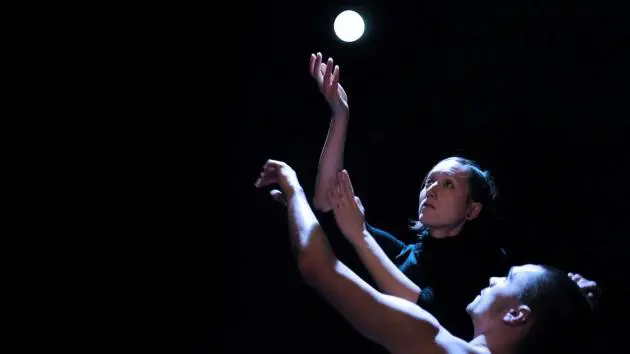


Cancelled last year, compagnie 14:20's "Magie Nouvelle" makes it Southeast Asia debut this Saturday
I FIRST came across the term “magie nouvelle” (new magic) at the Biennale de la danse a Lyon in September 2012. In the short performance titled “Ellipses” by Compagnie 14:20 seen at ENSATT, the French national academy of dramatic arts, the lone dancer Aragorn Boulanger was engulfed by the physical, visceral and visual magic envisioned by Raphael Navarro and Clement Debailleul.
The excitement last year when the French Embassy announced that 14:20’s full-length work “Notte” (“The Night”) would be part of the French-Thai cultural festival La Fete was cut short by the news that an artist’s injury was forcing a cancellation.
No such disasters befell the company this year and they’re now in Thailand.
From the Lyon festival’s programme book, I learned more about the background of these two wizards.
Navarro says, “At the age of 10, I met the magician Hugues Protat, who comes from a long tradition of illusionists. He was my magic master for a good many years. Then a second meeting with the magician Jacques Delord, his philosophy and conversation, and what we drew from it, gradually gave rise to the idea of ‘magie nouvelle’.”
Debailleul, who met Navarro at a contemporary circus festival while both were in their teens and have worked together ever since, adds, “Coming from a circus background, I’ve always tried to push my technique to the boundaries. And I was very keen to open it up to the possibilities that magic could offer. After all, what juggler has never dreamed that his objects never hit the ground?”
Emerging in the last decade and representing a clean break from the traditional magic, “magie nouvelle” is neither about a series of tricks carried out without a narrative thread, nor a matter of a virtuoso magician showcasing his talent.
Navarro and Debailleul add that the term is used, “When the artist’s concern is to distort reality in the here and now – in other words, in the very presence of reality.”
“We’ve been establishing a difference between magic and illusion. For us, magic is not just an expertise, a puzzle, or something that eludes us, it is an emotion.”
They say that often “a sensation” triggers their creativity, explaining, “The kinaesthetic experience of black was the starting point for ‘Notte’. We try to induce the feeling of magic – that moment when reality loosens its grip on perception and gives rise to a sensation of profound presence in the world. To achieve it, we work hard at eliminating any sense of linear time in our shows, and try to create empathy among the spectators, so they can incorporate the strangeness of the magic images and transform that sensation into a real experience.”
The story of opposites, attracting then losing each other, crossing eternally and sometimes meeting, in the search for balance, “Notte”, a sublime blend of magic, dance, juggling, music and video effects, is a duo piece performed by Kim Huynh and Aragorn Boulanger.
The latter is a highly renowned choreographer himself, of whom the two creators say, “His approach to the body, the inner presence, and to the perception of time has enriched us enormously and is a very natural complement to our projects. Aragorn, whether as performer or choreographer for the Genom company, has always understood and been able to use the differences and the complementary qualities of illusion and magic. He dances; we do magic. We share the aesthetic intention of bringing intimacy and strangeness closer together.”
“Magic and dance share the fact that they both question space and time and how the human body relates to physical realities such as gravity and its own spatiality. Magic seems to offer an opening to unexplored choreographic spaces, and the possibility of working with bodily states that are freed from these constraints.”
French critics have been raving about “Notte”. Le Monde newspaper described Compagnie 14:20 as “New magicians of contemporary art”; Liberation concurred that the choreography is “spellbinding” and that “they reinvent the codes of discipline”; La Terrasse said, “it appears voluntarily hovering like a daydream where juggling becomes improbable, where video projections plunge the body in a unique atmosphere”; and Telerama called it “beautiful, soothing” and “totally hypnotic.”
“Notte” was part of La Fete’s Chinese counterpart “Festival Croisements” in 2012, and Debailleul recalls, “The Chinese audience did appreciate our performance but I really think that of all of our performances in Asia, our work has been the most understood and appreciated in Japan. That’s certainly because we work on pure aesthetic, where silence, empty space and energy all together become a real matter to be watched and to be felt. That ties in with the Japanese culture.”
As for the future, he says, “We’ll keep working in the same direction. The border between real and unreal is where magic is born. The magical feeling is stronger when we stand on that line, between the possible and the impossible. This is where the new magic territory lies. Our upcoming creation will have five performers, which is a novelty for us. Magic will circulate among the different characters and alter the reality of situations between reality and dreams through holograms, levitations and time stretches.”
And in case you’re wondering, “14:20” is simply, and magically, the time at which Navarro and Debailleul founded this company one day in 2000.
The writer wishes to thank the French Embassy’s Benoit Etienne and Asma Sentira for all assistance.
One “Night” only
Compagnie 14:20’s “Notte” is at Chulalongkorn University’s Sodsai Pantoomkomol Centre for Dramatic Arts this Saturday at 8pm.
Tickets are Bt250 (Bt150 for students) at ThaiTicketMajor.
Find out more at www.1420.fr, www.LaFeteBangkok.com and Facebook/LaFete.Festival.
